
The Bricker sisters’ art journey
By Sarah Bearup-Neal
Sun contributor
The fourth in a year-long series of articles about local art, culture and creativity.
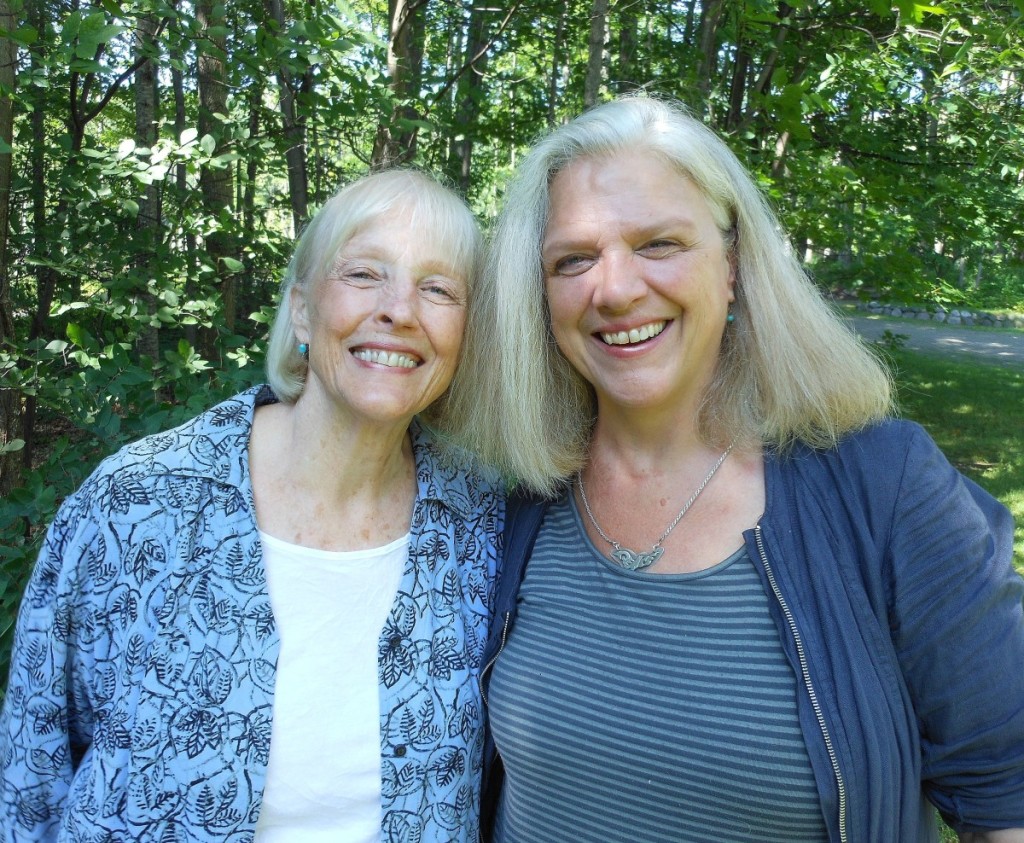
Beth Bricker and Cherrie Stege are sisters. They created an art gallery in Glen Arbor. And, their mother may have been a wood elf. What?
Ananda Bricker, Cherrie and Beth’s late mother, lived in the woods here, in both the spiritual and literal senses of that verb. It was her natural habitat, and the flowers were her familiars.
“When I was growing up, it was all about spring wildflowers,” Beth said. “This was our religion. We had to find the first Hepaticas, and Trillium, and Violets, and Bloodroot, and Lady’s Slippers. (Ananda’s sister) Barrie, Mom and the dogs — always dogs and children — would go off and wander around the woods starting in May, and you wouldn’t stop until October. They made us think of wood elves, too.”
And it was that elfin intimacy with wildflowers that ultimately provided an income for three families, and a legacy for Cherrie and Beth.
Ananda Bricker’s union with the Glen Lake woods was cultivated over a lifetime. She, her three siblings, and parents summered on Little Glen beginning in the early 1900s. Her father built a modest cottage on the lake’s west shore. When Ananda married Ben Bricker in 1942 and created a family, their four children were inducted into the summer-at-the-lake traditions of water, woods and dunes. The Bricker family’s home base was Kalamazoo, but even there the forest wildflowers bloomed.
”My mother was making botanically-correct porcelain wildflowers in the early 1970s,” Cherrie said of Wildflowers by Ananda, her mother’s business inspired by northern Michigan’s native flora. “At the same time, I was beginning to make wildflowers out of copper. We went along, side-by-side, separately, mainly selling our flowers at art fairs until the early 1980s” when they began collaborating on these botanical sculptures.
“She knew my copper flowers had a sturdy structure. Her flowers’ stems were made from floral wire and weren’t sturdy,” Cherrie said. “And from then on, I no longer made flowers. I made leaves and stems, and (Ananda) made the rest of the parts, which we combined. I was the person who assembled them.” Beth got reeled into the business — renamed Forest Flowers — soon thereafter. A serious avocational painter, Beth was handed an airbrush by her mother, told to figure out how it worked, and when she did, Beth painted each of the porcelain flowers their proper colors.
By the late 1980s many Brickers had relocated permanently to Leelanau County: Ben and Ananda to the Glen Lake cottage of her childhood in 1984; Cherrie and her family moved from Suttons Bay in the early 2000s, to a home at the base of the dunes across the street from her parents. Beth and her then-spouse buildt a home behind Cherrie’s, even closer to the Sleeping Bear. Beth had given birth to her first daughter, when Ananda said, “ ‘Here! You’re going to do this and support your family.’ She made a job for me,” Beth said. “I’d bring my baby (to Ananda’s home studio). We’d hang out. We’d do a little work while the baby was sleeping. By the time Abi came along (Beth’s second daughter), the (business) was so huge.”
Just as Beth was readying to give birth to her second daughter in 1983, a representative from the Smithsonian Museum Store spotted the Forest Flowers booth at an art fair, and placed a wholesale order for 500 Blue Flag Iris sculptures.
“Up until that point we’d made about 100 of them,” Beth said. “Every single thing was done by hand, and you’d do it the same way if you were making one (sculpture) or if you’re making 500. There was no place to streamline the process.” Forest Flowers could be found in the Smithsonian’s store catalog for five years, Beth said. There were other accounts across the country, and the sculptures were carried by 40-to-50 shops.
And then came the fall. Forest Flowers faded away with Ananda Bricker when, in her late 70s, dementia began erasing her memories. Ananda died in 2010. She was 85. And that was the end of it.
“I think we were worn out,” Cherrie said.
Ananda’s death really wasn’t the end of the story. She left a legacy to her daughters, and it was a deep and abiding relationship with the world of Little Glen, its dunes, woods, and plants. Ananda’s legacy to her daughters was a sense of place, and this particular place fuels the Bricker Sisters’ own creativity.
“There’s this palette I live with,” Cherrie said. “It comes from this world. Right here.”
That palette of woodland greens, big lake blues and arboreal browns can be seen in Forest Gallery. Today, Cherrie and Beth’s gallery at 6023 S. Lake St. is filled with studio-made ceramics, glass, wood and metal objects that not only hue to these colors, but honor the spirit and style of William Morris’s Arts and Crafts Movement. The building in which the gallery is located is an old automotive garage. It was purchased in 1987 by Ananda and Suzanne Wilson, friend and fellow artist, in the hope of establishing a creative center in Glen Arbor. Suzanne created a painting studio in one part of the building. The groundwork for what became the Glen Arbor Art Association was laid here, too. And in the south end of the building, Ananda set up a street-level gallery for her porcelain flowers. A decade later, with Ananda sidelined, Beth and Cherrie began making the gallery their own. Renamed Forest Gallery, it became a place where they could sell other artists’ work alongside their own.
Cherrie, now 71, inherited Ananda’s concern for botanical fidelity. After Forest Flowers she returned to her interest in metalsmithing and began creating copper leaves, “which I just don’t cut out,” Cherrie said. She gathers local fallen leaves, studies each one, how its veins are organized, researches the botanical reasons for this.
“And, I learned this from Mom,” she said.
After Cherrie has cut her leaves, she incises them to suggest the leaf’s physical characteristics, shapes them into dimensional postures, then quickly passes her torch’s flame over the copper leaf to bring out the metal’s blue and red tones, Cherrie’s palette.
Beth’s medium has long been paint. Her subjects have most always been her home place and her neighbors: Black-capped Chickadees, Titmice, a white pine on the dune standing sentinel over the lake. While there is always a painting in process, more than a year ago Beth began exploring cut-paper compositions. But that, too, goes back in family time.
“Paper dolls were key to our childhood. Mom and (her sisters) made paper dolls, they made their clothes,” said the 54-year-old Beth. “When I was little, the coolest thing ever was to look at those paper dolls. I grew up under the table at my family’s art fair booth, and what was I doing? I was under the table playing paper dolls.”
The subjects of Beth’s cutouts are drawn from her vicinity: familiar bird shapes intertwined with vegetation, groups of children climbing trees, or fishing, or jumping rope. She uses a sturdy, textured handmade paper on which she applies translucent, gradated layers of paint. The finished cutouts are mounted and framed. They’ll be exhibited in Aug. 5-11 at Center Gallery, adjacent to Forest Gallery.
Another of Beth’s creative gifts is her ability to engagingly talk about each artist represented at Forest Gallery. “People want to know the story, “ Beth said. “You tell someone the artist’s story and not only do they love the look of the thing, they fall in love with the thing and they want to want a part of it, and then they become a new part of the story. It goes on and on. It connects us.”
Each time Beth or Cherrie retell their mother’s story it connects Ananda — who may, or may not, have been a wood elf – with new listeners. And, regarding the wood elf question: One doesn’t usually advertise these things, so we’ll never know for sure. But Ananda’s deep elfin love of and bond with the Glen Lake woods became her daughters’ inheritance. These feelings sought a more physical expression, and it was seen in Ananda’s porcelain wildflowers, then in the subjects upon which Cherrie and Beth built their artmaking. It’s a good story. And sometimes in the telling, Cherrie’s and Beth’s ears get a little pointier.


