Voices and Visions: Women artists declare “We will not whisper” at Alluvion exhibit
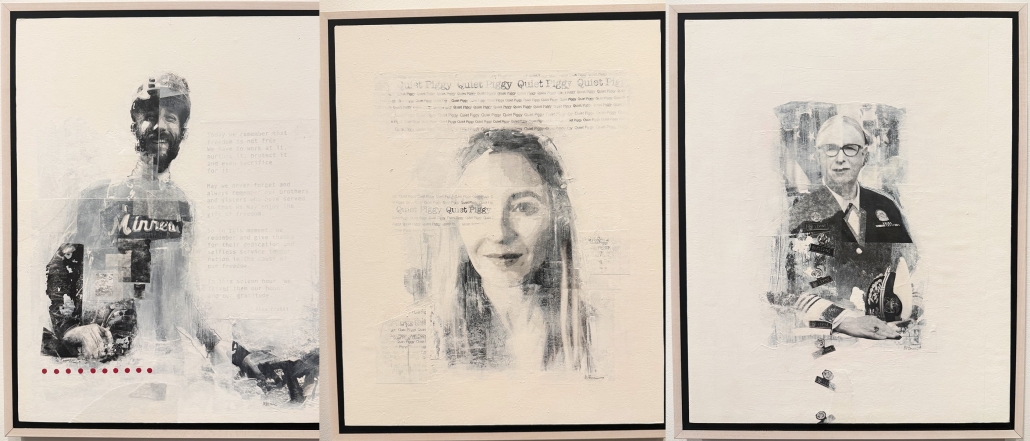
Images, left-right: Margo Burian’s “We Know the Truth, We Saw It with Our Own Eyes” memorializes Alex Pretti, a VA nurse who was killed by federal officers in Minneapolis on Jan. 24; “Quiet, Piggy” focuses on Bloomberg News journalist Catherine Lucey, who was publicly disparaged during a 2025 presidential press exchange; “My Name is Rachel” confronts the erasure of Admiral Rachel Levine’s legal name from an official portrait, responding to hostility directed at the first openly transgender four-star admiral in the U.S.
By Katie Dunn
Sun contributor
“It was the 1960s and I could not act like everything was okay. I couldn’t paint landscapes in the 1960s—there was too much going on.”
—Faith Ringgold (1930–2024), pioneering American artist, author, and activist.
For Ringgold, the turbulence of the 1960s made remaining neutral impossible. The era’s upheavals—the Vietnam War, the Civil Rights Movement, and the rise of women’s liberation—forced a reckoning for many artists. Ringgold moved beyond purely aesthetic concerns and toward work that directly engaged with the political realities unfolding around her.
Ringgold’s refusal to “act like everything was okay” feels uncannily contemporary. Her words land squarely in present-day America—a time marked by rising authoritarianism, assaults on reproductive rights, threats to LGBTQ+ communities, pervasive gun violence, environmental instability, the humanitarian crisis surrounding migration, and now, an escalating global conflict in the Middle East.
For women in particular, art has long been a vehicle for confronting gendered, social, or political marginalization. Across generations, women have used storytelling, language, the body, performance, and self-representation to make experiences previously overlooked visible.
Think: the collective activism of the Guerrilla Girls (founded in 1985), an anonymous feminist group challenging sexism and racism in the art world; the provocative, text-based interventions of Jenny Holzer (b. 1950); the identity-driven photographic tableaux of Cindy Sherman (b. 1954); the psychologically charged portraiture of Alice Neel (1900–1984); the autobiographical symbolism of Frida Kahlo (1907–1954); the multimedia storytelling and performance of Laurie Anderson (b. 1947); and the incisive explorations of race, gender, and power by Kara Walker (b. 1969).
This tradition of female conscience is not confined to art history. It persists today, urgent and uncompromising, manifest in the work of a cohort of women artists here in northern Michigan, presented in the exhibition: We Will Not Whisper.
Margo Burian’s Leadership
The refusal to retreat from uncomfortable truths inspired Margo Burian, a Leelanau-based multidisciplinary artist, to conceive We Will Not Whisper. Renowned for her mastery of landscape painting, Burian shifted her creative practice to meet the demands of the moment. She also invited 20 women artists to partake in the same endeavor. For this exhibition, they temporarily set aside practices once focused primarily on aesthetics or personal expression. The result: work that serves as witness, protest, and resistance.
“In early January 2025, I ran across an article on CNN reporting that Meta [parent company of Facebook and Instagram] had removed ‘guardrails’ preventing hate speech targeting women, people of color, and LGBTQ+ communities,” Burian says. “I began discussing this with other women artists, and as the full implications of Project 2025 became clear, it felt urgent to respond visually to these issues—environmental, voter rights, women’s autonomy, immigration, and civil rights among them.”
Responding to Burian’s call, the participating artists, based in Leelanau County and across Michigan, explore painting, collage, assemblage, fiber, and mixed media. The exhibition features Kathleen Bechtel, Sarah Bearup‑Neal, Carrie Betlyn‑Eder, Shanny Brooke, Elaine Dalcher, Christy DeHoog Johnson, Tracey Easthope, Liz Barick Fall, Lori Feldpausch, Lauren Everett Finn, Mary Fortuna, Megan Kellner, Jessica Kovan, Nancy McRay, Wendy Kay McWhorter, Kathy Mohl, Shanna Robinson, Barb Schilling, Mallory Shotwell, and Nikki Wall.
Assembling 21 artists around urgent political themes required moral courage and trust. Much of the invitation to participate evolved organically, fostering a network of mutual support among the artists involved. Burian emphasizes that for many of the exhibitors, herself included, the work represents a departure from their typical creative practice.
“For many of us, myself included, our artistic practices have largely focused on creating images of calm and serenity,” she shares. “Events over the past year have been anything but calm. Creating art—especially in times of distress—gives us a visual voice and a tangible way to process events as they unfold, while also offering a different perspective.”
Burian further underscores that making this an all-women exhibition was intentional.
“So much of Project 2025 seems to target women’s civil and humanitarian rights,” she observes. “It made sense that the voices responding to these issues should come specifically from women artists.”
The Alluvion as Ideal Venue
Designed by and for artists, The Alluvion in Traverse City is a space where visual art, music, and community dialogue converge. For We Will Not Whisper, it proves especially apt: its openness and commitment to creative exchange allow the works to be experienced with the immediacy and intensity they demand.
Jessica Kooiman Parker, the gallery’s Visual Arts Curator, explains that, “Authentically supporting artists—their vision and freedom to express themselves—is the core of my curatorial practice. Witnessing these artists create a collective commentary on current events was very inspiring. Artists play a vital role in reflecting our world back to us through the lens of their experience and perspective—whether that is heartbreak, rage or peace.”
Opening Reception
The opening reception on March 7 drew a robust audience. The work confronted the moment with unflinching clarity, and the room carried a palpable seriousness, far from the casual curiosity of a typical art opening. Each piece stood boldly, defiantly and gracefully, demanding acknowledgment. The energy was not celebratory but collective, introspective, and deeply present.
Among those attending the reception was Florina Kapitzke of Traverse City, who reflected on the emotional and political depth of the exhibition.
“A man [at the reception] said, ‘There’s a lot of angry women in this room.’ I asked him, ‘If the collection was a group of male artists would you use the same adjectives?’ He seemed puzzled… Since the ’90s the media has found it easy to pigeonhole women into convenient, but inaccurate places,” Kapitzke says. “Feminazis, man-hating, anti-family. I see more than just angry… These artists aren’t just angry. And if it’s anger, it is justified anger. Righteous… I see a range of emotions—anger sure, but disappointment, sadness, patriotism, fear, outrage, dignity, purpose, feminine power, vigilance, empathy, maternal awareness. They are refusing to ignore the calling of their purpose. Art IS political.”
Highlights from Exhibit
Every work in We Will Not Whisper amplifies to the exhibition’s urgency and power. While space allows only a glimpse of 21 artists and their offerings, the works highlighted here serve not as “best” or “more important,” but as entry points into the exhibition’s central themes: resilience, resistance, and unyielding voice.
Carrying the Mantel: Margo Burian
If the exhibition has an animating force, it is Burian.
She contributes three works to the exhibition, each part of her ongoing Fractured series, which examines the erosion of societal and institutional norms.
Quiet, Piggy focuses on Bloomberg News journalist Catherine Lucey, who was publicly disparaged during a 2025 presidential press exchange. Through fractured image transfers, collage, and paint, Burian dismantles and reassembles Lucey’s visage, transforming a moment of public humiliation into endurance and testimony.
My Name is Rachel confronts the erasure of Rachel Levine’s legal name from an official portrait, responding to hostility directed at the first openly transgender four-star admiral in the U.S. Public Health Service Commissioned Corps. Burian’s fragmented imagery exposes precisely how identity can be publicly contested and diminished.
We Know the Truth, We Saw It with Our Own Eyes memorializes Alex Pretti, an intensive care nurse for the U.S. Department of Veterans Affairs, who was fatally shot by U.S. Customs and Border Protection officers in Minneapolis on January 24, 2026, during an immigration enforcement action. The splintered imagery captures both the brutality of the moment and the competing narratives surrounding the event.
Shanny Brooke—The Emotional Fracture
For Shanny Brooke, painting has long been “how I work out personal issues, process grief or anger, or just find a way to express a memory from my childhood. It’s cathartic.” But in the current political climate, that catharsis has shifted. The ordinary rhythms of her practice have been interrupted by a persistent sense that everything is not, in fact, okay.
Her contribution, What If Everything Does Work Out?, holds that tension in place. The central female figure appears exhausted, yet not defeated, suspended between despair and fragile hope. “I find myself feeling complete hopelessness one day… then another day seeing tiny little glimmers of hope,” Brooke reflects. “It’s those glimmers that keep us still being able to get up each day and navigate our daily lives.”
Her painting does not resolve that oscillation but honors it. In doing so, Brooke quietly echoes Ringgold’s insistence that there are moments in history when neutrality becomes impossible—or complicit.
Lori Feldpausch—Truth Destabilized
If Brooke’s work conveys emotional disruption, Lori Feldpausch addresses epistemological collapse—the destabilization of truth itself.
In Drowning in Disinformation, Feldpausch turns to Ophelia from Hamlet as both muse and metaphor. Historically archetypal of vulnerability and constrained agency, Ophelia becomes, in Feldpausch’s hands, a contemporary figure overwhelmed by misinformation and political chaos.
Partially submerged in water, harkening to the Lincoln Memorial Reflecting Pool, and wrapped in the American flag, Feldpausch’s Ophelia drifts as monuments burn on the horizon and protest signs sink beneath the surface. “My concept deals with how we are drowning in disinformation and living in an echo chamber,” Feldpausch shares.
Wendy McWhorter—Grief Stitched into Form
Gun violence enters the exhibition through the intimate language of family and memory.
In Torn, Mend, and Resilient Hearts, Wendy McWhorter transforms century-old quilt fragments from her grandmother into a garment that reads as both memorial and armor. The torn hearts stitched into the surface evoke the lives lost to rampant gun violence, and the families left bereaved. “The torn hearts literally express visually the gun death victims, as well as all those grieving these victims,” she explains. “The red ties represent what we do to try to mend our broken hearts.”
The language is domestic—fabric, thread, heirloom—but the message is civic. Private grief becomes public witness.
Mary Fortuna—Displacement and Rage
Where McWhorter channels mourning, Mary Fortuna channels fury.
In Tears of Rage, Fortuna transforms wool felt, linen, embroidery beads, horsehair, and feathers into a hand-stitched mask that feels both ceremonial and confrontational. The work responds to escalating Immigration and Customs Enforcement actions, violent reprisals against dissent, and the spread of false narratives, what Fortuna describes as “the unceasing barrage of daily horrors unfolding in the country.” Although political content had not typically defined her practice, in 2025 she felt compelled to respond.
The mask becomes an emblem of dissent, not passive but alert, not decorative but declarative.
Liz Barrick Fall—The Body Legislated
The stakes of Project 2025 become most visceral in Liz Barrick Fall’s Modern American Gestation Accessory.
A pregnant torso and uterus, reconfigured from a vintage anatomical model, is pinned to red velvet with insect specimen pins and enclosed within a metal box. Jail cell bars run through the uterus itself. “I placed jail cell bars within the uterus… to emphasize the objectification and subjugation women are being forced to endure,” Barrick Fall explains.
Drawing on her own experience as a mother of four who once required life-saving reproductive care, Barrick Fall underscores what is at risk when women’s bodily autonomy is restricted. The work is not metaphor alone; it is personal history made structural critique.
Kathy Mohl—Sacred Witness
From the legal constraints imposed on women, the exhibition turns toward their spiritual reclamation.
In She Knows the Way, Kathy Mohl reimagines Mary Magdalene, a figure historically silenced, demonized, or misunderstood, as a symbol of guidance and perseverance. Magdalene’s body merges with a tree, her torso forming the trunk, within which a jar of oil and a skull are embedded, while arms branch outward. Beneath her, a cracked path sprouts blossoms, fragile signs of life and renewal breaking through. The iconography suggests transformation and the delicate emergence of new life.
“Art is not only what we see, but what we feel,” Mohl says. “If viewers pause and see or feel something in a new way, then the painting has done its work.”
Barb Schilling—The Figure Rising
In I Dreamt I Was Free, Barb Schilling paints a female figure rising from a thorned rose bush, lifting a glowing orb. The composition evokes two of art history’s most iconic female figures: Sandro Botticelli’s The Birth of Venus (1484–1486) and Eugène Delacroix’s Liberty Leading the People (1830), celebrating women as enduring symbols of courage, moral clarity, and presence.
Schilling describes her practice as rooted in contemporary impressionist painting, translating emotional and social experience into “states of being—resilience, autonomy, and the quiet refusal to disappear.” Here, resistance is framed not as aggression, but as triumph.
Carrie Betlyn-Eder—Mobilize
We Will Not Whisper culminates in Carrie Betlyn-Eder’s assemblage Mobilize, a hanging mobile and one of three found-object sculptures she presented for the exhibition. Constructed from tissue paper, cardboard, glue, a plastic fan cover, curly willow, wooden stars, and a three-minute timer, the suspended piece unites four interconnected female forms, their bodies rising in sharp, headless silhouettes while strands of willow and flower-like elements cascade beneath them. The work balances fragility and force. As Betlyn-Eder observes, “The work sings together,” embodying the solidarity of women, both universally and in this chorus of 21 female artists.
We Will Not Whisper remains on view through April 11. A public panel discussion on March 31 offers visitors the opportunity to engage directly with the artists, witness their convictions, and leave inspired to mobilize.