Sugar Moon’s Maple Syrup
By Sandra Serra Bradshaw
Sun contributor
 It’s that time of year again as many in northern Michigan, including here in Leelanau County, begin tapping the maple trees to reap their golden harvest.
As Old Man Winter fades, maple trees offer us the first gift of the season—a pure, golden sap which through lots of hard work is transformed into the rich, sweet syrup beloved by many. The 2025, U.S. maple syrup industry produced 5.7 million gallons according to the USDA statistics service. Until the 1930s, the United States produced most of the world’s maple syrup but has been surpassed by Canada during the 1990’s with that country now producing more than 80% of the world’s maple syrup.
It wasn’t until the Civil War that the maple syrup industry was born. Most early producers were dairy farmers who made maple syrup and maple sugar for their own use and for extra income.
Technology remained much the same for the next century until the energy crisis of the 1970s forced maple syrup producers to change to a less labor-intensive process. They designed long tubing systems taking the sap directly from the tree to the sugarhouse. Vacuum pumps were introduced to the tubing systems, pre-heaters were developed to “recycle” heat lost in the steam, and reverse-osmosis filters were designed and added to take a portion of the water out of the sap before it was boiled.
These technological advances continue today, ever moving onward the story of maple syrup production forward. But for those of us who want to produce maple syrup from the trees in our own backyard, it is a much less complicated process.
Here in Michigan, maple syrup is the first farm crop to be harvested each year and is the oldest agricultural enterprise in the country. Michigan ranks fifth in maple syrup production in the U.S. and produced more than 200,000 gallons in 2023 and is one of the few agricultural crops in which demand exceeds supply
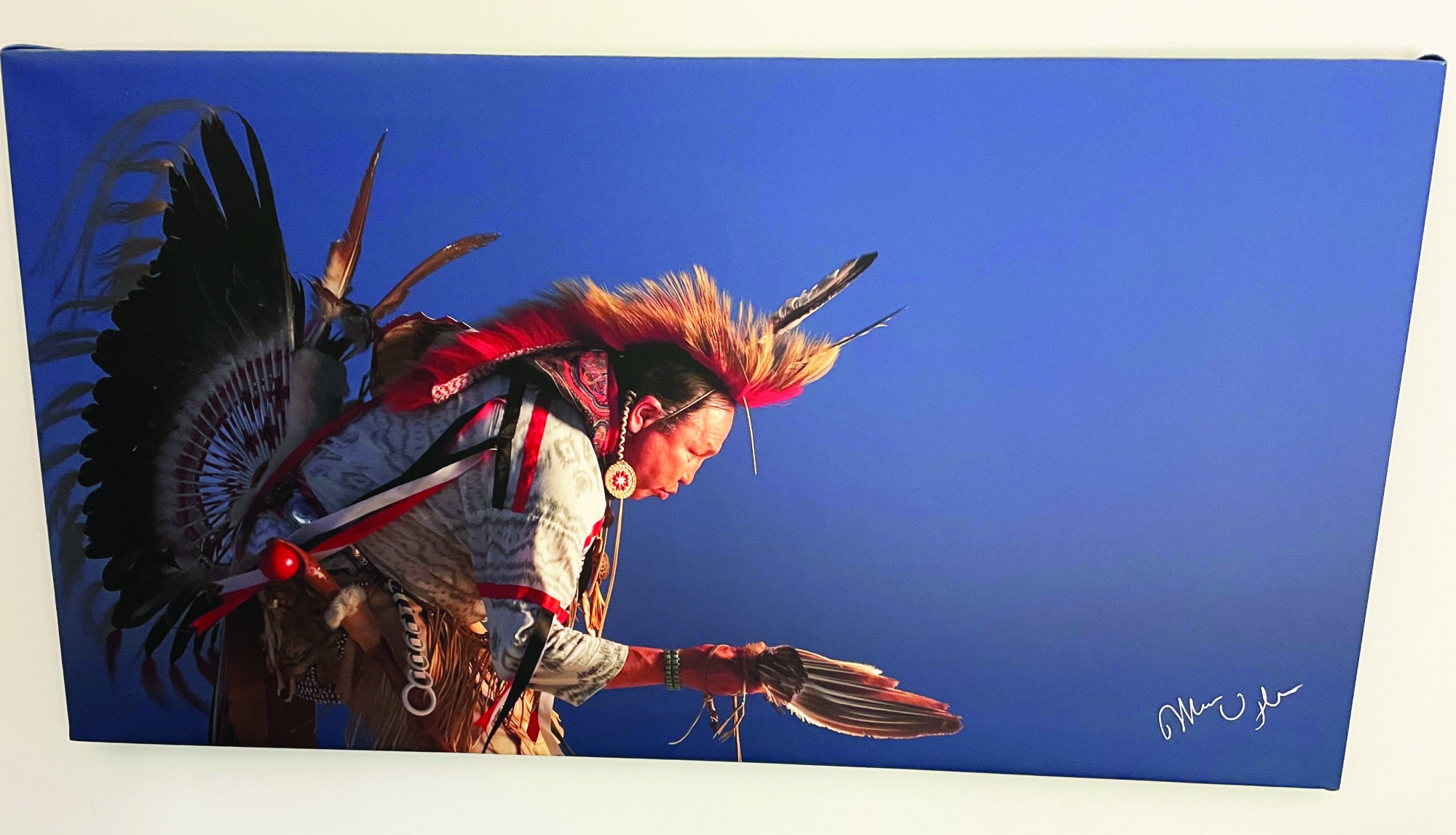
Tapping Maple trees for their sap began long before Europeans settled in America. Early origins of maple sugaring are preserved in oral traditions of Anishinaabeg and other tribes of northern Michigan and northeastern North America. The Anishinaabe people began the deep connection to the tradition and referred to the season as Ziinzibaakwadoke Giizis (Sugar Moon). They made Maple sugar, rather than syrup, due to its ease of storage and transport. Maple sugar was used as a natural sweetener in many of their dishes. It also held cultural significance in their ceremonies and trade.
When European settlers arrived in the northeastern Unites States, after tasting the sweet Native American’s maple sugar, they learned how to make it themselves, and those early methods are still used today by some family-owned sugar bushes (maple tree groves) around northern Michigan.
Alexander Henry, a British trader at Fort Michilimackinac, was one of the first to describe the Anishinaabeg method of sugar making. He recorded the following as he recalled a visit to an Ojibwe encampment near Sault St. Marie:
“For many centuries, Native American families moved each spring from small winter hunting camps to groves of maple trees. There, they gathered and processed their first plant-based food of the year, harvesting maple sap and boiling it into sweet, maple sugar. To get maple sugar, Native Americans put their collected sap into wide, shallow bark vessels and left them out to freeze. The freezing process separated the water from the sugar, and they would then remove the ice. Native Americans started building ‘sugar bushes.’ They boiled the sap with hot stones. When European settlers arrived, they boiled sap over an open fire to make syrup.”
In these early years, it was maple sugar (rather than maple syrup) that was the most popular and widely known maple product. “We know that tapping maple trees was an important way of life for the Native Americans. When the white settlers came, they learned from the Native Americans and they too incorporated it into their lives,” explained Kim Kelderhouse, executive director of the Leelanau Historical Society. “To this day, collecting maple sap is an important part of Leelanau County’s people’s lives.”
Our next-door neighbor, Bill Sterett, a retired DNR forester, has tapped Maple trees, turning it into maple syrup, for much of his life. Bill uses the traditional method to process his sap into maple syrup. “Maple sugaring time typically starts in late February to early March here in Leelanau County,” he explained. “With the season’s accompanying freezing nights and warmer days, this causes the sap to move upward and then this process reverses itself at night flowing downward into the branches of the trees.”
“There are multiple ways to tap the trees, but the basic process is the same,” said Bill. “When sap is flowing freely, a small hole is drilled into the tree about two inches deep, next a spile (or spike), a hollow tube, is fit snugly into the hole. It can be made of metal or plastic and provides the place to place a bucket or bag or a connection for plastic tubing.”
The hung spile directs the sap towards the hanging bucket that is hung on a hook fitted onto the spile. It may sound strange, but this hook is important; “If you pound the spile into the hole before fitting the metal hook over the end of the spile, there is no way to hang the bucket,” said Bill.
Next, he hangs a large pail underneath the spike directing drips into a waiting container. The Native Americans called these containers mokuks which they constructed out of birch bark. It’s fun to watch the sap’s progress as it fills the buckets, some days giving an abundance of the sap, while other days it is much slower.
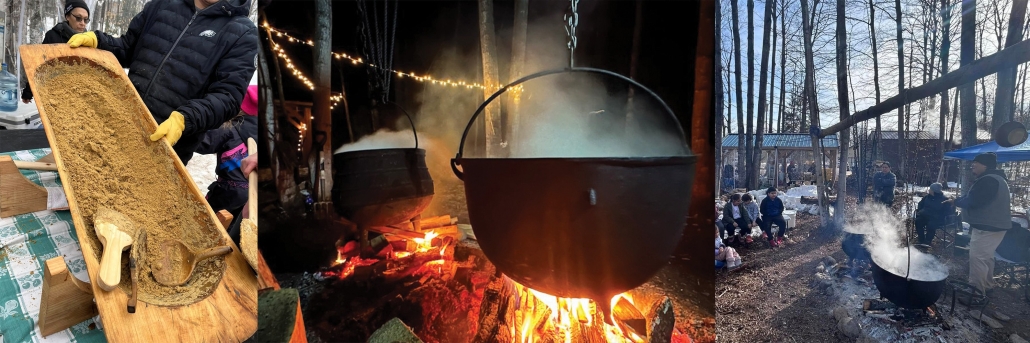
When the buckets are full Bill then carries and transfers each of them into a large container sitting by the side of the wood burning cooking stove he has set up in his backyard. “It probably takes, in the average boil that I do with about 80 gallons of sap, up to two days to get the syrup to the right consistency,” he expounded. “I use a special instrument to measure the concentration of sugar to sap. When I am boiling and it tells me I just about have syrup I transfer it to a kettle and let that settle for a couple of days. Then I bring the kettle into the house where I filter the syrup and then bottle it. The bottling process is quite simple. As long as your bottles are clean, and you use new caps, and you are bottling hot syrup you should not worry about the syrup going bad.” It is interesting to note it takes around 40 gallons of sap to boil down into one gallon of syrup!
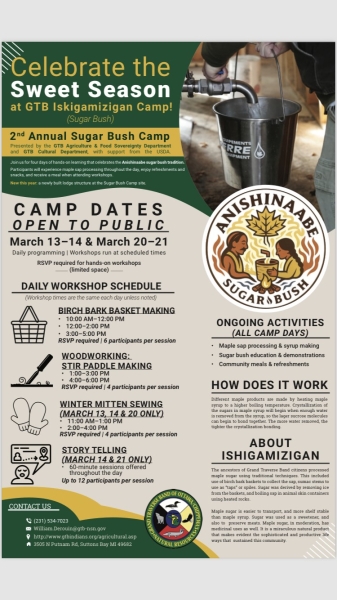
The Grand Traverse Band of Ottawa and Chippewa Indians (GTB) Natural Resource Department manages a community sugar bush on Putman Rd in Peshawbestown. For the last seven years GTB has hosted a community sugar bush to celebrate this important tradition.
“We are celebrating a tradition that started with indigenous groups in the American Northeast and Great Lakes that included the Anishinaabe,” said William Derouin, Agricultural Manager at GTB. This program has grown to include the GTB Sugarbush camp, which will be held on March 13-14 and March 20-21.
The process requires patience, skill, and a knowledge of nature’s rhythms. For generations, families and small producers have carried on this tradition, gathering sap in the crisp spring air and boiling it down to perfection. More than just a seasonal task, maple syrup production is a labor of love that connects communities to the land and each other.
“I look forward every year to this season, when the sap starts to flow not only in the trees, but it seems to flow in my blood and gets it moving after the long winter cooped indoors,” said Bill.
Yes, tapping maple trees is worth it for the experience but do prepare for a lot of hard work. Knowing the finished product came from your own back yard can be a happy, and ever so delicious, end reward.
For more information and a list of events, visit: GTBIndians.org/events.asp