
Proposed Sleeping Bear Bay to Bay Trail meanders through support and opposition
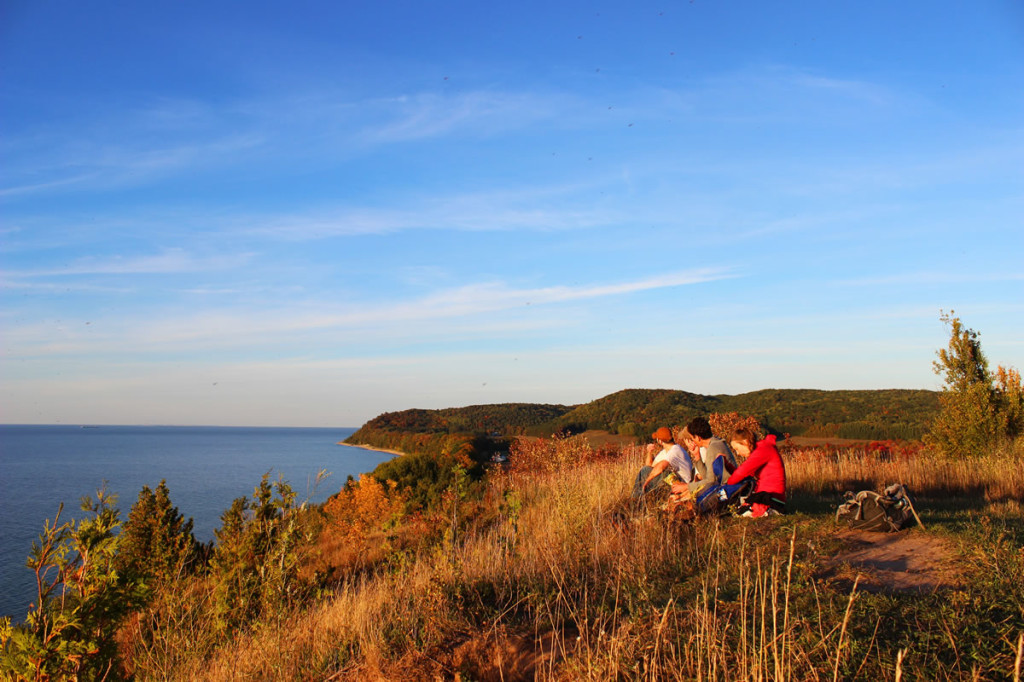
By Jacob Wheeler
Sun editor
A “Bay to Bay” hiking, paddling and camping trail proposed for the Sleeping Bear Dunes National Lakeshore has generated excitement among local business owners and recreation enthusiasts but also attracted significant opposition from private property landowners who live near the trail’s potential route. Staff at the National Lakeshore have subsequently slowed planning for the Bay to Bay Trail initiative. They extended the public comment period by an extra month this fall, and have drawn out the project’s scoping phase until next summer.
According to Kevin Skerl, chief of natural resources at Sleeping Bear, the Park won’t conduct an environmental assessment for at least another year. Skerl said that the Park received approximately 125 public comments, with views that ranged from support to opposition. Park officials were surprised by the amount of pushback they received. According to executive assistant Gary VanDerziel, the Park will examine the trail’s environmental impacts, but also where camping sites are appropriate and whether the National Lakeshore has the manpower to monitor and maintain the trail, in the first place. “We’re looking at the big picture here,” VanDerziel said. “We want to get this right.”
The Bay to Bay trail would roughly follow the Lake Michigan shoreline between Platte Bay (in Benzie County) and Good Harbor Bay (in the heart of Leelanau County). It would allow hikers, and canoers or kayakers, to traverse over 40 miles of the Sleeping Bear Dunes National Lakeshore, and sleep at campsites along the way. The Lakeshore currently offers only smaller looped trail routes.
The trail was referenced in the Lakeshore’s 2009 General Management Plan (GMP) as “ … a ‘bay-to-bay’ trail for hikers and Lake Michigan paddlers (that) would parallel the Lake Michigan shoreline within the Lakeshore; on land, this trail would make use of active beach areas or existing disturbed areas and corridors …”
The National Park’s website further explains the impetus for a Bay to Bay trail: “Development of these facilities would fulfill the intent of the GMP and would provide opportunities that do not currently exist in the National Lakeshore. The concept is to develop a trail system for hikers and Lake Michigan paddlers that includes a designated and signed route, lake access points, and backcountry campsites. The routes could be used by through hikers and paddlers as well as day users.”
Cherry Republic CEO Bob Sutherland has become one of the Bay to Bay trail’s strongest advocates (he also championed, and raised money for, the popular Sleeping Bear Heritage Trail, which by spring 2015 will stretch from Empire to Port Oneida). In October, Sutherland and four others hiked from Platte Bay to Good Harbor Bay along a route they chose that could become the Bay to Bay trail. He blogged about their journey on Cherry Republic’s “Orchard Report” (read his story below), and he hopes to help raise money for the project.
But the Park has also received pushback from private property owners such as Mary and Frank Crane, who live on Thoreson Road, near where the northernmost section of the National Lakeshore meets The Homestead resort. “Although you have asked for comments on the Bay to Bay Trail we find we have questions rather than comments,” Mary wrote on Oct. 14. “That in itself is perhaps our comment. We are surprised we have not been included in the loop. … Obviously our private property, along the Lake Michigan shoreline and within the boundaries of the SBDNL, will be affected. … Working with limited knowledge I can say we question the necessity of such a trail. We also have other thoughts and concerns about things like liability, impact on the environment and safety.”
Crane told the Glen Arbor Sun she is worried about crowds flocking along the beach and causing erosion to the pristine, 90-foot bluffs. She worries about campfires and fireworks at campsites causing forest fires. (Crane says she was later assured in a phone conversation with the nonprofit Friends of Sleeping Bear that campfires will not be allowed at inland campsites.) She also worries whether kayakers and canoers will be safe in Lake Michigan’s open water, which has claimed several lives in recent years.
“I wonder how all the cars on Thoreson Road will impact the wilderness experience,” said Crane, who has visited this area for 72 years and settled on land that was developed by a descendent of the pioneering Burfield family.
Thoreson Road has also seen increased activity in recent weeks as the third leg of the Sleeping Bear Heritage Trail (running north from Glen Arbor toward Port Oneida) has been cleared. The trail is expected to be paved next spring. “With the Heritage Trail coming through, people are saying let’s slow down and take a few deep breaths, and see what impact that has before we proceed (with the Bay to Bay trail),” added Crane. “I’m not necessarily opposed. Just alarmed at how fast it seems to be moving.”
Peter and Jane Maher, who also wrote a letter of concern to the Park, concurred that the Bay to Bay trail, on top of the expanding Heritage Trail, seemed like a pile-on. “Sleeping Bear Dunes Park already possesses a host of hiking trails, a brand new biking path and numerous watercraft usage opportunities,” they wrote in an Aug. 19 letter. “Furthermore, it already offers wilderness backpacking experiences — on the Manitou Islands — for interested Park visitors. In other words, for a Park of its size and natural features Sleeping Bear Dunes Park already presents a wide variety of outdoor and recreational options for Park visitors.”
The Mahers also worried that a trail connecting the three separate parts of the National Lakeshore would increase traffic in their backyard, which is not public land.
“The concept of creating a new hiking and boating trail in the Park which in effect “connects” the three distinct and separate parcels of the Park — and therefore which must OF NECESSITY traverse the private and community properties (of Empire and Glen Arbor) — would ‘institutionalize’ a significant increase in the number of hikers and boaters who must pass through these two communities. … Speaking as owners of private property in one of these communities with land extending to the Lake Michigan shoreline, my wife and I are concerned that these increased hiker/boater traffic will, either by virtue of ignorance or by willful disregard for the boundaries of private property, be disrespectful of our property rights.”
Hiking the Bay to Bay Trail
By Bob Sutherland
From Cherry Republic’s “Orchard Report” on Oct. 16
It’s an epic hike. From south to north across the entire Sleeping Bear Dunes National Lakeshore, hiking the Bay to Bay Trail will be an amazing experience.
When we first heard about the proposed Bay to Bay Hiking and Kayak Trail we were excited. The trail’s planned route ran from the south of the Sleeping Bear Dunes National Lakeshore all the way to the north and passed through much of its most stunning scenery. From the Platte River and Empire Bluffs in the south, past Pierce Stocking Scenic Drive and the Dune Climb, around Alligator Hill, and up to Pyramid Point and Good Harbor Bay in the north. What an addition to the Park this would make.
At Cherry Republic, we’re pretty big fans of an arduous hike (Sutherland and several employees hiked across the ice to North Manitou Island one day last winter!), so naturally we couldn’t wait to get out and hike it. But how do you hike a trail that isn’t built? Easy! Break trail and use the effort as a fundraiser for the Bay to Bay Trail’s construction. (Check out the fundraising campaign here.)
Taking three days to hike over 40 miles is no simple task, but several of us at Cherry Republic leapt at the chance. I was joined by our corporate chef Tony Finnestad and by North Manitou hike veteran Tom Bisbee. We also put out an invitation to our customers and were delighted when Alex McGregor and her friend Joe Welklin, both from Cornell University, signed up.
Although we had many other staff members and customers express a desire to join us, when it came time to set off it was just the five of us.
There were lots of questions on the five of our minds as we assembled for the Bay to Bay Trail-Breaking Hikeathon. Foremost on my mind was how would the five of us decide what our route we should take. There is no Bay to Bay Hiking Trail yet; the Park service hopes to have it finished for the summer of 2016. (The Park has not determined an official timeframe for developing the Bay to Bay Trail —Ed.)
The five of us had to decide between hiking beaches and dunes, short segments of trail and old, barely traceable logging roads, or miles of unmarked woods. And there are lots of obstacles such as lakes and rivers and swamps to go around.
We were all excited about getting to know the Sleeping Bear Dunes National Lakeshore better. By walking it, we would get a perspective of how large the Park is, and we would really feel the diversity of its terrain. It also happened to be fall and virtually peak color. With a near-perfect weather forecast, we were thrilled to be fully outdoors enjoying every moment.
It was seven years ago, when Cherry Republic’s Chief Operating Officer and I went to the Park service to meet about this north-south hiking and kayaking trail. We knew it was in the Park’s plans to build it at some point, and we offered Cherry Republic’s help. Now, seven years later, we are finally raising some money. After a successful hike we will hopefully meet with the Park staff and offer some route suggestions.
With your contributions and Cherry Republic’s match, we’ve raised $850 dollars so far. Thank you to all who have supported us.


