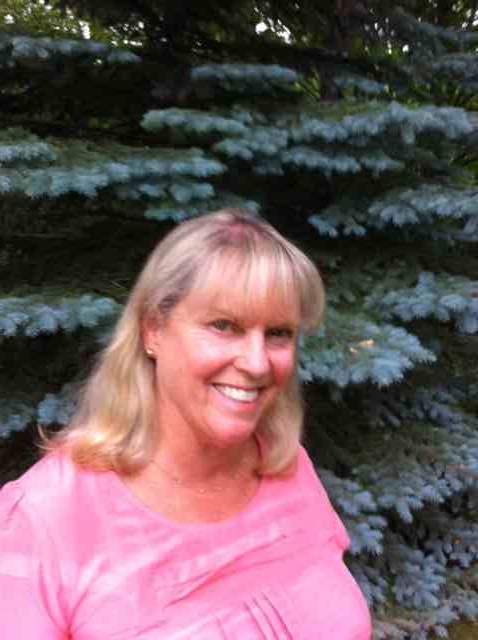
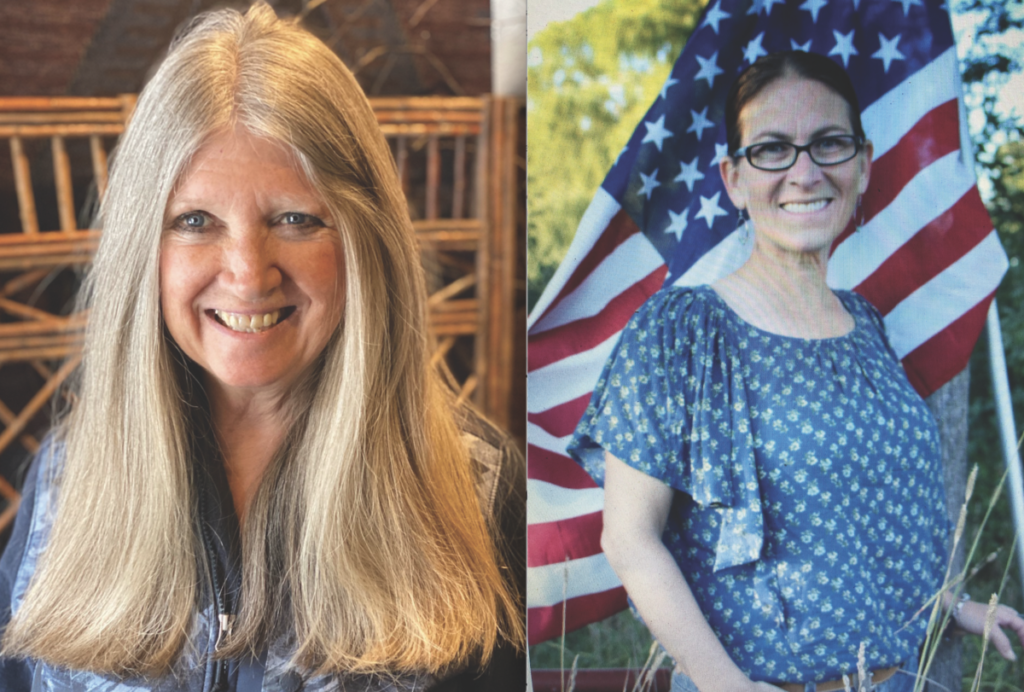
Leelanau Commission District 6 candidates Gwenne Allgaier, Julana Schaub address key issues facing County
From staff reports
Today we’re featuring the candidates vying to represent Leelanau County Commission District 6 (including Glen Arbor, Empire and Cleveland Townships), which is being vacated by Democrat Carolyn Rentenbach, who is stepping down. Running to succeed her are Democrat Gwenne Allgaier and Republican Julana Schaub.
We asked the candidates the following six questions.
Sun: What are three hurdles facing Leelanau residents that you think the County Commission should address?
Allgaier: We need to know that our water is safe to drink and lakes are safe for swimming. Our County has discussed this issue, and the need for a septic ordinance, since at least 1994. We have the science and the experience of other communities now, and we can act responsibly. We need to extend and strengthen cell signals and broadband connections so we can work from home and our children can do their schoolwork. We need affordable housing so that young families can raise their children here and their children can go to our schools, so that year around workers can be part of our community, and we need workforce housing to support our businesses. I must add that we must always strive for equity in our hiring practices, our Boards and Commissions appointments and our approach to evaluating and meeting community needs.
Schaub: The three hurdles we need to continue to address are: Senior services. Helping our lower income and poor. Keeping services funded; Keeping our Sheriff’s office fully funded; It’s important to balance our budget under these COVID conditions. Keeping our staff and residents safe.
Sun: What can the Commission do to increase broadband and Internet access?
Allgaier: Leelanau County Economic Development Corporation has formed LIFT, Leelanau Internet Futures Team, chaired by Patricia Soutas-Little, a collaboration of businesses, local residents, nonprofits, community organizations and the Tribe, that is working to advance broadband coverage. A survey was completed, needs were identified, tower sites are being identified. LIFT has been and will continue to work with township boards, zoning administrators and planning commissions to address zoning ordinance needs. It is working with Networks Northwest on an Economic Development Administration grant to fund two new towers needed for expanded internet. If the LCBoC authorizes the Emergency Management Director to pursue this grant high speed internet in our County can be greatly improved.
Schaub: The county has already offered 6 months free access to the towers. After this timeframe the rent has been reduced. We continue to work towards broader coverage at affordable prices.
Sun: What can the Commission do to increase affordable and workforce housing options here?
Allgaier: Leelanau County needs 668 additional affordable housing units by 2025. The Housing Action Committee (HAC) has met since late 2017 to tackle this issue, and has identified key areas needing support and/or improvement. Permit processes need to coordinated between departments and streamlined. There needs to be a process for referring builders to available grants and funds through landbank and brownfield, with referrals to Networks Northwest, Housing North and the HAC. While the Leelanau Planning Commission creates a five year plan, more work can be done to work with township supervisors and planning commissions to support needed housing. Other Counties have been willing to take some financial risk to support housing—accepting grants, leveraging bonds and being willing to underwrite community development grants, all of which our County could and should consider. There is work to be done, careful consideration is needed as to how to best meet this need to support our residents and our businesses. Our children should be able to raise their children here, our workers should be able to be a part of our community. Candidates Wessel and Bahle have both been integral to the work of the HAC.
Schaub: For the past two years the county task force has been working for affordable housing. Reducing permit fees, reducing inspection fees.
Sun: What can the Commission do to protect Leelanau’s environment and mitigate the effects of Climate Change?
Allgaier: While County government does not play a direct role in environmental policy, it need not be silent on the importance of sustainable practices and energy efficiency. Our Planning Commission can include accommodations for windmills and solar in its Five Year Plan, and support incorporation of the same in township zoning and planning commissions. A sustainable energy committee could work with community partners to promote solar and windmills, and direct developers and citizens to grants and loans. County government should always look for sustainable options for its own campus, and be a positive voice and support for sustainable practices in Leelanau County.
Schaub: It’s important to continue to monitor our water levels. In the past we’ve raised road levels to deal with excess of water on roadways. Paying attention to our seasonal cycles. We’ve also helped reduce gas prices to help make better vehicles affordable to run here in our county.
Sun: What can the Commission do to reach a resolution for Sugar Loaf?
Allgaier: Sugar Loaf was for years one of our County’s biggest job creators, was a wonderful attraction for visitors and created wonderful memories for residents. It is now a hazard and an eye sore, and action is needed to remove dilapidated and dangerous structures. While for years there was not an identified owner who would take action, now we have a responsible owner, with good intentions, whose businesses and income stream have been hammered by the effects of COVID. This is a difficult situation—but a bottom line right now is that the structures are dangerous, and must be removed. Brownfield funds have been applied for. The primary actor with Sugarloaf is Cleveland Township—the County can provide support with brownfield options to deal with immediate safety issues.
Schaub: If we as a county would stop harassing the owners, stop taking them to court, I believe a true resolution could be found. Allowing the owners to go ahead with upgrades, maintenance, and rebuilding. This will bring in more revenue to our county. Continuing to fight will only deter any renovations.
Sun: What did you learn from the Commission’s pained efforts to draft an anti-racism resolution? Why was it so difficult to do so? What next steps should the Commission take on combatting racism in Leelanau?
Allgaier: The statements and attitudes expressed when the County Commission first attempted to approve an anti-bias statement were unfortunately not surprising to me … I have witnessed, in my years of attending meetings, similar attitudes and statements by Commissioners Lautner, Bunek and Rushton many times. That is one of the reasons I decided to run for Peachy Rentenbach’s seat when she stated she needed to retire. We have commissioners whose political ideology repeatedly expresses itself in County Commission decisions. I firmly believe that commissioners should act to meet the needs of citizens, and be non-partisan. Caucasians have lived in a world of white privilege that we often are not aware of … we have much to learn, all of us, about our implicit bias, about the ways our assumption of white privilege has benefitted us and disempowered people of color. I am glad commisioners are engaging in Title Track’s training. We need to examine our hiring practices, our employment environment and make an effort to recruit people of color to our board and commissions.
Schaub: The county has come up with an excellent resolution regarding the racism issue. This was accomplished in only one week. I feel the process went extremely smooth.