From Black Eden to Migrant Prison: ICE’s second largest detention center nationwide opens 80 minutes from Leelanau County

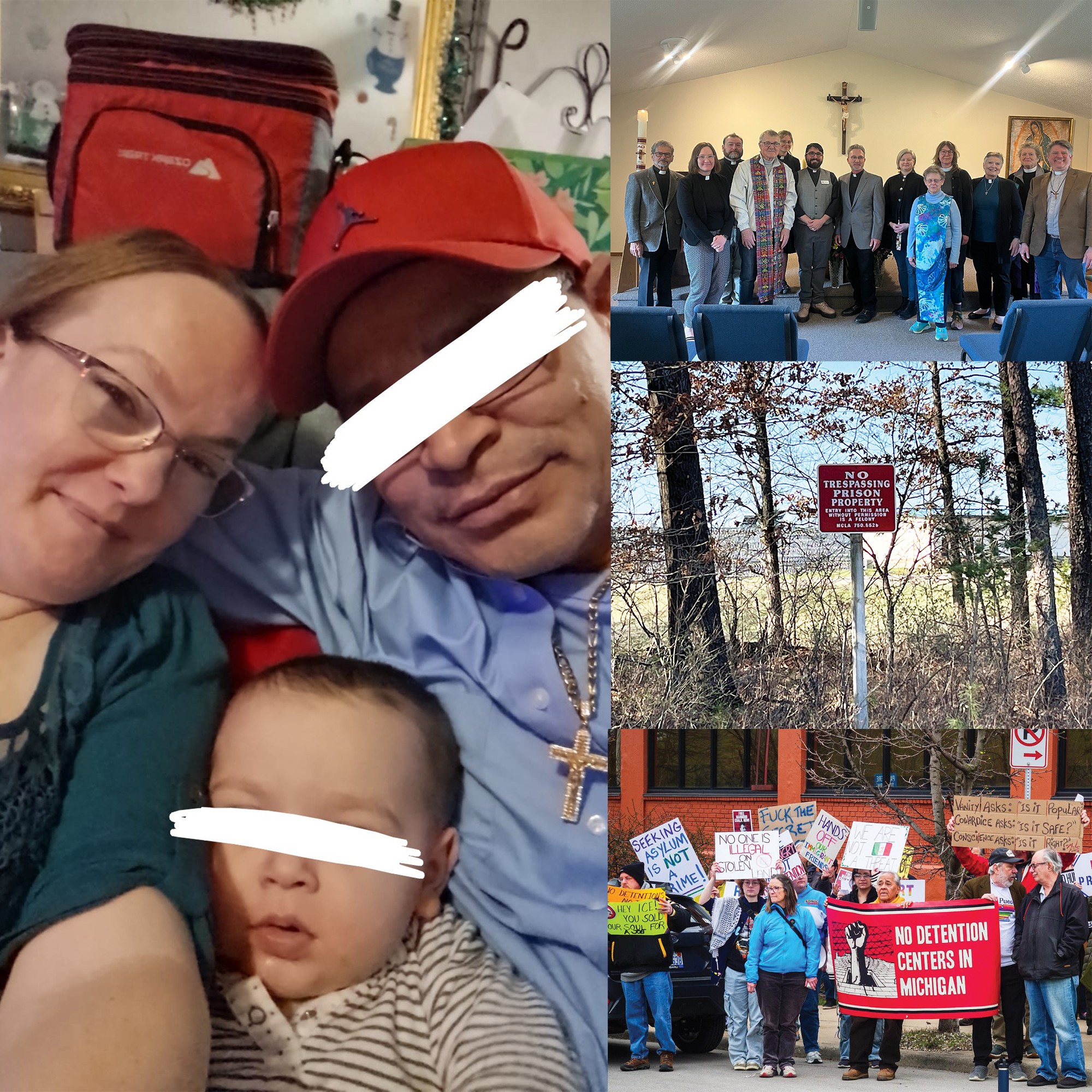
More than 200 people rallied in Grand Rapids on April 17, to protest the opening of GEO Group’s for-profit ICE detention center in Baldwin. Photo by José Guadalupe Jiménez Jr
By Jacob Wheeler
Sun editor
BALDWIN—A village council meeting was unusually packed on May 12 as people across the lower peninsula called for officials to stand against the reopening of an immigrant detention center just north of Baldwin. The 1,800-bed, maximum-security North Lake Correctional Facility, owned by the for-profit prison corporation Geo Group, would become the largest such facility in the Midwest and second-largest in the nation.
Several were concerned that an increased Immigration and Customs Enforcement (ICE) presence would hurt Michigan agriculture. Others spoke of habeas corpus and humane treatment. “We really don’t want Michigan to have a Dachau,” said another, referencing the Nazi concentration camp.
“I understand everyone’s concerns,” Harold Nichols, Baldwin village president, assured the room before stating the village council had little power to stop Geo Group, which operates 16 ICE facilities across the United States and was a large Trump donor. The federal prison wasn’t even on the council’s May 12 agenda, and Nichols suggested those gathered might have better luck taking their case to neighboring Webber Township, which needed to complete a sewer upgrade before the prison could reopen.
On June 16, just over a month after the meeting, the facility officially reopened, and the first detainees disappeared behind its walls. The advocacy group No Detention Centers in Michigan says that among them was Mayib Dieng, a Senegalese immigrant whom the group says was arrested in May in Detroit despite a work permit and pending asylum status. UPDATE: No Detention Centers in Michigan worked with the Detroit-based African Bureau for Immigrants and Social Affairs to raise and pay Dieng’s bond. He has since been released.
The fact that the prison will most likely hold non-white immigrants like Dieng stands out in this part of Michigan.

Vacationers pose on the beachfront in 1938 at Idlewild, known as the “Black Eden,” a resort community that catered to African Americans during Jim Crow. Photo by The Abbott Sengstacke Family Papers
Baldwin, a rural town of 900 with a large historically Black minority, is five minutes from the unincorporated community of Idlewild in Yates Township, which once thrived as a vacation refuge known as “Black Eden.” It catered to African-American performers and audiences during Jim Crow. Louis Armstrong and Duke Ellington played there, as did Aretha Franklin and Stevie Wonder. W.E.B. Du Bois vacationed there. The local motel was listed in the Green Book of safe places for Black travelers to stay.
Black Eden faded after the Civil Rights Act of 1964 ended legal segregation in public places, but the memory of the freedom fight lingers. A homemade sign on a house across the street from Baldwin High School offers a nod to John Lewis, the late Georgia congressman and Freedom Rider, with the line: “Make Good Trouble.” That legacy informs the opinions of some here about the North Lake prison.
Barbara McGregory, the Yates Township clerk—and the great-great-granddaughter of abolitionist Dred Scott—opposes the facility. “Why are they putting them in prison—you’re saying every one of them are criminals?” she asks. “My frustration is with the presidency. … The person in the White House has 34 felonies. He’s more of a criminal than the people he’s trying to put in jail.”
The detention center has also drawn fire from advocacy and legal-aid groups across the state. Susan Reed, an attorney with the Michigan Immigrant Rights Center, told local TV station WMMT that she fears the new facility will feed into an escalation of ICE activity in Western Michigan. ICE agents recently arrested six immigrants at routine check-ins in Grand Rapids.
When the reopening was first announced, the No Detention Centers in Michigan coalition and the Detention Watch Network organized a “Communities Not Cages” action at the ICE field office in Grand Rapids in April that drew a crowd of more than 200.
A subsequent demonstration held by the Manistee County Democrats drew 250 people to a township park north of Baldwin on a scorching hot June 21. Two days later, No Detention Centers in Michigan protested a hiring fair in Baldwin by the state employment agency Michigan Works, which included a table manned by Geo Group.
Geo Group has promised 300 to 500 jobs at the North Lake prison (though it has no local-hiring guarantee), and No Detention Centers’ Cam Brown estimates that about 250 have been filled.
At the May 12 council meeting, village president Nichols made a joke, to uncomfortable chuckles: “How about a correctional-themed Airbnb [instead]?”
 The quip betrayed an inconvenient truth for some in Baldwin, the seat of Lake County, among Michigan’s poorest. Here, 32% of children live in poverty, nearly double the state average. Upon reopening, the North Lake facility immediately regained its title as the county’s largest employer and taxpayer.
This wild region of lakes and rivers prides itself as being a sportsman’s paradise for fishermen, hunters, canoers and snowmobilers, and motorcyclists who flock to Baldwin every May for the “Blessing of the Bikes” celebration. Meanwhile, house trailers and broken-down cars pockmark lots along M-37, the highway through town. North of Baldwin, a Confederate flag hangs visible from the road, and some front lawns still sport Trump-Vance signs. In April, a billboard at the corner of M-37 and 32nd St, a dirt road that leads to the Geo Group prison, featured an advertisement for condoms on one side and a message from “Feeding America” on the other.
“I want good things for this county,” says Bonnie Povilaitis, director at Pathfinder Community Library in Baldwin, of the prison reopening. “We want to bring kids here. We want to have a better school.”
The news also prompted whiplash. The North Lake prison has opened and closed multiple times since 1999, when Geo Group (then Wackenhut Corrections Corporation) originally opened it to house juveniles. Referred to as a “punk prison,” the state pulled the contract in 2005 after reports of neglect. Brief contracts to house prisoners from California and Vermont followed.
It opened for immigrant detention during the first Trump administration, then closed in 2022, under President Joe Biden. During that time, hunger strikes led by Black detainees exposed mistreatment.
 “A facility like the prison has a very large economic impact on Lake County,” said Larry Reed, president of the county chamber of commerce. “Our funds took a drastic hit with the prison closed.”
Many of Geo Group’s workers at North Lake won’t be locals, Reed conceded, but they will contribute to the local economy when they gas up their vehicles or eat at local restaurants.
“When it was open, you used to walk into places at lunchtime and see [their] employees eating and spending their money.”
Geo Group’s prison is also the largest taxpayer in Lake County, which Reed said is crucial because half of the county’s land is either state or federal forest and can’t be taxed. Meanwhile, Geo Group is fighting its 2024 tax bill for the North Lake facility.
At the village council meeting, Nichols predicted that the prison would close again in four years—a nod to the next U.S. presidential election.
Following the council meeting, Lake County Commissioner Clyde Welford, who is Black, lingered. “People are saying [this prison is] about economics and creating jobs, but you’re running up one group of people,” Welford says. “These people have a right to flee a burning house. … some of them were fleeing atrocities and gangs and people being murdered. They wanted a better way of life. These [Geo Group] guys are going to make money on these people.”
He adds, “[It’s] just about money, and that’s why I’m opposed to it.”
In These Times originally published a version of this story.
As ICE moves into Baldwin prison, residents hope jobs will stay
By Claire Keenan-Kurgan and Maxwell Howard
Sun contributors
Around 200 vehicles filled the parking lot of North Lake Correctional Facility, a private prison on the outskirts of the small town of Baldwin in Lake County, on the morning of the last Friday in May.
About 10 men in white uniform T-shirts were busy outside, applying a fresh coat of paint to the front gate and using a propane torch to burn weeds in the gravel outside the detention center’s main entrance.
They were there for employee training as the shuttered prison prepared to reopen with a new client—US Immigration and Customs Enforcement, which is desperately searching for beds for immigration detainees as President Donald Trump expands deportation efforts across the country.
The prison, which reopened on June 16, has been shuttered since 2022. Neither prison owner GEO Group nor ICE could be reached for comment on this story.
It will likely be the second-largest ICE detention center in the country.
GEO Group has been scrutinized for unsafe conditions at facilities across the country, including at ICE detention centers in California and Colorado. Recently, members of the public—many of them from outside the area—voiced their opposition to the reopening of the facility at county and village meetings.
“I know there’s a big outcry nationally about it,” said Lake County Commissioner Robert Sanders. “There’s a large portion of our country that doesn’t support ICE detentions. I try to keep that out of what our decisions are, because we don’t have any control of that.”
He said he thought those coming into town meetings from outside the area needed to “step back and look at Lake County, what we have. It’s the poorest county in the state of Michigan … Don’t judge us. We’re trying to keep our schools, our seniors, and our people safe through the taxes that they capture from those facilities.”
GEO Group plans to hire as many as 500 people to reopen the prison, according to the local chapter of Michigan Works!, which is helping GEO Group recruit new staff. Leaders and residents said that would be a big deal to Lake County, the poorest county in Michigan, with an unemployment rate of 7.6%, compared to 4.2% nationally, and around 20% of residents living below the federal poverty line.
For local residents, promises of new jobs are tempered by what has long been an on-again, off-again relationship between their community and North Lake, which has repeatedly opened with much fanfare only to shutter completely when a contract ends.
Many residents doubt whether this contract will last.
“In four years, are we going to have another president, another House of Representatives, and a Senate that is gonna change their stance on immigration?” Sanders said. “That’s the hardest thing for us.”
For locals, a familiar cycle continues
Baldwin is nestled in the middle of Manistee National Forest, a middle point between Grand Rapids and Traverse City at the intersection of US-10 and M-37. A small river snakes through the woods within walking distance of shops on the town’s main drag.
When North Lake is closed, most of the economic activity in the area comes from recreation. It’s a well-known spot for trout fishing, celebrated by a 25-foot tall statue of a brown trout in the center of town.
North Lake is tucked away just 2 miles north of that statue.
“When it first came in … I was against it and a lot of my friends were against it,” said Baldwin librarian Bonnie Povilaitis. “We thought, of all the things Baldwin does not need is a prison. But it brought in jobs. It gave money to the township for infrastructure.”
When North Lake is open, it’s the largest employer and taxpayer in the county. But the jobs the facility has created in its 25 years in Lake County have been anything but consistent.
Julia Lemieux was born and raised in Baldwin and has lived in the town her whole life.
She’s a bartender and waitress at Shoey’s Log Bar, a busy restaurant with a horseshoe-shaped bar that seats regulars whom Lemieux looks forward to seeing every week.
“I know pretty much everybody,” she said. “I mean, people know your business before you do, sometimes.”
She was in high school when the prison shuttered for the first time in 2005, just six years after it first opened. It was still a state-run facility then, for juvenile offenders. She remembers protesting outside her school to try to keep it open. At the time, her best friend’s mother was employed there.
“I was part of that protest to keep it open,” she said. “There were a lot of people that worked there. Then it closed, and then it reopened.”
She remembered thinking, “Is it gonna stay open? Is it gonna keep money coming in?”
The short answer was, it didn’t.
The prison reopened in 2009 after GEO Group expanded it from 500 to 1,800 beds. It was used, at either partial or full capacity, to lock up out-of-state prisoners until 2017, when GEO Group terminated a contract with Vermont. Then, in 2019, it opened again under a federal contract to house non-citizens convicted of federal crimes.
At that time, Lemieux’s life became even more intertwined with the facility. Her father took a job there in 2020 as a corrections officer. But in 2022, then-President Joe Biden issued an executive order ending all federal contracts with private prisons, and he was laid off.
Eventually, he found work in Big Rapids, about a half an hour away.
These days, Lemieux says she avoids watching the news. She is staunchly opposed to Trump and says things right now feel “terrifying.” She said seeing people she knows embrace ICE detentions makes her question the community she grew up in.
“I am worried that the outside world is finally finding my corner,” she said.
Jobs, taxes, and dependence on GEO
Shelly Keene is the executive director at Michigan Works! West Central, which oversees employment and training programs for six counties and has an office in Baldwin.
Back in 2019, Keene was just about six weeks into her job when her office got word of a new contract for North Lake.
“All of a sudden, we got a 6 a.m. call that they were getting a contract,” she said. “We stopped, dropped and rolled and did everything possible for GEO.”
But the closure just three years later left many hundreds laid off. Keene’s office went into crisis mode, offering services inside the prison itself to help people find work elsewhere or file for unemployment.
She said many employees were sure their jobs would be back soon once the prison got a new contract.
“From our perspective, at that point, we were like, oh man, these people have false hope,” Keene said. “But here we are, a few years later, and they’re opened back up.”
Lake County officials say it’s a mix of locals and out-of-county people who work at the facility, which is currently hiring for a range of positions, including a facility administrator, doctors, dentists, and nurses. Most openings appear to be for detention officers, with a starting wage of $29 per hour.
According to the superintendent, Baldwin Community Schools gets around $630,000 from North Lake’s property taxes every year — whether the prison’s open or closed doesn’t change that number. Private prisons, unlike public facilities, have taxable property values.
GEO Group took the county to court a few years ago to lower that value. They won, and the school district had to pay around $1 million back to GEO Group. Then GEO Group filed another petition with the Michigan Tax Tribunal in May of last year, while North Lake was still closed, seeking to reduce the facility’s taxable value by more than $12 million. The prison now opening may affect their case.
“They are the biggest taxpayer to our school district,” said Sanders, the Lake County commissioner. “They pay the 18 mills that go directly to the schools, the veterans funds, any mill that we collect. The road patrol, the ambulance millage, the 911 millage …”
Sanders says there aren’t many options for employment in Baldwin, or most of Lake County. He’d love to see some industry drawn to the area, but he says the county’s infrastructure isn’t good enough to support it. The huge swaths of state forest land mean there’s less room for agriculture. People come to town to fish, but not enough to support the local economy.
Part of a national trend—which may be temporary
“Immigrant detention has increasingly become a central part of the private prison business model,” said Brett Burkhardt, associate professor of sociology at Oregon State University. “To the point where, nowadays, the big companies are generating 30%, or even closer to 40% of their revenue from immigrant detention contracts with ICE.”
He has studied the economics of private prisons. He said that, as prison populations declined starting around 2009, “we have seen more and more prison closures, both public and private.”
ICE contracts, however, stayed very lucrative for companies like GEO Group.
But, Burkhardt said, “although there is currently a very high demand for these immigration detention facilities, we just have no idea how long these policies will be in place, and we don’t know how long these detention facilities will be needed … There is always the possibility—the very likely possibility—that some of these immigrant detention facilities will be closing in the not-too-distant future.”
Harold Nichols, Baldwin’s village president, worked as a detective for the county sheriff’s department for 25 years. He thinks Baldwin—and Lake County, overall—have more to offer than North Lake.
“What we’re good at is we have the most lakes and the most rivers in any county around us. We have a huge national forest. We have the most trails for riding, the most snowmobile trails … Those are the things we should build on as a community,” he said. “That’s what I’m hoping we get into, instead of more industry, like prisons or factories or all those kinds of things that come and go.”
For other nearby residents, negative feelings about North Lake go deeper than just its economic instability.
Roderick Holmes spends his summers in Idlewild, a historically Black resort town right next to Baldwin and just a few miles from North Lake.
Holmes knows what it’s like to be imprisoned in a place like North Lake. He spent 25 years as an inmate in 17 different prisons in Michigan—he was released in 2020. He’s not looking forward to seeing the buses they use to transport detainees pull up to his corner gas station like any other bus.
“You’re gonna see these buses coming in. You’re gonna have people sitting in there … shackles on, looking out the window, like where the hell are we?” he said. “I’ve been there, I know that feeling. I know exactly what that person is thinking, feeling … it’s not easy.”
This reporting is made possible by the Northern Michigan Journalism Project, led by Bridge Michigan and Interlochen Public Radio and funded by Press Forward Northern Michigan.