Not a sprint, not a marathon. For Minnesotans it’s a relay race
Report from the resistance to ICE’s invasion of Minneapolis
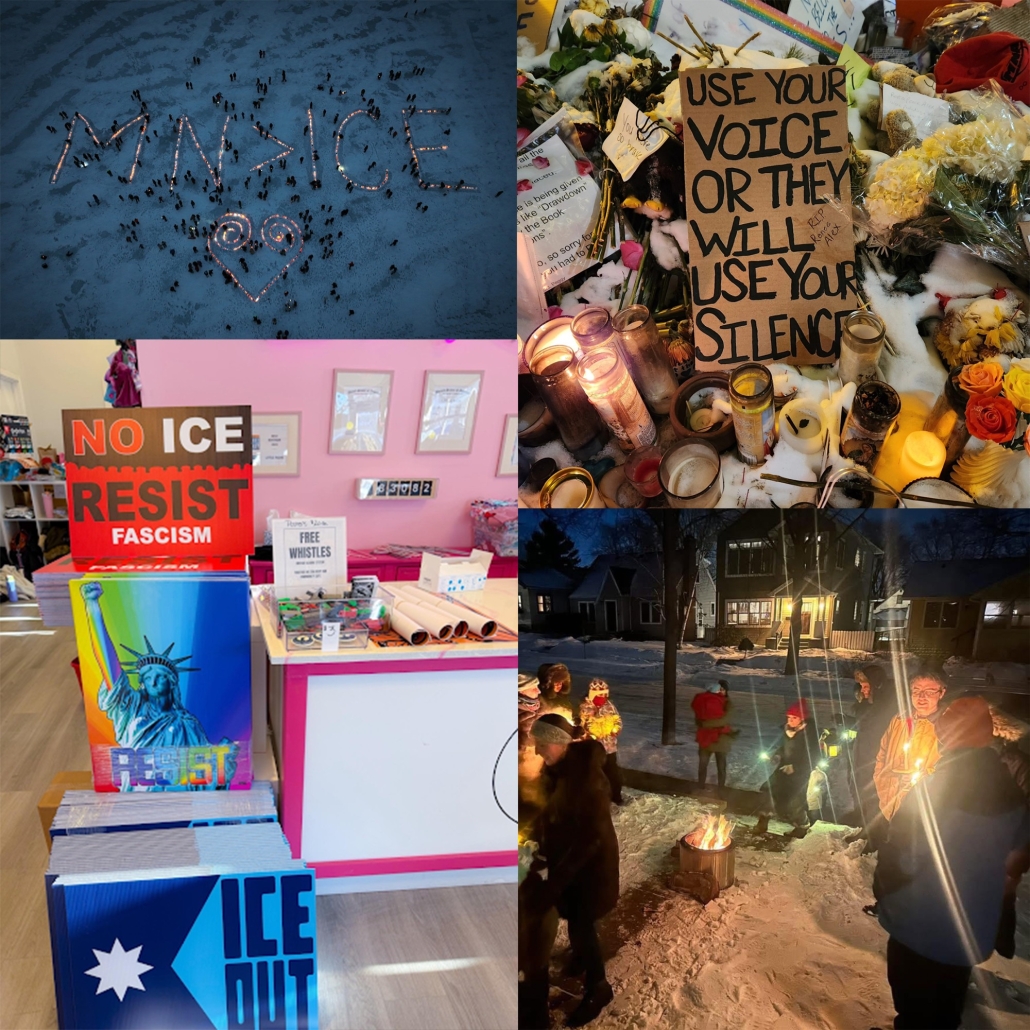
Photos, clockwise from top left: Interfaith leaders and community groups covered St Paul’s Lake Phalen with a traditional Hmong heart reflecting one of the city’s largest immigrant communities (photo by Nenick Vu); Candles at the Alex Pretti memorial site (photo by Catherine Reid Day); Author’s front yard vigil for Alex Pretti on Jan. 24 (photo by Martin Ludden); Shops like Little Roo’s in the Minneapolis suburb of Chaska offer free whistles and sell yard signs (Facebook).
By Julia Wheeler Ludden
Sun contributor
We take the bags of groceries—dried beans, rice, cornmeal, plantains, avocados, fruit pulps, meats I don’t recognize and juices with names I can’t pronounce—and load them into the IKEA bags in my trunk. Quickly, in case Immigration and Customs Enforcement (ICE) agents are nearby. Five deliveries today, down to Eagan, out to Woodbury, and a few in St Paul. The car smells like tamales. This isn’t our usual Sunday afternoon Trader Joe’s run.
“This is my gun,” the grocer says with a weary smile, pointing to the black plastic whistle hanging around his neck. I wrap an arm around him. We’ve been coming here for weeks now, picking up groceries to deliver to families “sheltering in place.” Usually reserved for natural disasters, this phrase now applies to many people of color in Minnesota. It’s anything but natural, and yet, two months into the largest federal immigration roundup operation in U.S. history, it has started to feel normal. White folks and brave Black and Brown U.S. citizens deliver a lot of food these days. We all follow the same protocols: Text when you arrive. Don’t knock. Expect dark windows, shades drawn. They’re home.
After the first delivery, the woman texts me, Dios los bendigo. I Google translate it. “God bless you.” I have so many questions, but I don’t ask. It’s not just unauthorized immigrants who are staying home. Along with people who crossed the border illegally (in some cases decades ago), ICE has taken legal refugees, U.S. citizens, even Native Americans (where do they plan to deport them?). Anyone Brown. Anyone who looks African. Anyone who speaks Spanish. I send back a heart emoji, then delete the texts and the woman’s address from my phone’s map history. Just in case.
Operation Metro Surge began in December 2025, with the Trump administration’s promises to detain and deport criminal immigrants in Minnesota. By January, 3,000 ICE and Border Patrol agents were deployed here, and within weeks, the Department of Homeland Security (DHS) reported 4,000 arrests across the state. As the Trump administration and DHS assured the country they were coming after “the worst of the worst,” contradictory videos and reports from local news and private citizens soon flooded airwaves, social media feeds and text threads. The scenes that emerged showed people without criminal records being detained and deprived of due process, regardless of their legal status. (According to a Feb. 9 CBS News report based on an internal Department of Homeland Security document, less than 14% of nearly 400,000 immigrants arrested by ICE in Trump’s first year back in the White House had charges or convictions for violent criminal offenses.) Meanwhile, nonviolent protesters were being threatened and arrested. It didn’t make sense. It didn’t feel right. A few activist friends shared newly formed mutual aid networks. People started protesting on highway overpasses.
Then, on Jan. 7, an ICE agent killed Renee Good, arguing she had attempted to ram him with her vehicle. Videos disputing his claim went viral, and the protests quickly grew. Local nonprofits, schools, churches, parent teacher associations, and neighborhood groups took to Facebook and Signal chats and to the streets to organize, create and circulate opportunities to give and show support. Communities stepped up, carrying lessons and inspiration from friends in cities that ICE had previously invaded—Chicago, Los Angeles, and Portland. Friends set up observer networks and buddy family programs to pair households in need with people willing to help provide rides to school or medical appointments, grocery deliveries, financial assistance, and more.
Two weeks later, agents shot Alex Pretti 10 times in the back as he lay detained in the street. More videos. Bigger protests nationwide. More businesses started handing out free whistles. “ICE OUT” signs multiplied in yards like ours, and in shop windows across the metro. We watched friends get pepper sprayed, tackled, and doxxed for peacefully voicing opposition, while our government kept saying it was our fault, not theirs.
Tens of thousands marched in subzero temperatures through downtown Minneapolis. Twice. A thousand interfaith leaders came here from all over the country, including a lovely UCC minister from Boston who stayed in our guest room. Non-immigration attorneys volunteered to help local immigration lawyers with the hundreds of first and fourth amendment cases and due process claims piling up from detained refugees and protesters alike. Doctors spoke up about the conditions in detention centers, and the health consequences of so many people of color being prevented from accessing medical care because it’s not safe for them to move around the city. Protests erupted all over the country, and internationally. Millions of dollars have flowed into local nonprofits and mutual aid networks.
And here at home, weeks later, we are weary but the work continues. The recent drawdown of 700 agents from Minnesota still leaves more than 2,000 here. Minnesota’s Lt Gov Peggy Flanagan shared last weekend at a vigil, “This isn’t a sprint, and it’s not even a marathon. This a relay, friends.” We are not leaderless. We are leaderful. Dozens of protests take place every single day, on street corners in city neighborhoods and suburbs and towns across Minnesota. In one recent weekend, participants at an indigenous-led “Not on Stolen Land” rally tied thousands of prayer ties to the fence separating protesters from ICE headquarters at the Whipple federal building near Minneapolis, while up the road, a Lutheran church hosted a standing-room-only crowd for resistance singing. Elsewhere, a group of protesters were arrested after throwing adult novelty toys and snowballs at ICE agents, and across town, hundreds stood on a frozen lake unveiling a snow sculpture honoring Renee Good and spelling ‘ICE OUT’ with luminaries visible from passing airplanes. Along the Mississippi River, a Kids March walked the Stone Arch Bridge in Minneapolis chanting “We like ice cream, we don’t like ICE.” Leaderful, indeed.
The dissonance between what we see in our neighborhoods and what we hear from our federal government hits everyone differently. There are grandmas handing out cookies at every protest, but President Trump says we’re the radical left. Antifa. My middle schooler calls me from school to say “Mom, I’m going to the walkout at the state capitol. We’re getting in Oscar’s dad’s car right now.” It’s his first protest. I’m proud but scared. I talk to a friend whose middle schooler just told him, “I don’t want to be alive right now.” Hugs. Tears. And we’re white. No one’s hunting us. When they shot Renee Good and Alex Pretti, it became clear that this is about more than immigration enforcement. It’s also about our freedom to stand up for what’s right, and to document and speak out against what’s wrong. “Minnesotans are standing up for the rule of law and the dignity of all people,” said Gov. Tim Walz.
After Alex Pretti was killed on Jan. 24, word spread encouraging candlelight vigils at 7 pm across the metro, especially along the multicultural immigrant corridor of Lake Street. We live across the river in St Paul, so we invited neighbors to our front yard and fired up the solo stove; with just an hour’s notice, everyone came. It was 10 below zero so people didn’t linger, and by 8 pm I was driving to my son’s evening futsal game. The roads were quiet, and on every corner along Lake Street, dozens of abandoned candles still flickered in the snowbanks.
“You don’t see helicopters just hovering like that here. They were everywhere in Iraq,” my husband says. It’s harder for him, seeing our cities occupied by thousands of armed federal agents carrying out orders that don’t make sense. He’s been on the other side. It pisses him off more than it does the rest of us. It did six years ago, too, in the uprising that followed George Floyd’s murder. Then, he sat on our front steps with a bourbon and a baseball bat. Today, he fights back by volunteering as a street medic at protests, red duct tape crosses on his arms and his pack. He’s loaded with first aid gear and water bottles to flush eyes after tear gas or pepper spray, but mostly it’s just doling out handwarmers and fruit snacks.
Last weekend, I joined an anti-ICE protest outside the elementary school of five-year-old Liam Conejo Ramos, the boy with the blue bunny hat who was detained and sent to Texas with his father. Hours after the protest, a judge ordered that Liam and his dad, a lawful asylum seeker, be released and returned to Minnesota. Each day brings new stories of injustice, but also stories of community and strength. Is it helping? A Mexican-American friend, local teacher, and coach says that “it reminds me that most people in Minnesota actually do want me here, whatever ICE or Trump says.” That’s enough to keep me standing on the corner with my “Make Minnesota Boring Again” sign.
Raised in Leelanau County, Julia Wheeler Ludden lives in St. Paul, Minnesota.
Minnesota organizations to support:
Local Leelanau organizations to support:
Justice and Peace Advocacy Center
Immigration Law and Justice Center
NoMi Neighbor Network (NoMiNN) is a local collective working in solidarity with immigrant neighbors across the greater Grand Traverse region. NoMiNN provides Know Your Rights/Peaceful Observer Training and helps ensure neighbors are supported and not alone during this challenging time. Click here to donate and support their work. This fund offers financial support for basic and essential needs for our vulnerable neighbors.