Communities, researchers measure ice thickness on the Great Lakes
By Vivian La
Interlochen Public Radio
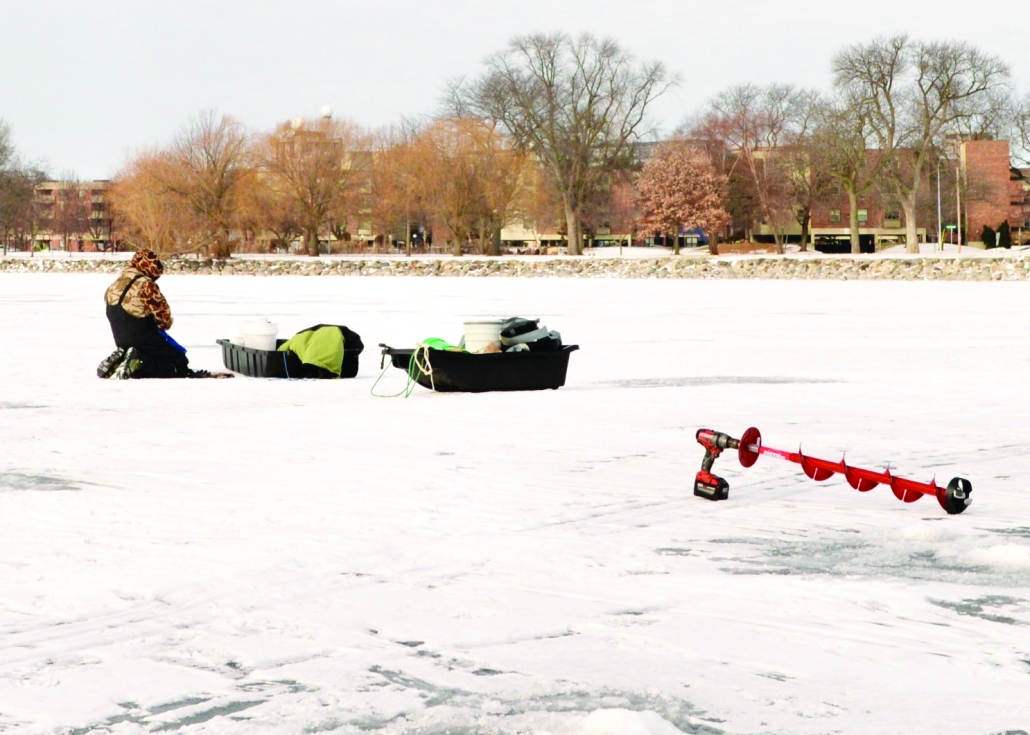
 Scientists are asking for help from the public this winter to measure how thick the ice is on the Great Lakes and inland lakes.
Data submitted by ice fishers and other people who spend time on frozen lakes could improve the models that forecast ice cover on the Great Lakes. Satellites do a good job at capturing how much ice there is, but not how thick it is, according to researchers at the Great Lakes Observing System (GLOS) in Ann Arbor.
More data could give researchers insight as to how climate change is altering ice cover in the region and provide important safety information for people out on the ice.
Researchers are seeking data on ice thickness and snow cover, which can be submitted online. Stipends are also available to volunteers who contribute data from the Great Lakes.
“Usually it’s the scientists putting data out to the public, and this time, we’re asking the public to give feedback to the scientists so they can improve the models,” said Shelby Brunner, science and observations manager at GLOS.
She said buoys that collect data on lakes typically get pulled out in the winter because of harsh conditions.
The citizen science program is in its second year of data collection. Last year, the program recruited around a dozen people in the Great Lakes region and logged around 30 measurements.
Brunner said the data showed researchers that ice is more variable than they initially predicted. That’s why more data from people who are already “in tune with the ice” is useful to tap into, she said.
“They’re posting pictures of when there’s water in between layers of ice, and that’s information that is so novel for the modelers to have,” Brunner said. “If we can continually improve, we’re going to get safer and safer predictions.”
The data is also useful as ice formation on the Great Lakes shifts with climate change, Brunner said.
Research suggests that average ice cover on the Great Lakes has decreased overall since the 1990s, but year-to-year variability is high. That means there are years with very little ice or years with a lot of it — as of Jan. 26, 43% of the Great Lakes had iced over this winter.
“We don’t get to go back in time and measure the past. We have to measure it now and keep it safe. So we can use it for reference for how things are looking in the future,” Brunner said.
It’s not just ice fishers who can contribute data. Mandi Young, science teacher at the Pathfinder School in Traverse City, took her middle school students out last year to measure ice thickness on Cedar Lake.
Young has her students regularly collect information from the water like temperature or depth to compare to previous years. Ice thickness was another data point they could add to the mix, she said.
“The students really love it. They get the chance to be outside. They know that their information is being saved and used by other community members,” Young said.
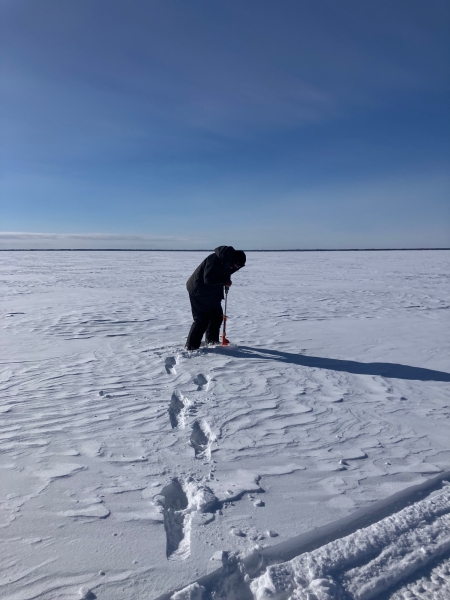
Young plans to have her students measure ice thickness again this winter. This time, they have an auger to drill holes into the icy lake.
She said one of her favorite parts is the questions students ask while they’re out taking measurements: “‘Could we throw a rock on it, will it break? Oh what about throwing ice on ice, what’s gonna happen? Oh did you hear that sound?'”
“Kids just get curious about ice,” she said.
The data they collect from inland lakes like this one will be kept for archives and used in future research.