
When ‘Anything Goes’ dries up
Op-ed by Trace St. Julian
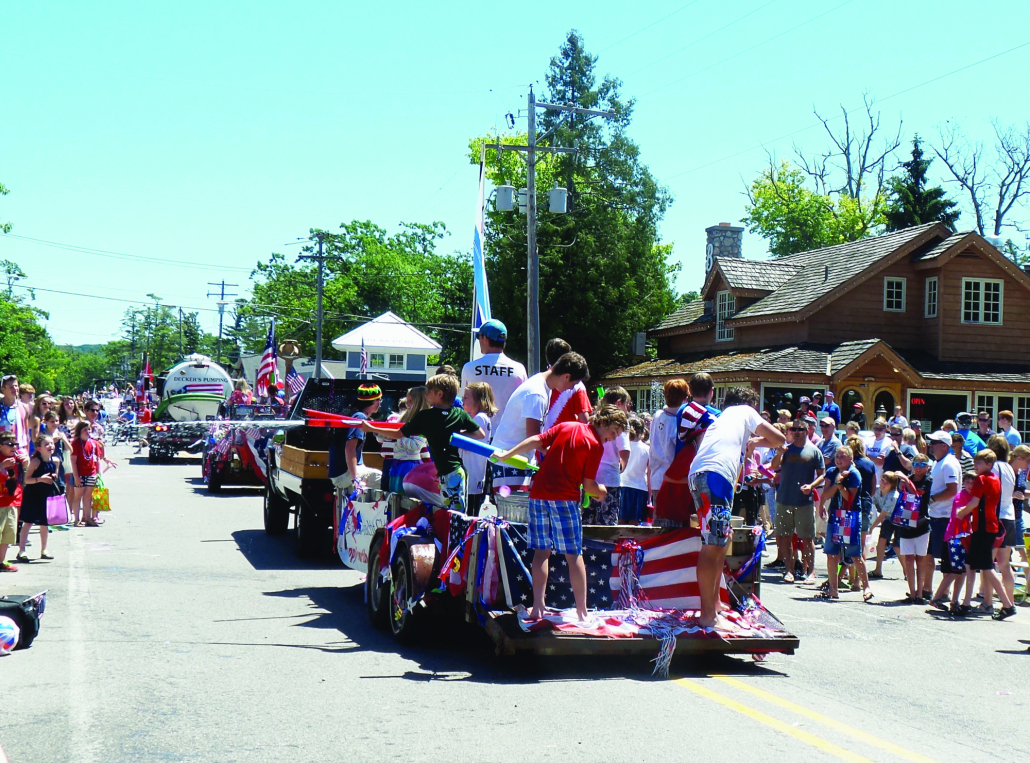
Photo: Children spray water from a parade float during the 2014 Glen Arbor Fourth of July parade
Over the past 62 years, Glen Arbor’s Fourth of July parade has become well-known for its “anything goes” spirit. This approach is a point of local pride for many, encouraging the patriotic participation that has transformed a small-town procession into a northern Michigan tradition unlike any other. However, in 2023, the Glen Arbor Township Board broke away from the “anything goes” tradition, announcing a “no water” rule that bans long-time parade hallmarks of “water guns, blasters, balloons, bottles, or other water items”
Fast forward to 2025—the water ban is still in effect, and the Township Board appears more determined than ever to enforce it.
As a community member who has enjoyed decades of water-filled Fourth of July parades as both a participant and spectator, I find the Township Board’s policy dismissive toward Glen Arbor culture and a rejection of the celebratory spirit that defines the event. Moreover, I also believe that easily implementable compromises to the water issue do exist.
Beyond the disheartening fact that the water ban was announced in the very first year following the passing of parade founder Stan Brubaker (which I view as a departure from—rather than a tribute to—the legacy of a Glen Arbor legend), I believe that it is important to recognize the role in the parade that water activities played for many.
In 2023—the first dry parade—I stood as a chaperone upon the Glen Lake Yacht Club’s float, watching the Club’s kids miss out on a part of the parade that I had cherished growing up. But it wasn’t just those on the float who felt that something was missing. As the float passed Art’s, an older man stepped forward from the crowd smiling and pointing to a sign taped to his shirt; it read “Bring back water!”
Just as it was for me, water has long been an integral part of the parade experience for many. In recent years, water activities have expanded beyond just the floats—spectators, too, have increasingly joined in, often bringing their own water to spark impromptu water fights and join the fun. It is no surprise, then, that many floats and spectators largely ignored the ban in 2024’s parade. I urge the Township Board to view this behavior as a strong desire to preserve tradition—not a reason to crack down on perceived disobedience.
While it is unfortunate that the Township Board seems so determined to eliminate a beloved aspect of the parade celebration for many, I understand that the decision came as a result of “several complaints from the crowd.” However, I believe there are reasonable compromises that can maintain the water tradition while also addressing the concerns of those who prefer to stay dry.
One solution could be to designate “wet zones” and “dry zones” for spectators. An even simpler approach might be to assign one side of the street as the wet side and the other as the dry. I do, however, agree with the Township Board’s decision to ban water balloons, as they can cause injury on impact, and a simple misaim can unintentionally strike a spectator in a dry zone.
Through local channels, I’ve heard both support and criticism of the water ban. But while two sides to this issue do exist, the current policy only honors one—disregarding those who find joy in the water festivities and abandoning a long-standing tradition. Therefore, I ask the Township Board to revisit the total ban on water and consider a sensible compromise, such as wet zones and dry zones, that can protect the comfort of all attendees while preserving the parade’s unique heritage.


