What’s in a name? Truths and mistruths behind Leelanau’s names
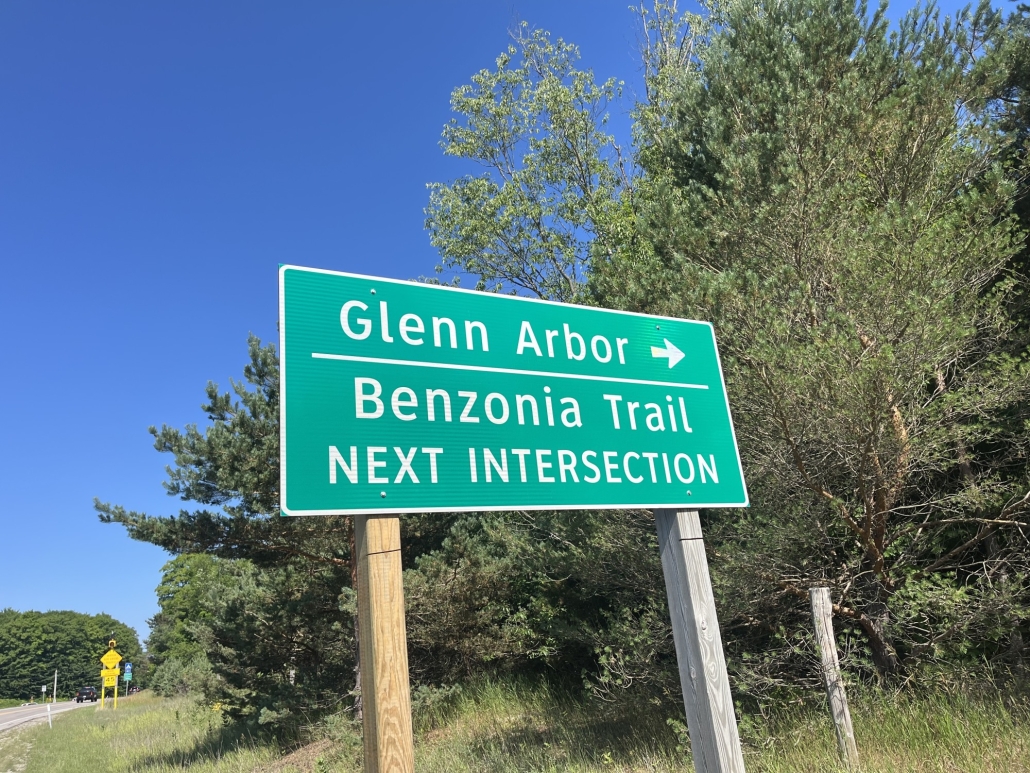
Caption: Sometimes names are misspelled on road signs. The sign, pictured above, at the corner of M-72 and Benzonia Trail (CR-677) misspells the name “Glen” Arbor.
By Ross Boissoneau
Sun contributor
A rose by any other name would smell as sweet. So said Juliet in the Bard’s most famous work. But would Leelanau really be such a land of delight if that’s not what its name really meant?
Spoiler alert: The name Leelanau doesn’t come from any Native American source. That’s despite the stories that have sprung up around it, some of which were spread by the person who came up with the name. More on that shortly.
Many of the county’s locations have stories surrounding their names. Start with Sleeping Bear Dunes, the story of which is well-known. Mama bear and her cubs swam across Lake Michigan to escape a forest fire. When Mama reached shore, she looked back, waiting for her cubs. She eventually became the sand dunes, while the cubs became the Manitou Islands.
Move to the north end of the county, where you find likely the easiest one of all. It’s not hard to derive the source of Northport’s name. After all, it is indeed the northernmost point of the county, and was a port for ships of all sorts.
But go back 175 years and you would find yourself in Waukazooville, named after the Odawa Chief Peter Waukazoo. In 1854, a newcomer named Deacon Joseph Dame arrived. He platted the village and renamed it Northport, simply because the settlement was located at the northern tip of the Leelanau Peninsula and mirrored the name of a town in Maine where he had lived. The name stuck, though the original moniker lives on in the form of Waukazoo Street, one of the town’s main roadways.
At the south end of the county, Empire took its name from a ship. Make that two ships. The Empire State was 19th-century side-wheeler steamer that grounded and was stuck off the Leelanau shoreline in 1849. Just 16 years later, the schooner Empire was trapped in offshore ice during a severe winter storm. The area subsequently became known as Empire, and the name was officially adopted when the village was incorporated in 1895.
Glen Lake, Glen Arbor and Glen Haven and all reference the surrounding glens, the rolling, wooded hills and valleys characteristic of the area. The lake was known as Bear Lake by the Native Americans. Harriet Fisher, the wife of early settler John E. Fisher, renamed the waters for its nearby topography, then combined the name of the lake with arbor, to describe the leafy, shady grapevines she admired growing on the area’s trees.
Glen Haven’s name references the sheltered, deep-water port it provided for Great Lakes steamships needing wood and supplies. Founded in 1857, the town was originally called Sleeping Bearville, though the name was changed shortly after its founding.
Some towns are named for a person who founded or otherwise impacted it. Residents of Suttons Bay may know the town was named for landowner Harry Sutton. They may not know it was originally named Suttonburg. It is such a charming town the name was changed to Pleasant City when it was replatted in 1860. Alas, that settlement failed, and it reverted to Suttons Bay a year later.
Suttons Bay is typically is spelled without an apostrophe. While it was named for a single Sutton—hence Suttonburg—the U.S. Board on Geographic Names, the official arbiter of American place names, discourages the use of possessive form in place names.
It’s not just towns that are named for people. Kasson Township was named for Kasson Freeman, the first county surveyor of Leelanau County. He was further celebrated, but not by name, for another familiar county place. John Fisher and Freeman were honored for their early efforts in the area with a picnic on Aug. 3, 1893. That date was Freeman’s birthday and the day Fisher arrived in Glen Arbor from Wisconsin. In 1904, the picnic moved from Maple City Road a quarter mile from Glen Lake to its present location on Dunn’s Farm Road in what is now officially named Old Settler’s Park.
Lake Leelanau is pretty easy. It’s named for the lake of the same name, which makes sense as the waterway borders much of the town. But of course, that is not its original name. The town was first known as “Le Naro,” due to its location at the narrows between the north and south arms of the lake. As the settlement grew and was improved, the name was changed to Provemont, a play on “Improvement.” When the area’s first post office was established in 1871, it was officially named Provemont, and as such was home to the Provemont General Store, designated a Michigan Historical Site in 1991.
On March 31, 1924, the village adopted its current name for its post office and the settlement, to match the surrounding body of water. Good thing it waited, as Lake Leelanau was known as Carp Lake until 1901, when it was renamed Lake Leelanau by Leelanau County supervisors.
For a hint as to Maple City’s name, simply look at the nearby trees. But again, as with Lake Leelanau, that isn’t the full story. The restaurant in the middle of town offers a clue: Pegtown Station references the town’s original name. It was named for a local factory that used the surrounding maple trees to manufacture wooden pins – pegs – for footwear.
Nearby Cedar is another easy one. Founded in 1885 by lumberman Benjamin Boughey, it was originally named Cedar City. It is located in the midst of cedar forests and swamps. The historic name was retained for many years after the post office was officially shortened to Cedar in 1893 by the local Manistee and North-Eastern Railroad depot.
When Reverend Peter Dougherty and his band of Native American Indians left Old Mission, they settled across the bay at a site variously called A Point Beyond or New Mission. According to the Omena Point Preservation Society, the new name came about through Dougherty responding to interesting information with the phrase “O-ma-nah” which means “Is that so?” in Ojibwe. In time the Mission and the town became known as “O-ma-nah” or Omena.
Leland is surprisingly not related to Leelanau. Its exposure to the north winds meant it was in the lee, so it became Lee Land.
So back to Leelanau itself, which may boast the most interesting story. It is among the ten counties in Michigan whose names were created by Henry Schoolcraft, a geographer, geologist and ethnologist, who served for a time as a United States Indian Agent in the state. His made-up words often combined Native American words with roots in Greek, Latin and Arabic.
Some sources still ascribe the county’s name to a Native American word or combination of Native American and French, meaning “delight of life.” But the Library of Michigan calls it a name totally fabricated by Schoolcraft and his wife, Jane Johnston Schoolcraft, an Ojibwe writer. She used “Leelinau” as a pen name for stories published in their 1820s family magazine, The Literary Voyager. He later used “Leelinau” as the name of a Native American heroine in his 1839 book Algic Researches.
So, “Land of Delight” may indeed refer to the county, with its hills, lakes, beaches and ample attractions. But a native word? Sorry, no.