
Sowing community in Empire
 By Pat Stinson
Sun contributor
Bees are humming amongst spotted purple knapweed, grasses and Queen Anne’s lace growing thigh high in a cluster of unsold lots on the south side of the New Neighborhood. Empire resident Robin Johnson, who lives across M-22 from the development — in the former Lillian and Irwin Beck, Jr. farmhouse — points to this sunny spot resembling a meadow more than future home sites.
An architect with an appreciation of life cycles, Johnson convinced her New Neighborhood developer-husband Robert Foulkes to forego mowing the 124-foot-deep patch of wildflowers that some might call weeds. This way, she explains, fauna can continue using the space as habitat, at least until the lots sell.
 “I care a lot about the landscape,” says the assistant professor (Andrews University School of Architecture) back at her home, while sharing some of her architectural drawings. A project she calls “Cycle” was meant to transform a gash in a Dublin, Ireland roundabout into a circle of planted oak trees, their tops tethered inward toward a mound covered with artistically-crafted ceramic, with a ditch to collect acorns. Her idea: as the ceramic crumbled over time, the acorns would touch soil — leading to a new generation of trees. (The project never materialized, but a future Glen Arbor Sun story will highlight the couple’s tree-planting work in Ireland.)
Other drawings show Celtic motifs Johnson suggested as ornamentation for rustic, boathouse-inspired guest quarters on South Bar Lake, and the 1,600-square-foot Long Lake house she designed (in the form of their old boathouse at the water’s edge) for her parents. The home climbs the same hillside owned by her grandfather (a pharmacist at the former state hospital in Traverse City), where she used to “hang out” as a child during summers at the lake. (Johnson’s parents were raised in Traverse City: her brother Greg Johnson, a NASA astronaut and retired Air Force colonel, was featured in our July 15 edition, “Empire community glimpses life in space”.)
“I love working with the topography,” she adds.
 Growing greenery
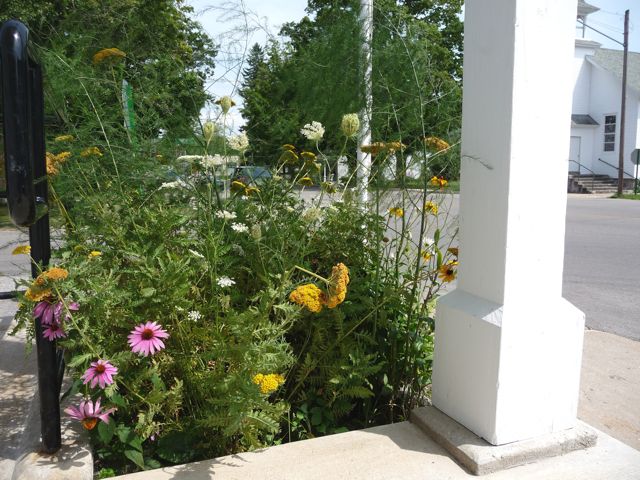
When plans were underway for the first Empire Asparagus festival, Johnson noted that the only asparagus “visible” in the village was in a culvert at Lake and Niagara streets. She says she thought the long, east-facing wall of the Post Office needed a garden, and she made a proposal to the Village Council, which agreed to contribute $100 toward the purchase of plants if she promised to join the Village Beautification Committee.
“Greystone Gardens (on Manning Road, south of the village) sold to us and donated loads of gorgeous plants, including some spectacular three-foot-high golden yarrow which has found its way into other village planting beds,” she says. “It’s great in the hot August heat. You can see it featured prominently today along the east wall of the pump house at the beach. Residents of the village contributed mature plants at that time as well — daylilies, poppies, shasta daisies … I love it when people pitch in like that.”
Beds were installed at the southeast corner of the town hall, along the east wall of the Post Office (surreptitiously hiding the air-conditioning unit), in front of State Savings Bank and at the Empire beach turnaround.
“One of the plants I am particularly happy with from those Beautification Committee days is a certain poppy in the round planting bed at the beach, by the anchor. It was absolutely stunning the last two years. I think it’s the same one I transplanted from someone’s yard. (It) took awhile to get situated and then, wow, it’s beautiful in late spring — blazing red with western sunlight glowing through it.”
Johnson says that Linda Payment, the chairperson of Parks on the Village Council and a “fabulous gardener,” oversees care of the planting beds today.
Vision for a veggie garden
Thanks to Johnson’s ability to see potential in a fallow field and her belief in community, a portion of a reserve septic drain field planned for future use in phase 5 of the New Neighborhood has become a 50-by-80-foot community garden area. Raised vegetable beds were constructed of slab wood provided by her husband’s timber-framing business, White Oak Timber Frames of Suttons Bay. A nearby neighbor currently supplies water by hose, but the gardeners hope to obtain permission from the village to access a water hook-up on lot 63, also communally held. Each gardener contributes $25 per year for infrastructure.
“There couldn’t be a more ideal spot than an area held for common use,” she says of the garden site, adding that property ownership and use makes it “not that easy to work out the details” of this type of endeavor when the land isn’t held for shared purposes.
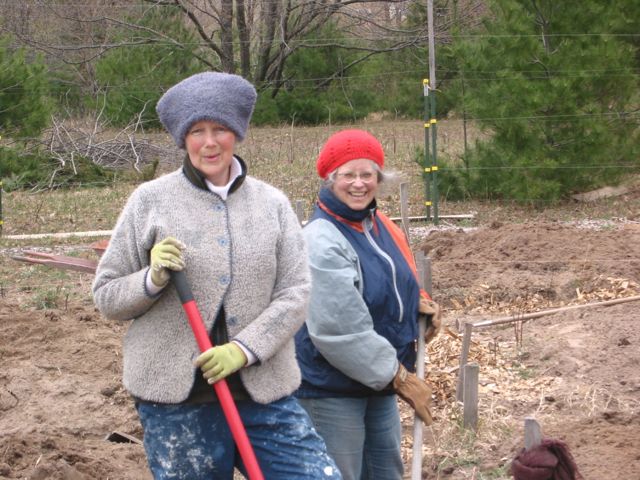
One of the 10 community gardeners couldn’t put up a fence at his home, due to lot restrictions placed by developers on his land, so he tends one of the garden’s 10-by-15-foot plots protected from critters by a seven-foot-tall fence and a solar-powered electric fence. The other nine gardeners include several village residents and a handful of New Neighborhood residents, and a majority of them worked together last year to add a trailer load of aged manure to the beds.
“It was a really fun time — followed by hot cider and other goodies people contributed in good communal fashion,” she says. “We retreated to the wood stove in my living room, after all the hard work in the frosty cold, to warm up and have an impromptu potluck.”
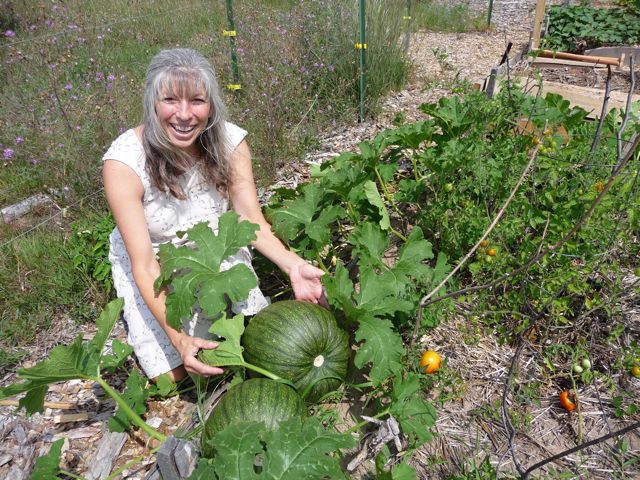
Johnson gamely poses for a photograph next to large and healthy-looking pumpkins planted by New Neighborhood resident Cile Plumstead. Afterward, as she threads herself between horizontal fence wires, her smile is still wide as she adds a final thought:
“I really like the idea of doing stuff communally. There’s a helping that happens among friends when the set up is easy, and it’s a great use of the land.”
For information about the community garden or her services as an architect, email Robin Johnson at robinaj9988(AT)yahoo.com.