
Empire community glimpses life in space
 By Pat Stinson
Sun contributor
Hard work, enthusiasm and a sense of humor can take you pretty far in this world. If you’re Greg Johnson, a NASA astronaut and retired Air Force colonel, that combination and a diverse skill set can also propel you 200 miles into space and onto the orbiting International Space Station (ISS).
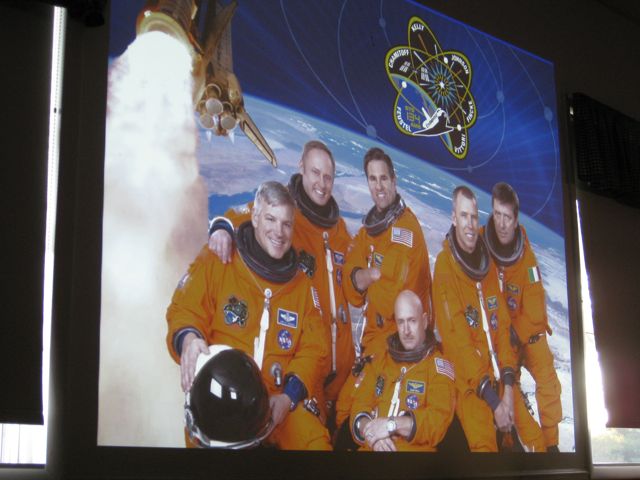
Speaking to a curious crowd of all ages who packed the Empire Town Hall on Friday, July 9, Johnson — who will pilot the Endeavour for the final space shuttle mission scheduled for Feb. 26, 2011 — shared slides and video of his first shuttle mission in 2008 aboard the Endeavour and the ISS. He also gave thoughtful responses to a number of questions, including one about how he was chosen for space flight.
“You know those 8 balls?” he replied, with a devilish smile that glowed like liftoff in the darkened hall, (he paused as laughter from his joke about the fortune-telling toy subsided), “It’s a big mix.”
 Johnson, 48, said that being proficient at using a robotic arm was probably his biggest asset beyond his experience as a pilot, and that personality, skill set and seniority (plus mysterious attributes known only to the astronaut chief) are also part of the selection process. He explained that he worked “very hard” in school and stressed the importance of doing well because “it follows you for the rest of your life.” What the modest astronaut didn’t say was that he has excelled at each level of his own education. He was valedictorian of his Fairborn, Ohio high school class and an Eagle Scout. He was a U.S. Air Force Academy “Distinguished Graduate with Honors” in aeronautical engineering and received a Guggenheim fellowship to Columbia University, where he earned an M.S. in flight structures engineering.
He began his career in 1986 as an Air Force pilot stationed at Reese Air Force Base in Texas, the state where he makes his home today. (He spends a portion of his summers at the family home on Long Lake in nearby Grand Traverse County. As a child, he said he visited The Bluebird restaurant in Leland almost every year.) The former F-15E Eagle pilot flew 34 combat missions during Operation Desert Storm and 27 missions supporting Operation Southern Watch in Saudi Arabia. He received “Distinguished Graduate” recognition after Air Force Test Pilot School in ’93 and was awarded “Top USAF Test Pilot” in ’96. (He ultimately flew 40 different aircraft and logged more than 4,000 flight hours before retiring from the Air Force in 2009.)
 Of tens of thousands of hopeful applicants, Johnson was among 30 selected for NASA’s astronaut training program in 1998 and has since received the agency’s “Superior Performance Award.” In an interview with Imagiverse, the website of the Imagiverse Educational Consortium, Johnson said of the sometimes long interval between training and space flight, (his was 10 years; other astronauts never reach space): “The wait grates on morale at times, but few astronauts “expect” to fly (and we feel lucky just to be in line). Our day-to-day mission is to support all manned flights in our manifest — a flight assignment is the frosting on the cake.”
Up in the air
Johnson first caught “the bug to fly in space” 41 years ago as he watched Neil Armstrong step onto the moon, an event he remembers sharing with his siblings around the family’s black-and-white television set in their former Caro, Michigan home. (Sister Robin Johnson, now an Empire resident, has twice invited him to speak to the community.) Directing his attention to younger audience members, he said, “Whatever you think you want to do, just go after it.” He continued with some “sage advice” he received from an Air Force pilot: “The best way to reach your lofty goal is to do something you love because if you love to do it, you’ll do it very well.”
The vacationing astronaut said his loves are science and flying, and he put them together to be a test pilot. “I’ve loved every single minute in the Air Force, flying.”
Blasting off in the space shuttle, however, was an entirely different experience, with the rocket’s multimillion pounds of thrust, the orange glow of reflected light and continual acceleration.
“It was sensory overload,” he said. “Just like my heart starts pounding when I see the clock go 28, 29, 30… It (the rocket with shuttle) leaps off the ground like a wild animal.”
It took 26 seconds to reach the cloud deck a mile up, he said, and 8 minutes and 20 seconds to reach a stable orbit, where the shuttle travels 17,500 mph.
After a year’s worth of training, including “incredible” simulations by laptop and in mock-up modules, he said he expected almost everything he encountered during the real trip, yet nothing prepared him for the sight of the mountains from his position in low earth orbit, anywhere from 220 to 280 miles above Earth’s surface.
“I would just lose my breath looking at the beautiful planet float by,” he said.
Down to work
As pilot for NASA’s 25th Space Shuttle mission to the ISS, he was responsible for maneuvering part of the shuttle’s payload — a Japanese Experiment Logistics Module, Pressurized Section — to its position on ISS. Entering the Japanese module from inside the space station for the first time, Astronaut Takao Doi of Japan quickly put his country’s flag up.
“I sneaked in there and put up an American flag,” Johnson said, chuckling. “It was kind of a joke. Takao said, ‘No, no, no, you can’t do that.’”
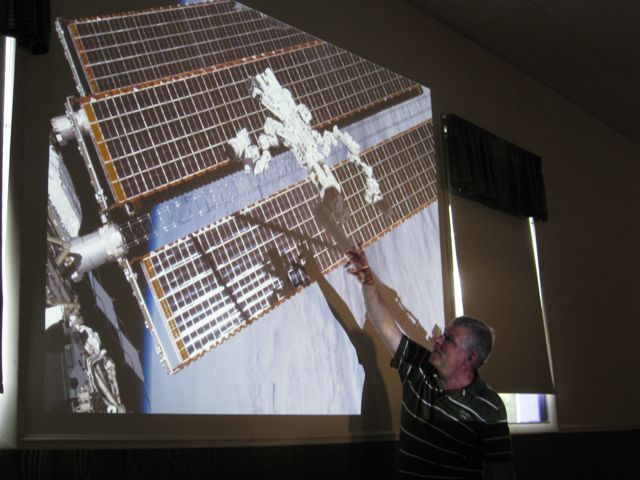
Space walkers (Johnson wasn’t among them) worked two at a time during the mission. Three out of five total walks were spent building the Canadian Space Agency’s “Mr.” Dextre, (Special Purpose Dextrous Manipulator), a small, two-armed, state-of-the-art maintenance robot that allows astronauts to replace exterior hardware without a spacewalk.
In addition to his role as primary robotics arm operator for both the shuttle and the ISS arms over the course of the longest shuttle mission (17 days) to the ISS, he said: “I’m kind of the Scotty guy (part of the crew of the original Stark Trek TV series). I fix toilets … I’m the engineering kind of guy.”
The space station’s zero-gravity interior — where up is down, down is up, and there’s a virtual roof and floor to which the astronauts orient themselves (rotating 90 degrees when moving from the space shuttle to the ISS) — necessitates exercise sessions to maintain bone density, but is a boon for sleeping and playing. As Johnson said, it’s his belief that “you have to have fun” on a mission and that’s part of his contribution. In one instance, he experimented with a ball of water. In zero gravity, he explained, a sphere of water sticks to a straw, but when the straw is pulled away, it floats, and if it’s touched, it sticks to whatever surface it touches.
“I started tossing M&Ms in there,” he said of the sphere. “It was amazing; they started dissolving and (someone) went over there and ate it!”
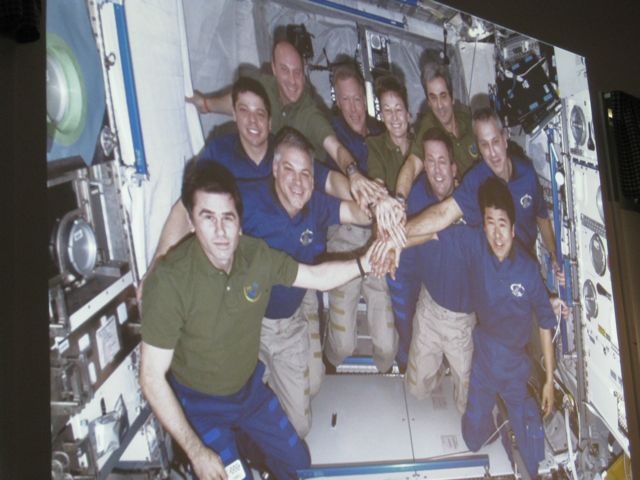
On Easter Day, the astronauts were given a half-day to themselves, and Johnson insisted that everyone “dive.” With an HD camera, he recorded the astronauts as they propelled themselves one by one horizontally (or was it vertically?) through a doorway and past the camera. The idea was to keep their hands together on outstretched arms in front of their heads, and their legs together behind them as they shot smoothly through one of the station’s compartments. The success of this maneuver varied widely. Each crew member was allowed to bring two personal effects to the station and Rick Linnehan, a veterinarian, brought a stuffed Kermit the frog — which floated its way past the camera too. Diving was followed by “tumbling,” which requires a constant rolling motion.
“It’s hard to get yourself rolling without floating up or floating down or backwards,” Johnson said, explaining the intricacies of the weightless sport.
Around a second time
When Johnson pilots the Endeavour again next February, he and his fellow crewmembers will be bringing an Alpha Magnetic Spectrometer with them. The cosmic ray particle physics detector collects and determines the type of matter and anti-matter it encounters, Johnson explained, and will contribute to the understanding of dark matter and the origin of the Universe. His job is to attach the spectrometer to the top of the space station using a robotic arm.
“It could be as important as the Hubbell telescope,” he said, with obvious excitement, “…(only) for subatomic particle physicists.”
What did he learn from his first space experience and how did he change, audience members wanted to know. He said he always felt that to have a fundamental understanding of something, you need data. After the shuttle trip, he shared that he became more spiritual.
“There’s something cosmic out there that I’ll never be able to understand,” said the lifetime devotee of empirical evidence.
He also realized how fragile Earth is and better understood how a meteor 65 million years ago could cause the demise of dinosaurs.
“People ask me all the time, ‘Why spend all of that money on the space program?’”
He tells them that Lewis and Clark were thought in their time to be failures for not finding the Northwest Passage.
“But we know 200 years later it was one of the greatest explorations.”
For more about Johnson, visit www.astronautix.com/astros/johgoryh.htm and visit www.nasa.gov to learn more about the February shuttle mission. Visit our website www.GlenArbor.com for a brief interview with Johnson following his slideshow presentation.
This interview with Johnson was conducted immediately following his Empire slideshow presentation: