
Time-keeping mystery: Glen Lake clock to appear on PBS History Detectives
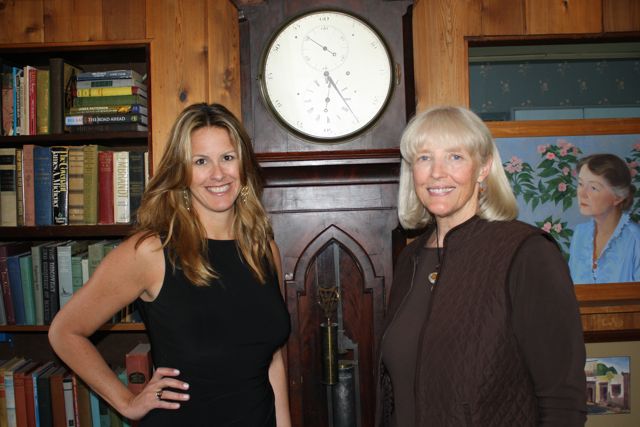 By F. Josephine Arrowood
Sun contributor
For over 50 years, the tall-case clock has kept time at the old Dillon cottage on Little Glen Lake, its pendulum quietly tracing the passage of the days. But this was no ordinary heirloom passed down by a proud ancestor. The handmade wooden piece, crafted in the popular Victorian-era Gothic style and standing more than eight feet tall, boasts three separate faces that mark the hours, minutes, and seconds behind a round glass portal. The steel pendulum shaft ends in a large glass cylinder, more than eight inches tall and two inches in diameter, filled with mercury, while the brass counterweight and other fittings are much thicker and heavier than usual. Strangest of all, according to its current owner Ben Bricker, “Here’s this clock from way back, but it has electrical fittings!”
Ben has wondered often about the old timepiece, which originally belonged to his late wife Ananda “Tump” Dillon’s mother’s family in Chicago. As he explained, no one now alive could share direct evidence of the clock’s origins or purpose. Yet he has heard plenty of tantalizing but unsubstantiated family lore about its role as “the official timepiece for east of Dayton, Ohio, and west of Lincoln, Neb.”
When he happened to see an episode of PBS’ History Detectives about a year ago, he was struck by the question that the show’s host, Elyse Luray, asks each week: “What is it that you want to know?” Ben realized that he should try to document the piece’s intriguing history for his family’s future generations. After writing down as much of the stories as he could remember, he and his daughter Cherrie Bricker Stege contacted the show’s producers to see if they could take on the challenge of the mystery clock from Carl Sandburg’s so-called “City of the Big Shoulders.”
Back in late 19th century Chicago, Tump’s maternal grandmother had an uncle named John Mayo, who owned the upscale Mayo Jewelry Store, located in the opulent Palmer House Hotel at State and E. Monroe Streets, in the present-day “Loop” (so named for the trolley loop that serviced the 19th and early 20th century central business district). The hotel, built just after the Great Chicago Fire of 1871, boasted such notables as Ulysses S. Grant and Mark Twain among its many powerful and wealthy guests. Nearby were Union Station, the Board of Trade, and the Financial District, whose financiers, business magnates and railroad barons also frequented the Palmer and its many amenities.
The railroad itself played a pivotal role in Chicago’s — and the nation’s — dramatic expansion in the decade between 1840 and 1850, moving people and goods more quickly across a larger geographic area. Utilizing the newer technologies of steam locomotion and the telegraph system invented by Samuel Morse that allowed instant communication along great distances, the rail companies (privately owned but generously subsidized by the federal government) soon needed more uniform time-keeping standards to avoid crashes on the single-track railway lines. According to an online article by Denis Cummings, the previous custom of individual towns and cities relied on the primitive method of setting clocks by local sundials. He notes that, by 1853, “the first standard time in America was introduced by railways in New England.” In 1883, American railroads adopted four standard time zones, which collectively were known as Standard Railway Time. Eventually the government also adopted them as the official time zones for the entire United States.
Did the clock play an important role in maintaining the orderly progression of commerce throughout the Midwest, as the family lore speculated and American history of the era suggests? Ben Bricker recalls that the “electrical fittings” were said to be connected to telegraph wires “to receive the Morse code signals from the Bureau of Standards” in Washington, DC.
“As the story goes, the clock would make a click, and someone standing there would manually recalibrate the three separate clock faces so that all three hands would stand up.”
He continues, “Theoretically, it was a nine-day clock but was rewound every Sunday, drawing the brass weight at the end of the gut cord back up. Otherwise, the weight would slowly sink to the bottom of the entire clock case, on the floor.” He opens the glass portal and demonstrates the winding of the clock with a small, removable brass handle. “Tump, [and her sisters] Barrie and Ariel all learned to tell time on this clock — wasn’t that strange, with its three hands!”
He is also fascinated by the ingenious method by which the stainless steel pendulum expands and contracts according to temperature changes, while the heavy mercury (a metal, though in liquid form) in the glass vial compensates by its limited downward expansion.
“This causes the vial to rise by the same amount that the pendulum shaft lengthens,” Ben explains. That maintains the device’s ‘escapement,’ or length of the pendulum’s arc, which regulates the length of the gear unwinding, “to be absolutely accurate.”
He notes that the clock has been cleaned and repaired several times over its century-plus history, most recently by his son Bruce, a physical oceanographer with the Office of Naval Research in Long Beach, Miss.
About 1980, he took apart every moveable piece and spread it across my living room floor. He cleaned it all, then put it back together, and signed his name and the date,” alongside the previous, mostly anonymous laborers, whose names are immortalized within the bowels of the clockworks.
Whatever the clock’s function, the selection of John Mayo and his jewelry establishment as timekeeper remains a mystery (perhaps to be revealed during the upcoming History Detectives episode, which will air on Monday, Sept. 6 at 9 p.m. local time). What is certain is that the tall, darkly burnished wooden spires atop the longcase stood sentinel in the Mayo Jewelry Store for several decades, perhaps until the hotel was rebuilt in 1924-27 to its present-day configuration. At some time, probably in the early 1950s, Mayo’s great-niece Alice Goss Dillon and her husband Frank (Tump’s parents) sold their home in Winnetka, Ill., and put the clock into storage near their downtown Chicago art studio, before moving it once again to their summer cottage on Glen Lake.
Ben says, “When Frank put everything in storage, he put the mercury in a coffee can, which was lead soldered. The mercury reacted with the lead, went right through the can onto the warehouse floor! They lost quite a bit, which had to be replaced. You can’t really pick up mercury, especially from a board floor that had wide cracks. This was before the days when mercury was dangerous,” he quips with a smile.
Today, the old timepiece remains on duty, lovingly wound each week by Ben, its present-day steward. Though it no longer carries the heavy responsibility of keeping time for a brawny Midwestern town, its pendulum continues its faithful arc across time, rising and falling with the weight of each given day.
… And here is the History Detectives episode that appeared on Sept. 6:
Watch the full episode. See more History Detectives.