
Lemonade stand lessons, from a son to a father
 By Bill Dungjen
Sun contributor
My son is seven years old. He has successfully completed his first grade year at Glen Lake School. This summer, his grandest plans include making his own independent fortune as a lemonade salesman.
One hot afternoon, he asked if he could set up the lemonade stand that his mother bought for him. Now I am a bit of a Luddite when it comes to summer fun. Wait, strike that, I am that way about most fun things that my son does for entertainment. I’ve signed him up for Cub Scouts and baseball — two of the slowest moving things I can think of to keep him occupied and give him a taste for savoring the good things in life, like a multi-course dinner. Take your time, linger over the afternoons of pop flies and grounder practice like an after-dinner espresso, enjoy the long stints in the green grass of the outfield between frenetic swings at the plate as you might a cheese tray, after the salad, but before the dessert arrives.
My son is seven years old. He fills his hat with wood chips in the dugout, he holds the team record for filling his glove with the most infield gravel. Gary Larson’s Far Side once had a cartoon captioned, “My Dinner With Andy,” that showed my son as I sometimes imagine him at the slow food dinners in his future; martini glass as a hat, noodles flying through the air, and a look of determined lunacy on his face.
My technophobia knows no bounds when it comes to summer fun. I reluctantly bow to the necessity of the aluminum bat for kids as a safety issue, but as for lemonade stands, I have always been, and remain, of the opinion that a lemonade stand should be homemade.
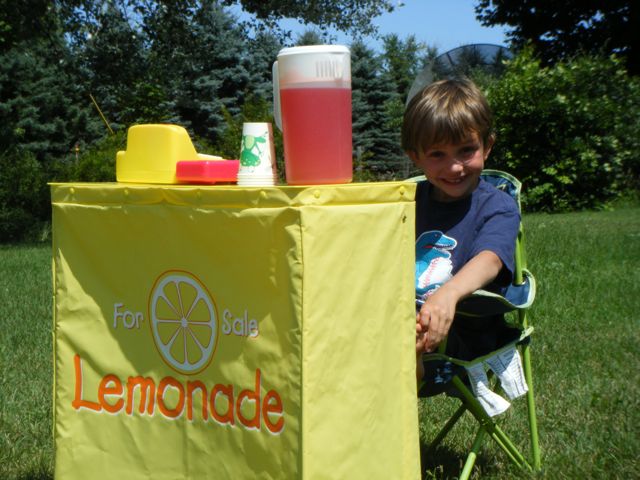
I feel that lemonade from a loosely jumbled pile of scrap lumber and twigs takes on the character of a fine vintage that you don’t find in the glossy aluminum tube frame, plastic counter top, and vinyl skirt pre-printed with “Lemonade Stand,” that my wife bought for him. She found the stand at the mall and thought it was cute. It had a little striped canopy for the first year. I always envisioned my son atop a ragged mound of wood and bent nails with a misspelled sign featuring some backwards letters, ala the Little Rascals or the Deadend Kids.
Now that the little striped canopy has broken, I like it a good deal better; I like it even more when my son sets up his plastic toy cash register on what’s left of it and mans it alongside our busy road. We live on what passes for a thoroughfare in Leelanau County, and many cars zip past our house on their way to or from Traverse City. When I say zip, what I mean to imply is that the speeds they attain make it hard for them to see, much less read the pre-printed sign. I tried to explain all this to him when he asked if we could set up his stand this year.
My son is seven years old. In his mind, hope springs eternally and his stand is just the thing for thirsty travelers to stomp on their brakes and screech to a tire-smoking halt to patronize. I helped him set up the stand and mix up a pitcher of ice-cold Kool-Aid. We scavenged whatever plastic cups we could find from our picnic baskets and camping supplies, and I gave him two dollars in quarters to make change with. He decided that 25 cents was a good rate for a glass of his finest and he took his bag chair out to the roadside to make his fortune. I watched him through the front windows of the house, took a few snapshots and worked on my, “Better luck next time speech.”
In less than 10 minutes, he had his first customer. Like a silent film, I watched him greet, inform, and make a sale to a very nice woman who parked in our driveway and beamed at his every move as he filled her order and took her money. They waved at each other as she drove away like they’d known each other for years. He tore into the house to give us a play-by-play rundown of who’d said what and how much money he’d made. She’d readily paid the price of a quarter and tipped him the rest of the dollar she’d handed him.
My wife and I smiled happily at him and he ran back out to wait for his next client. “Even a blind pig finds an acorn now and again,” I thought to myself, even as his next client pulled right onto the lawn and ordered up two or three glasses. Soon after, our neighbor came home and my son ran over and took an order for delivery from him. With the patience of a dyed in the wool salesman, he sat behind his stand for over an hour until his pitcher was empty and his cash drawer stuffed to overflowing.
He came in and tallied up his take at the dinner table and surprised his mother and I with an exponentially large number. When he asked if he could sell again the next day, I sat him down and explained that he could make a business out of it if he liked, but that we’d have to determine his costs and profits a little more scientifically. We looked at a bag of sugar to see how many pitchers it would divide into, we looked into different cup sizes to see which was more appealing to customers, we scribbled figures on paper and did math and found that at a quarter a glass, he would make about $4 per pitcher if he sold out each time. He was delighted with those odds and that week we took a trip to Meijer to purchase his inventory.
As we walked through the store, I explained that he’d have to expect some slow days and that he shouldn’t think he’d sell out each time. When we found that Kool-Aid was offering a deal — buy 20 packets and get a free five-pound bag of sugar — I knew that we were in trouble. All of our forecasting went out the window, our carefully calculated figures were based on a four-pound bag, and we never anticipated buying so much Kool-Aid. We found all the supplies he needed and he paid for them out of his initial profits.
Armed with uniform cups and an independently purchased product line, he set up his stand and met the same initial success — several customers within a short time frame. Then disaster struck; while waiting for a sale, he played a little fetch with the dog, who in a fit of playful exuberance, knocked over the stand and ruined the better part of a pitcher of Kool-Aid. My son is seven years old. His first thought was to blame me for allowing the dog outside while he was conducting business, but after his initial emotion, he said he’d try again another day.
Since then, he’s run a fairly impressive little business. His sticking power in the hot sun, in a fold up chair on the roadside astounds me. He’ll sit there by the hour; he made two pitchers one day and sold out both. He’s unfailingly polite to his clients and offered a carload of senior citizens a one-cent discount because they were “old.” He remembers his ‘please,’ ‘thank you,’ and ‘you’re welcome’s’ and on the rare occasion that a customer requests any change; he is quick with the computation.
It’s this last attribute that delights my wife. She has always worried about the road in front of our house and the speed at which people go by. Seeing these people at a high rate of speed and an agenda all their own slow to a halt and make a leisurely stop to buy a cup of wildly colored drink mix from a child renews her faith in the people of our area.
Naturally, there are some tourists who stop by, but by and large we feel that it’s mainly locals who stop off to chat with him at his prefab stand and drink a quick one before they are on their way again. All of his clientele seem genuinely delighted to take this time out. A frown or even flat expression is invariably missing from his customer base.
We are a busy family, and summer makes our schedule jump like never before, but with a few moments to spare, he’ll ask to whip up a pitcher and set up shop. I’m rarely able to turn him down.
My son is seven years old. He makes me physically shiver with frustration and, to pare it down the honest truth, rage. He can sit for hours over a pitcher of iced sugar water and perform complex math while making small talk with complete strangers, but becomes immutably deaf when asked to make his bed or pick up his room. He’ll forget a request to feed the dog between the words “feed the dog” and “please”. All day today he’s been a poster child for short attention span and willful inability to pay attention. He’s driven me to the point of threatening to remove EVERYTHING from his room except his mattress if he can’t shape up and act right. He’s made me storm from the house insanely muttering profanity to myself. I have put him in timeout, yelled, hissed, pointed menacingly at him repeatedly, and at one point stared at him in silence for minutes on end wordlessly willing him to get the point I was trying to make.
My son is seven years old. He brings out the worst in me at times. I can’t help myself but to try to explain what might happen so as to cushion blows for him. I can’t seem to stop myself from wheedling and cajoling and yelling at him to get him to behave in a way that will serve him as he deals with the rest of the world for the rest of his life. I have taken what he views as an amazing and delightful way to trade cups of Kool-Aid for actual money and broken it down into cents per serving and probable effects of weather on sales projections. I have tried to impose the “long view” on him in everything that he does. I have tried to make him see that his actions have consequences and that a little foresight will insulate him from unknown forces in the world that will act on him. I have tried to educate him and slow him down and put some barriers in the way of his impulses.
My son is seven years old. Despite my imposition, or maybe because of it, he manages to make a dollar on a cup of lemonade that he lists at 25 cents. His personality and seven year-oldness causes cars to stop and turn around. His live-in-the-now-ness and expectation that busy people will slow down long enough to buy a cup of icy cold summer from him wakes me from a restless sleep to feel remorse that I have treated him as I have. Regardless of whose good it is for, I find myself regretting trying to slow him down and act on forethought as opposed to impulse.
In writing this article, I meant, at first, to expose the “long view” and discuss how our careful planning made my son understand, and even embrace, thinking ahead. What I find is that forethought and careful planning are great things for a father. They are tremendous assets for a parent and that my son should be exposed to them as often as possible, but the truth remains: My son is seven years old. He won’t be so for much longer and if I was smart enough to carefully plan it, I would slow down and shut up and let him show me a thing or two.