John Soderholm’s accomplishments as township supervisor
What challenges lie ahead for Glen Arbor
By Linda Alice Dewey
Sun contributor
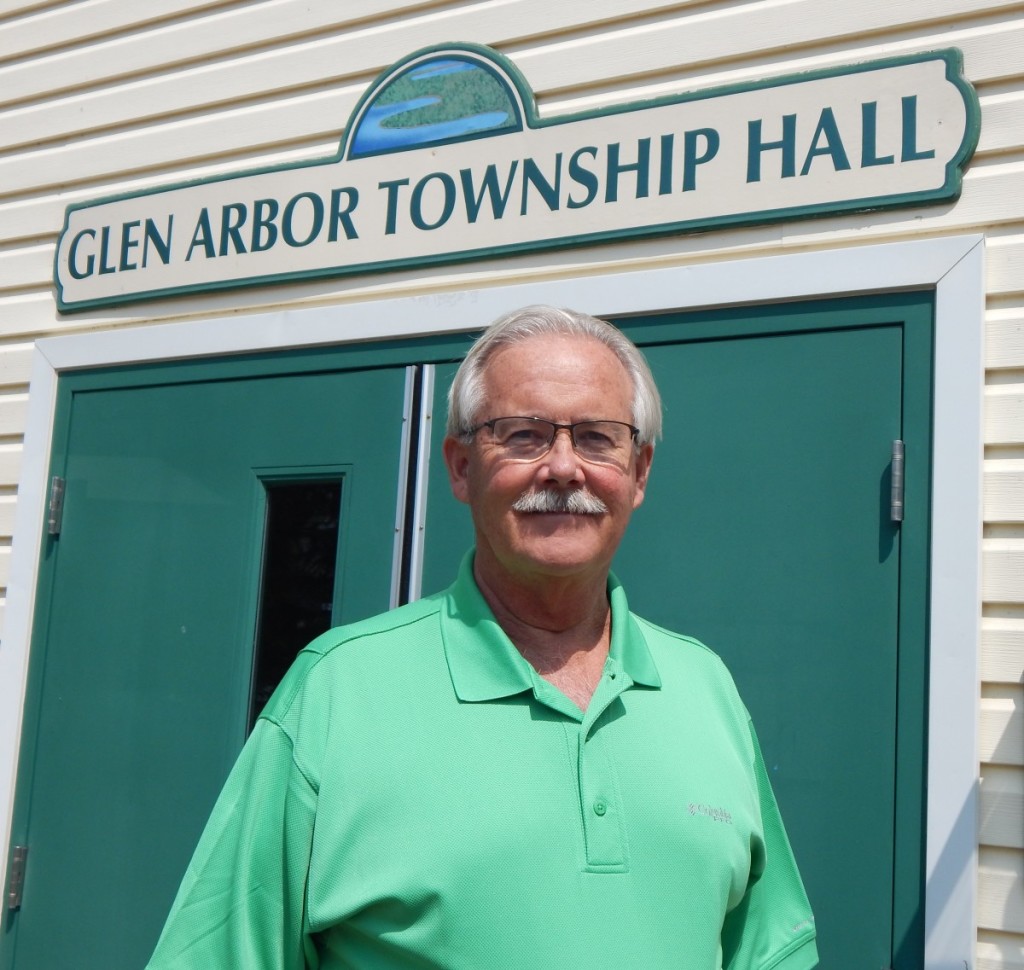
After serving as Glen Arbor’s chief executive for 16 years, township supervisor John Soderholm is stepping down for several reasons. “Sometime it gets so you need new blood in the system,” he said. For Soderholm himself, it’s a case of “service fulfilled. We accomplished a lot and there are some new challenges.” Plus, Soderholm feels he is at a point in life where time is getting short. He prefers now to focus on his personal life.
So, what are some of the accomplishments completed during his tenure? Soderholm ticks off a lengthy list.
First, Glen Arbor looks different now than it did when he came into office, primarily because of a new streetscape project which included adding curbs and sidewalks. That highly controversial project had passed by a single vote and was “floundering” when Soderholm came in, but the township successfully implemented it thereafter.
Then there was the sewer debate. “Implementation of a sewer system in Glen Arbor is dependent on the availability of vacant land,” explains Soderholm. “Since we are landlocked with the park service, no land was available. We found no significant problem existed at that time, based on [the advice of] consultants and the health department.” So the board put the project on hold.
A new fire station was built with solid support from the community and Homestead developer Bob Kuras. Both stations became equipped with a 24-hour-a-day, 7-day-a-week, staff and expanded emergency medical and paramedic programs. They added new equipment. The department combined with Empire, reducing costs significantly for both townships as well as lowering individual fire insurance premiums for homeowners. Finally, the township brought in fire chief John Dodson, whom Soderholm feels has done a superb job.
Two other areas of change include a new septic system inspection ordinance, perpetuating high water quality, and a special assessment district to pay for the dredging of the Glen Lake/Fisher Lake channel.
Another big issue involves the Leelanau County government. For years, Leelanau County had been receiving money from the federal government, known as the “payment in lieu of taxes fund.” This money filters to the state and then to the county. “At the time we became aware that the county was receiving funds, it had received about $500,000, which it kept and used for its own purposes,” he recalls. Although the county may keep the funds, Glen Arbor officials felt that the township and Empire were entitled to some of it for the fire department’s emergency services to the National Park Service. So Soderholm went to bat for the townships. The result? “We now receive 85 percent of the funds,” he says, “but each year, we have to go to the county and make sure they make that allocation.” The situation, he warns, must be continually watched.
The township had purchased a generator for the town hall and became identified as an official Red Cross shelter. During the crisis immediately following the August 2, 2015, storm Soderholm oversaw and coordinated support organizations and witnessed a tremendous outpouring to and from the community.
Soderholm is quick to point out that none of what has transpired could have been accomplished without community involvement. He credits the township board, “a long-standing group that’s provided continuity and consistency.” Add to that the volunteerism of Glen Arbor’s citizens. For Glen Arbor to operate as it does currently, “it literally takes about 40 people to be involved in the various commissions of the township.” When you consider the size of this year-round community, he maintains that it’s phenomenal. Numerous community organizations sponsor sports and cultural events, and there are community projects such as the public restroom and gardens. “A broad base of community makes Glen Arbor what it is today.”
Glen Arbor has changed in other ways since Soderholm took office. “We have [a greater number of] permanent residents,” he observes, “meaning less rental properties available and more private property developed for either part time or permanent residents.” The number of seasonal visitors has also grown tremendously, brought by media contests, newer local events and the Sleeping Bear Heritage Trail. “We’re still beginning to feel the impact of that,” he admits, referring to the latter. He sees the trail as a resource that will bring business and visitors to the town.
However, the downside of all of this, he says, is that it influences the “demand for services on our community (such as public restrooms), the [outside] tables at Arts, the Western Avenue Grill and Boonedocks.” All of that competes “with the needs of folks who have had family traditions…” in the area, making it “a little more difficult for them to enjoy [it] personally.”
Even so, Soderholm reflects, “There’s a plethora of things that we should all be proud of when we think of what’s transpired over the recent past. [For example,] the development of Woodstone has grown up before our eyes…” Also, the township’s relationship with the National Park Service has gone from adversarial to more cooperative. “That doesn’t mean that we see eye to eye with the park or that they see [everything our way],” he cautions. He credits that change to Sleeping Bear Dunes officials such as deputy superintendent Tom Ulrich and past superintendent Dusty Shultz.
So, what new challenges face the township? At the top of his list is the unionization of the fire department, with whom the township is currently in contract negotiations for the first time. Second is finding a solution for connecting the two segments of the Heritage Trail. Third, although the sewer issue is not immediate, he says, “it’s on the horizon.” Plus, continuing collaboration with the Park Service can be a challenge, making sure that both seasonal and fulltime residents are taken care of. “I don’t know the answer,” he admits, on that one. “It needs to be looked at with dignity and collaboration.”
Looking forward to his own future, Soderholm hopes “to retire with dignity, travel and enjoy my family. As you get older, time’s a little shorter.” But as he looks back over his time in office, John Soderholm is able to do so with satisfaction. “We had a lot to accomplish,” he says, “and we accomplished it…”
“We’ve had a good time.”