Glen Arbor to celebrate Tree City USA designation, May 9
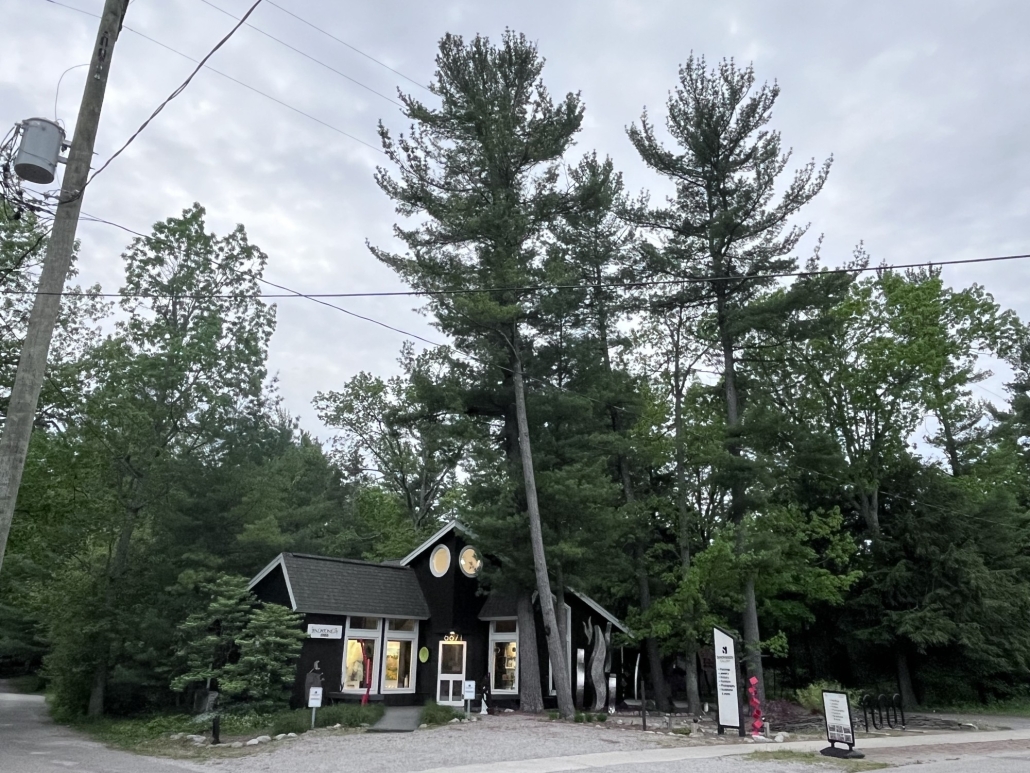
Photo: Giant white pine trees adorn Synchronicity Gallery on M-109 in Glen Arbor
By Ross Boissoneau
Sun contributor
It’s practically in the town’s name. So celebrating trees seemed like a no-brainer to Chris Sack of Glen Arbor.
Sack, the co-owner of Great Lakes Tea and Spice with his wife Heather, will be on hand at the the town’s May 9 Arbor Day Celebration, the inaugural celebration of Glen Arbor being named a Tree City USA. “We want to get this off the ground on the right foot,” says Sack.
The day will start at 10 a.m. with a tree planting ceremony at the corner of Lake Street and State Street, marking Glen Arbor’s first Arbor Day as a recognized Tree City USA community. It will be followed at 10:30 with a community “tree talk” at the Cherry Public House. Featured speakers will include a representative of Schillinger’s Tree Doctors of Northern Michigan, Nick Carlson of Carlson’s Tree Service, and Ellie Johnson, CCF Outreach Forester with the Michigan Forest Association.
Sack, a member of Glen Arbor Beautification, says this is a way to continue to trumpet the ecological importance of trees. Glen Arbor earned the Tree City USA designation from the Arbor Day Foundation in February, becoming the latest in a line of Michigan communities to achieve national recognition for its commitment to urban forestry. Northport, Frankfort and Traverse City are already designated Tree City USA communities, and to Sack it only made sense for Glen Arbor to gain that same designation. “Glen Arbor is called Glen Arbor for a reason,” he says.
Sack says one of the goals of both Glen Arbor Beautification and the Tree City USA designation is to help everyone realize the benefits of trees and to take care of them. That includes avoiding any unnecessary removal of trees. “Development in town is a foregone conclusion, but it doesn’t have to include taking down all the trees,” he says.
Trees play several crucial roles, according to the National Arbor Foundation. They clean the air, filter water, slow storm surge and flooding, provide habitat for wildlife, connect communities, provide shade and cool, and support our health and well-being. Trees emit volatile substances called phytoncides that increase the number of the body’s natural killer cells, according to the National Library of Medicine, which significantly boost human immune function and fight cancer and viruses.
The largest and oldest trees have a special role in the environment and a special place in Sack’s heart. “They have a critical value to the next generation,” he says, pointing to seedlings developed from the “mother trees.” “They provide homes for animals. They’re the most natural carbon sink. They take carbon from the air – trees are 70 percent carbon. They’re way more valuable than just for board feet or firewood.”
Sack says he first became interested in trees while in college and working for a downstate landscaping business in the summer. He eventually became a tree-planting specialist. He moved to Glen Arbor 26 years ago in part due to the area’s lushness and biodiversity.
He’s happy to talk at length about trees. He mentions the Black Willows cloned by Glen Lake students from a championship tree, courtesy Archangel Ancient Tree Archive. “The oldest and biggest Black Willow in the state of Michigan. They actually suck up harmful chemical toxins and hold or convert them so they don’t leach out into water.
“My favorite? Hemlocks provide a wonderful natural screen at our house. The Beech were one of my favorites. They look like elephant feet and legs. They provide amazing homes for porcupines. Now they’re gone,” he says, pointing to invasive insects and diseases, which kill them and other species. Weakened trees are then more susceptible to wind.
Sack says trees play such an important role in the environment that saving even one or two from construction sites is worth the effort. “For 26 years I didn’t do enough,” he says. He’s trying to rectify that any way he can, from Glen Arbor Beautification to talking with elected officials in Washington, which he did early this month.
Hence the May 9 tree talk. Topics will include the ecological and aesthetic value of mature trees, best practices for tree health, how to assess tree health and when to prune and the environmental impact of clear-cutting. It is free of charge and open to residents, business owners and visitors. The first 75 guests will each receive a seedling tree. For more information, email info@gabeautification.org.