“Brutal work” shoveling sand. Goodbye, Pierce Stocking overlook

From staff reports
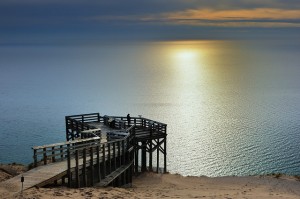 Millions of visitors to Sleeping Bear Dunes National Lakeshore remember the iconic wooden viewing platform a short walk from the Pierce Stocking Scenic Drive stop #9, which was removed by Park staff last month after shifting sands eroded the platform’s support.
Thousands have taken photos since the full platform was installed in 1986. Some ran down the steep cliff toward Lake Michigan. A few couldn’t get back up and paid hefty fines to be rescued by rangers and first responders.
Tom Mountz, a former maintenance worker who retired from Sleeping Bear Dunes in 2018 after 43 years on the job, remembers shoveling sand. Lots of sand.
After stop #9 on the scenic drive was completed, seasonal staff at the Park built a boardwalk between 150-200 feet long from the parking lot that included a couple small overlooks. The walk had steps in places to get pedestrians over the sand knolls. “It was called ‘Stairway to the Stars’,” said Mountz.
“Several times a week, first thing in the morning, a crew of four-six of us needed to shovel the boardwalk to #9. From a few inches of sand to a foot or more. Brutal work. But we were all 25-30 years old. Eventually a new, improved boardwalk was built and properly sized so a tractor could remove 90 percent of the sand.”
Another retired Sleeping Bear employee Pete LaValley recalled a long discussion about whether or not the road should come through the dunes and right to the overlook. Ultimately, the Park decided to close the road and create the footpath that exists today.
Every winter and spring the sand would cover the boardwalk again.
“A couple winters it blew in so much that the sidewalk was covered by an actual dune you had to scramble up to reach the overlook,” LaValley said.
At one point, he added, the Park floated the idea of digging a walk-through tunnel under the sand so that people could access the overlook platform without needing to blow sand every spring. But the expensive idea seemed outlandish to the public, and it went nowhere.
Viewing platforms already existed at the overlook when the Park completed the scenic drive in the mid-‘80s. The original platforms were built by Pierce Stocking, who owned the land prior to President Nixon signing Sleeping Bear Dunes into existence in 1970.
According to his daughter Kathleen Stocking, a local writer and historian, “he built the original viewing platform(s)—and everything else—not with his own two hands, or not only his two hands, many hands. He had a crew.
“They had fun. There was a sense of loving being alive. The sun. The blue sky. When the roads were in and the hang-glider guys came from Detroit and launched out over the lake, my dad and the other men would watch, amazed, sometimes grinning, with a kind of pride in living joyfully, if sometimes dangerously.
“His deep and abiding love of the land, of natural beauty, he wanted to share it.”
Bill Herd, an interpretive ranger for Sleeping Bear Dunes for more than 30 years, remembered there were two viewing platforms when the Park took over the scenic drive, including one overlooking North Bar Lake which they removed and did not replace.
The Park worked with a contractor who reinforced Pierce Stocking’s original platform that overlooked Lake Michigan. According to Herd, the crew had quite a time driving pilings 10 feet or more into the cliff because the sand holes kept filling up and they kept hitting large rocks and struggled to get traction while working on the steep slope. The posts had to be driven deep enough into the hillside that it could hold the platform.
“There was an idea to simply remove the old one and not replace it, but they did (keep) the original platform and soon had to build the upper section after the sand blew in behind the first deck and made it difficult to get to,” said Herd. “Then they had to (add) that sloped ramp to allow people to access the upper level.”
It’s lucky the Park decided to keep Stocking’s original platform, Herd said, because that overlook has inspired thousands of photos.
“Plus, it directed people to a good spot to view the beach without them accidentally going way down the bluff—probably avoiding thousands of difficult situations with people and kids struggling to make it back up,” said Herd. “The overlook was a safe way to get photos and keep your kids from galloping 350 feet down the cliff.”
For 40 years, visitors flocked to the overlook platform to take photos and stare and the mesmerizing blue lake below. But these dunes have been active systems for millennia, shifting with the weather.
When National Park Service staff arrived at the platform this spring, which rests on the dune some 450 feet above the lake, they found some of its pilings were no longer touching the ground. Winter storms, wind and rain had eroded the sand underneath.
“The western portion of that overlook was freestanding. It was free-hanging. The sand had moved on,” said Scott Tucker, superintendent of Sleeping Bear Dunes.
Now it’s gone.
“The dunes are inexorable,” said former deputy superintendent Tom Ulrich. “They will move, and you cannot stop them from moving, and you’re foolish if you think you can.”
After the Park posted the news of its dismantling on Facebook on May 22, hundreds commented on what the overlook had meant to them. People shared stories and memories of past visits, from engagements to shared moments with loved ones who have passed away.
Dan Herd and Interlochen Public Radio’s Izzy Ross contributed to this report. Herd is a former Park employee. Ross’s reporting is made possible through a partnership between IPR and Grist.