
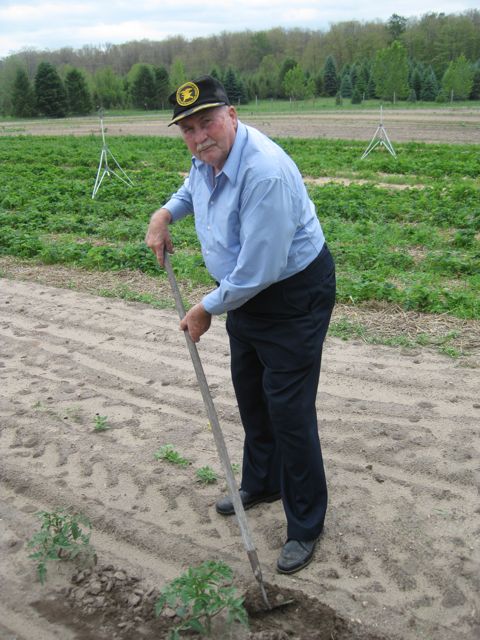
With a hoe in his hand
 By F. Josephine Arrowood
Sun contributor
On a bright June afternoon, a first glimpse of Irwin “Irv” Beck, Jr. reveals the 82-year-old sailing along on his red Farm-all tractor, as proud as a mariner, through the furrowed expanse of his 10 acres in Empire Twp. It’s the middle of strawberry season, and Irv is taking a break from harvesting the juicy fruits to tend the pumpkin crop and keep a weather eye on the rest of his farm.
“They say I was born with a hoe in my hand,” the octogenarian laughs. “I’ve been 62 years farming. I guess it’s in my blood.”
His grandfather, August Beck, was a German immigrant who arrived on South Manitou Island via Chicago in the latter half of the 19th century. He married 15-year-old Elizabeth Haas, daughter of a Coast Guardsman stationed in nearby Frankfort. The young pioneer couple settled on the island to work their 40 acres: raising a family of six children, clearing timber, planting orchards and other crops, and building a sturdy farmhouse. Now a part of the Sleeping Bear Dunes National Lakeshore, the house and several outbuildings were lovingly restored by the Manitou Islands Memorial Society, a local heritage preservation group, with help from the National Park Service.
As some of their neighbors left South Manitou for work elsewhere, the Becks acquired 160 acres, but times were changing quickly with the turn of the new century. Old sailing schooners were replaced by larger, more technologically advanced steam-driven ships. Once the limited virgin forests were lumbered, these big boats had less reason to stop to ship out the islanders’ market goods, and to bring in supplies from the mainland. And even with their large homestead, the Becks’ adult children found work opportunities too limited.
By the time of the First World War, August’s son Irwin, Sr. had left the family farm to seek his living. Although he had put a down payment on a Wisconsin farm, the deal fell through when he was drafted. Due to a bad hip, he never served in the military, and eventually returned to Empire. He and his wife Lulu bought the Tweddle farm south of the village in 1925, and their third child Irwin, Jr. was born in October 1927. At various times, his father also owned acreage on Norconk Rd, and near the village.
Irv says, “My dad was a general farmer; he raised corn, rye, beans, buckwheat, potatoes and squash. The squash was for pig feed in the winter. He had beef cows, strawberries and raspberries, too. He lived to be 101 years old; his sisters were 103 and 105!”
“I can remember having a team of horses, a nice pair of Belgians, pretty well-matched. He had a pair of black-and-whites, I loved to drag [cultivate the fields] with them.”
He goes on, “They didn’t have all this fancy stuff years ago. Big families — how’d they survive? My dad always said, ‘Beans, potatoes, and meat — you could live on that.’ I used to pick cherries for the Clagetts, apples, too. I had to buy my own clothes with that. With my outfits, kids used to think our family was rich!”
Irv recalls attending the old Tweddle School, still located on the corner of present-day M-22 and Stormer Rd. “You started out with a three-month school year, then it got to be five months, then eight months,” he explained, accommodating the needs of farm families’ planting and harvesting schedules.
“We went there until sixth grade, then over to the big school in Empire. We walked a mile, mile-and-a-half to school there. In summer, you could walk across the fields; in winter, you had to go by the roads. We had Ben Roen for a teacher,” he remembers, referring to a son of the famous Roen Saloon owner, whose beautifully restored bar can be seen today as a centerpiece of the Empire Area Historical Museum.
At the close of World War Two, Irv enlisted in the Army, serving with the second occupation forces in Japan in 1946.
“I’d had chemistry at Empire School, but hadn’t thought much of it. After Camp Polk, La., I shipped out to San Francisco, training as a medic. In Tokyo, I was a lab technician in a hospital; [I] took blood, gave shots, learned it all.”
One day, he knocked on the door of a hospital room. “A little voice said, ‘Come in,’” and the young medic beheld a large screen, only partially obscuring a flame-haired lady patient receiving her morning bath from an assistant. Lillian Raiford, from Little Rock, Ark., was working at General MacArthur’s Eighth Army headquarters, and had broken her wrist in a fall. Irv was smitten hard by the vision of the bathing beauty, but after she was discharged from the hospital five days later, he didn’t know how to contact her.
“I was going into Tokyo to play basketball, and here comes a woman with red hair, a green coat and hat with feathers in it. She said, ‘Want a ride in a staff car?’ We had hamburgers for 25 cents and Cokes for a nickel!”
When the couple became engaged, Lillian commissioned a wedding dress, veil and flowers, all hand-made from yards of creamy Japanese silk. The cost? “Twelve dollars!” Irv chortles. “It’s over in the museum now in Empire. She wore it for our 50th anniversary!” They decided to marry in the States to avoid international bureaucratic entanglements that would have included three separate ceremonies, and they wed in Little Rock in 1947.
He says, “It took 17 days on the boat coming to San Francisco. We could see each other, walk the ship, see a movie, but at the end of the day, we had to part! That was our ‘honeymoon’ — before the wedding — all we could see was water!”
Back in Michigan, he went to agriculture school in Traverse City, a half-day per week in the winter that was paid for by the GI Bill, and worked with his father on the family land. He and Lillian had four children: Ellis, Judy, Vicki and Keith. He also found a job as a farm equipment mechanic for Jim Johnson’s Case Farm Machinery, then situated around the corner from the Empire Bank.
“He was like another father to me,” Irv recalls of Johnson. “I did sales, repairs, manager, truck driver. I’d see him in the morning; he’d give me a list. There were three-four of us, and I [eventually] was the boss of the deal. When I had worked for him for 25 years, he gave me a brand-new, 1973 green Pontiac. That was better than a watch!”
Irv and Lillian acquired the old Tweddle farm, and they turned part of the large, 12-room farmhouse into a display area for their growing collection of pink Depression-era glass and antique phonographs. (His first purchase, won in a bidding duel with Dave Taghon at the Roen estate auction — now immortalized in writer Anne-Marie Oomen’s 2009 drama, Whaddaya Give? — is an Edison cylinder model with wooden listening horn from the Roen Saloon. It now sits on the restored bar, after Irv donated it to the museum last year.) Lillian researched, wrote, and illustrated several books about Empire and Manitou Islands history, and the pair continued to tend the land, harvesting sweet corn, pumpkins and berries.
When the Sleeping Bear Dunes National Lakeshore was created, the Becks reluctantly sold their farm to the government and bought 10 acres on Stormer Rd in 1976. They started farming all over again, planting 1,000 strawberry plants, over an acre of raspberries, as well as rhubarb and pumpkins. Although his beloved Lillian died in 2008, the farmer carries on his love affair with the land that has given back such abundance over the years, helped by daughter Vicki and a small cadre of neighborly teen helpers.
He laments the small strawberry crop this year, damaged by late frosts, but he brightens quickly as he looks ahead. He casts shrewd blue eyes over his tidy fields. “We’re going to have some good, early raspberries this year!”
“Farmers are the biggest gamblers in the world. Seems like it’s in your blood. You say, ‘Maybe this’ll be my last year.’” He laughs. “In spring, here comes equipment, here we go again! That hoe again! But it didn’t hurt me. I like to have the nicest stuff, and I’m proud of what I sell.”