“What does the future hold? It holds us”
Photos by Grace Johnson
By Kathleen Stocking
Sun contributor
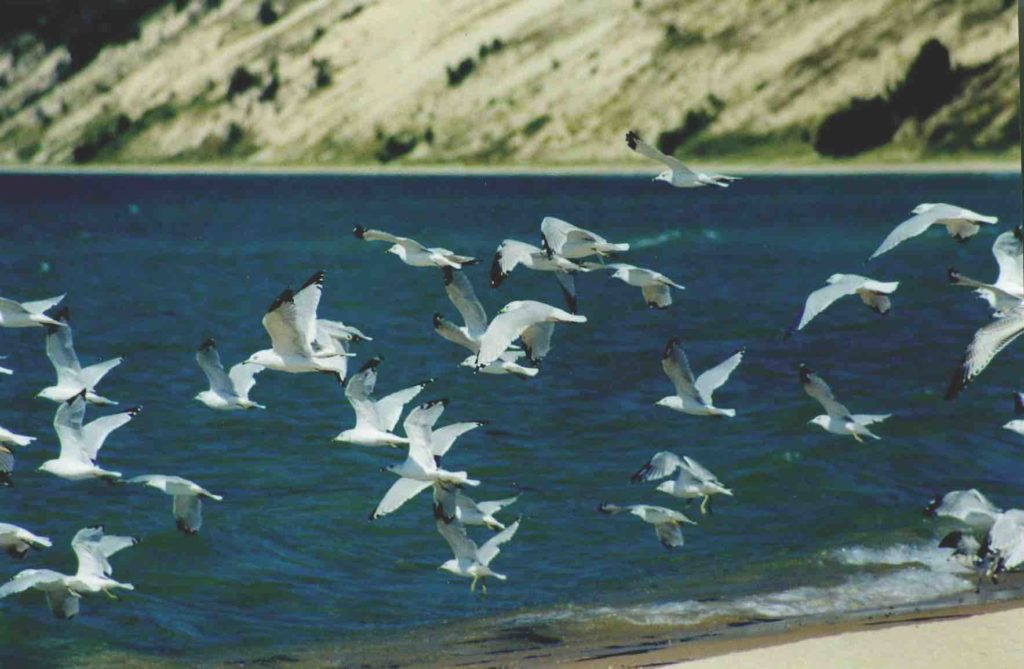
It’s July 2020, but in my mind it’s late summer, August 2019, out on South Fox Island. I’m lying on my back in the lacey shade of towering maples. Dunes range up the hill behind my head, as soft-looking as caramel-sweetened whipped cream. Every island is a tiny earth and South Fox Island, lapped by the rhythmic turquoise-and-indigo waters of Lake Michigan, may be one of the tiniest.
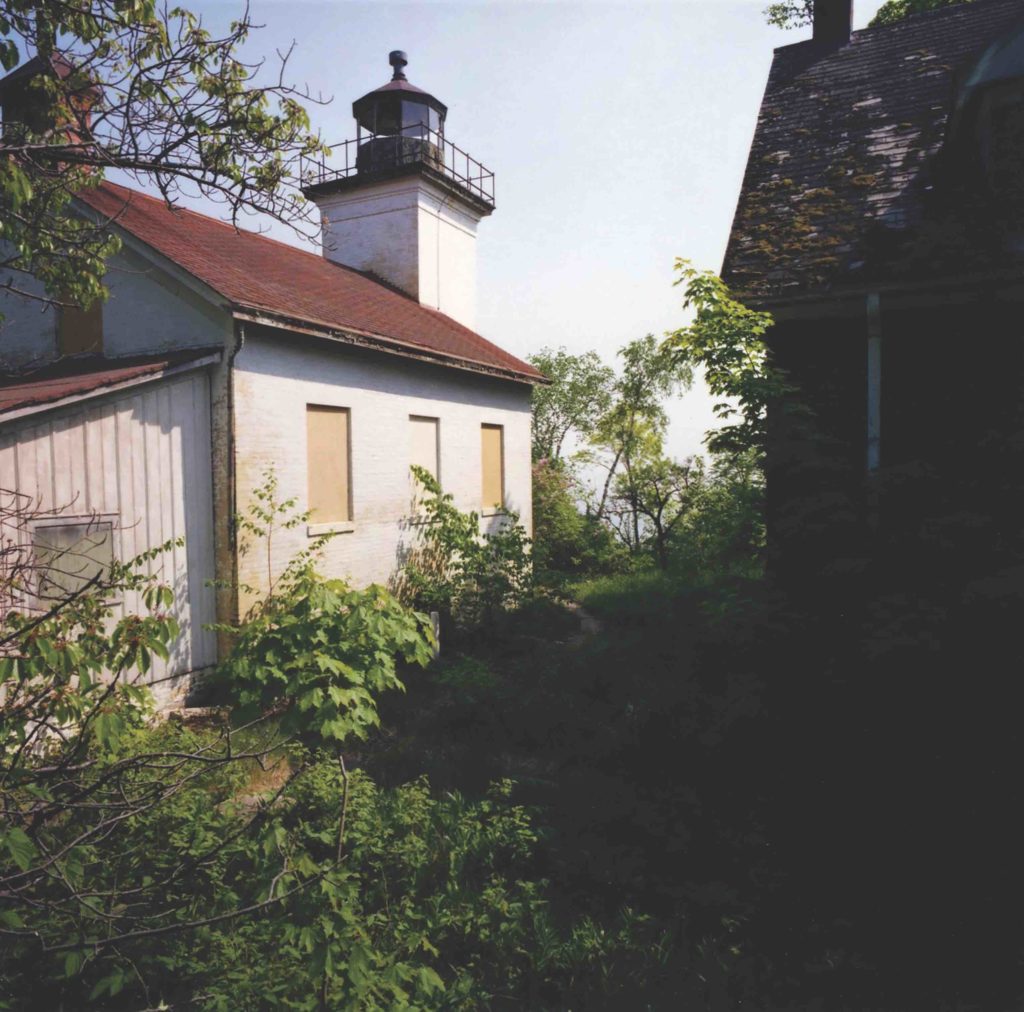
Around me volunteers work to restore the 1867 lighthouse. The volunteers are a random assortment of humanity, people who love water and islands and making things better. There’s the retired pharmacologist, Phil von Voightlander, cleaning the boathouse, who that morning on the way over had explained to me the curvature of the earth. The captain of the boat, a retired oral surgeon, Joerg Rothenberger, an inventor and polymath from Switzerland, is measuring the depth of the water in the shoals around the island with high tech equipment. A graphic artist, Cathy Allchin, is helping Andy Thomas, a woodworker, install a giant door, twice the size of both of them, on the lighthouse. There’s a Smithsonian bee scientist, David Roubik, fresh from his work in Panama, off in the bushes somewhere exploring the island’s insect population.
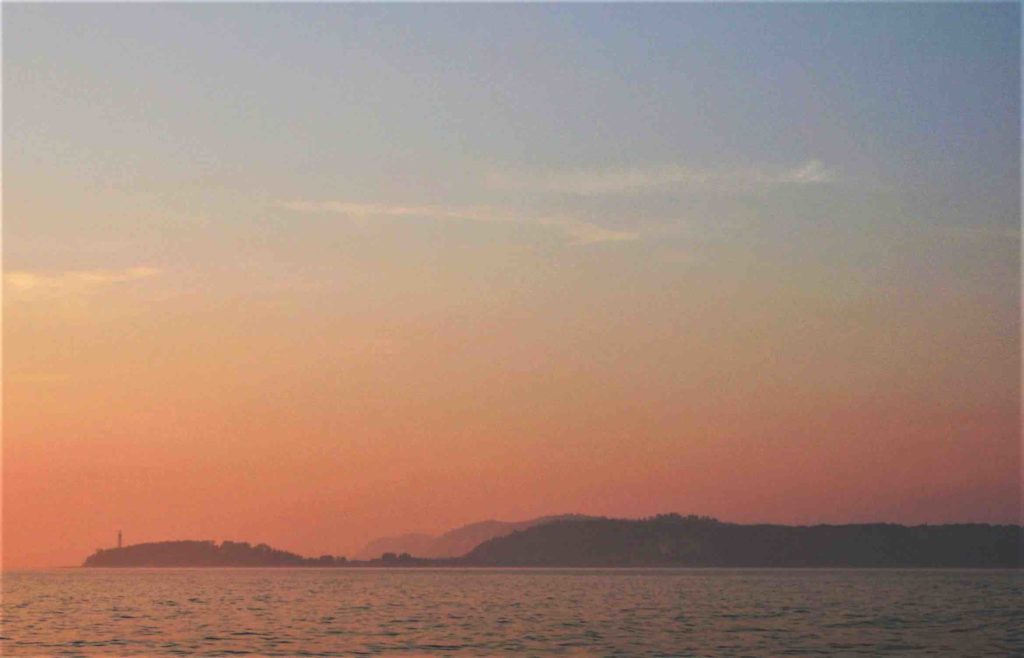
South Fox Island isn’t easy to get to. For years there was no boat. Eventually some local people found a commercial fishing boat and started to restore the lighthouse. In 2004 they formed the Fox Island Lighthouse Association (FILA). The lighthouse was necessary when the shoals around the island were not something one could check out with a depth finder. Many lives were saved by lighthouse keepers and their crews.
The storm of November 28, 1905 took down the ship Vega, the desperate sailors rescued by Native Americans living on South Fox. The last names of some of the Native people were Cobb, Raphael, Ance, and Southbird. The lighthouse keeper Louis Bourisseau and his wife, Susan, appointed to the lighthouse in 1891, and there during the wreck of the Vega, were mixed Native American and French from Canada.
There are dangerous shoals all around South Fox Island, shoals you can see on the navigation charts, shoals that extend out into the water toward the west for some distance. At various times when the water levels in the lake have been especially low, the shoals caused shipwrecks. The reason for the shoals is that the ancient glaciers carved the land, melted and receded and surged back in again, and some of the land they carved is just below the surface of the water. “It’s a wild landscape under the water,” Rothenberger says, “mountains, ravines, plateaus, hills.”
Thinking about the hills and valleys under the water makes me extrapolate to the hills and valleys of my thoughts, the topography of my mind. We are living in the time of the coronavirus pandemic, a time of wild juxtapositions of one reality and another, where we’re too acutely aware of the fragility of existence, a time of wooziness, of cognitive dissonance, when the surface is one thing, but what lies beneath is another.
There was no Cherry Festival in Traverse City this year, there will be no Bliss Fest in Cross Village this August, and no Leelanau Uncaged in the streets of Northport at the end of September. The entire world is upside down. We’re in the midst of a plague. Over 150,000 people have died in America and several times that worldwide, and more predicted. My daughter is an end-of-life care nurse in Connecticut with coronavirus patients. She has had the virus and survived and is back at work in her hospital, her businessman husband working from home to take care of their children. These are the ordinary people, the unsung heroes: the factory workers in Pennsylvania working around the clock, sleeping on the floor of the factory, to make protective gear for first responders; the “far-flung collaboration of scientists, engineers, entrepreneurs” cited in The New York Times, who figured out almost overnight how to make and mass produce ventilators.
Charts of the land beneath the water give a hint of what the place looked like after the last glacier started to recede 12,000 years ago. Geological survey maps reveal the coast between Charlevoix and Elk Rapids to have been once connected by a land bridge that goes all the way out to the Beaver island Archipelago. South Fox Island is one of the islands in that chain of islands. That land bridge is still there under the waves. “There’s a place between Beaver Island and North Fox,” Rothenberger says, “where the water is 10-20 feet deep. You can drop anchor and stay out there, right in the middle of the lake.”
South Fox Island is basically sand with a furze of trees and bushes. Rothengerber had told me that when the lighthouse was first built there were no trees or bushes around it. The wind often blew the sand “into the cooking pot,” he said and old photos show snow-fencing around the lighthouse to prevent the sand from finding its way into the keeper’s living quarters. I imagine life on the island was lonely, but on the day I’m there it is so gorgeous, and so deeply peaceful, there is nothing more to want in this world but to be there.
The soft and unscarred beauty of the land makes me think about the Native families who must have fished off the island for untold millennia. There’s no place in America that one isn’t aware of “the original people,” as they called themselves, the Anishinaabe. They would have been here with their bark canoes put together with split roots of black spruce, the Great Lakes as their highway and the shores as their living room.
Kathleen Nickerson Firestone has written an excellent history, “They Came to South Fox,” about the island. Her grandfather started a logging operation on the island in the 1950s. As a child, Firestone stayed on the island in the summer occasionally for a week or two at a time. “I still remember waking up on that island. Just the birds. The singing. Everything seemed bigger: the lady slippers, the wild strawberries, the orange wood lilies.” And the greater size of things was no illusion. One family of farmers grew potatoes on South Fox and the potatoes were so big no one would buy them. Three potatoes filled a five-gallon bucket, according to one account in Firestone’s book. “Wild roses perfumed the air,” Firestone says as we talk in Bayside Coffee and Tea in Suttons Bay. “The stars. The night sky was so bright with stars.” Firestone’s father, Sterling Nickerson, and her cousin, Glen Roop, both drowned in 1959, when a storm came up when they trying to bring a boat and supplies from Wisconsin. They were experienced with both boats and storms but ran into trouble.
Life on a small island, away from mainland food supplies, was never easy. “The winter of 1923 was an especially long one,” Firestone writes in her book. “Supplies were getting low at the Zapf logging camp. Near the end of March, some of the employees started across the ice but were forced back to the island by drifting ice and open water. About a month later … when things were even more desperate, three men spent three harrowing days making their way across 22 miles to the mainland … in a small skiff, carrying a pair of oars, an axe and a pole.” The ice destroyed their skiff; late in the night the wind came up and the trio was forced to jump from ice floe to ice floe. Luckily the wind blew them to the shore of the Leelanau Peninsula the next morning.
My mind rachets up and down, back and forth through the eons. One minute I’m thinking about the pandemic and the next about the beauty of the island. I remember my own growing up on Sleeping Bear Bay, before cell phones, before the Internet, before hand sanitizer. It amazes me that I could have lived through so many changes. If I went back 70 years, would I still be able to live in those times? Or back even farther, 150 years, to my grandmother’s time? I think, yes, I would. We adjust. And the men who jumped from ice floe to ice floe in 1923 were probably better able to actually jump from ice floe to ice floe than I am to try to imagine it, because they were, as we all are, as all humans are, adjusted to their times.
The work of saving lives is ongoing on South Fox Island, albeit maybe not with something as direct and succinct a purpose as a lighthouse. The bee scientist, David Roubik, from the Smithsonian knows the habitats of the world are all connected by bees and butterflies and birds. The woodworker, Andy Thomas, a man who remembers falling in love with the sound of his wife’s voice before he saw her, and who brought the essence of the April Fair, Feria de Aprille, in Andalusia, Spain, home to Northport as the fall festival, Leelanau Uncaged, says the community socializing at the Feria de Aprille was so uplifting and real that his only thought was, “I want to be right here, right now.” Thomas says everything he does, the lighthouse door, the street fair, wells up from a love of community, a love of his wife, his family, a love of music, food and people, all rolled together.
My eyes are half-closed because all around me is the little-flashing-mirrors lake light. I’m looking at some orange leaves on the maple trees, vaguely thinking fall has come early. The blurry orange leaves, seen through my eyelash veil, are fluttering slightly in a soft breeze. It’s not until I see a piece of orange and black glide down on an air current, that I know that it’s not a leaf but a butterfly.
I sit up slowly. I’m surrounded by butterflies. They are in the trees. They are in the air. They are on the low-lying bushes and wild asters. Monarch butterflies. They are migrating, a million little delicate fluttering pieces of life, resting before heading out over the lake to the mainland. Rothenberger comes by and when I remark on the butterflies, tells me that when he and his wife, writer Sandra Bradshaw, a founding member of FILA, were courting many years earlier, they camped overnight on the island and awoke to orange trees.
Monarchs migrate 3,000 miles at about three miles an hour, about the pace of a jogger. They don’t all survive. There are high winds, rain, snow, pesticides, helicopter propellers. Some go to the mountains of Michoacan, to ancient majestic forests northwest of Mexico City, where two scientists were recently murdered, presumably by people taking out the trees. The flight of the butterflies was miraculous forever, and now, like the evolution and existence of human beings, too, it’s becoming more and more fraught with difficulties. I think about human evolution. I think about how as small babies in the womb we all have gills like fish, and later still in the womb, tailbones like monkeys, and how, once born, we first learn to crawl, then walk, then run, every stage of a person’s life a replica of the millions of years of evolution. I find comfort in taking the long view, in thinking the endless cycles of life and death, loss and renewal, destruction and restoration, are all part of the rhythms of evolution.
What does the future hold? It holds us. The spirit of helping and caring for one’s community, alive on South Fox Island, exists in us, in the human genome. We are the people and we will not quit. Like the Monarch butterflies journeying thousands of miles through possible storms, to a place that may have no trees for them to rest in, we are not quitting. We are the people and we will do as much as we can for as long as we can, whether with making ventilators, sleeping on the factory floor to make protective gear, creating street festivals to share joy, or restoring lighthouses to honor the past. We are here and we are not going away, not anytime soon.