From cherries to lavender: a Leelanau grower adapts to change
By Linda Alice Dewey
Sun contributor
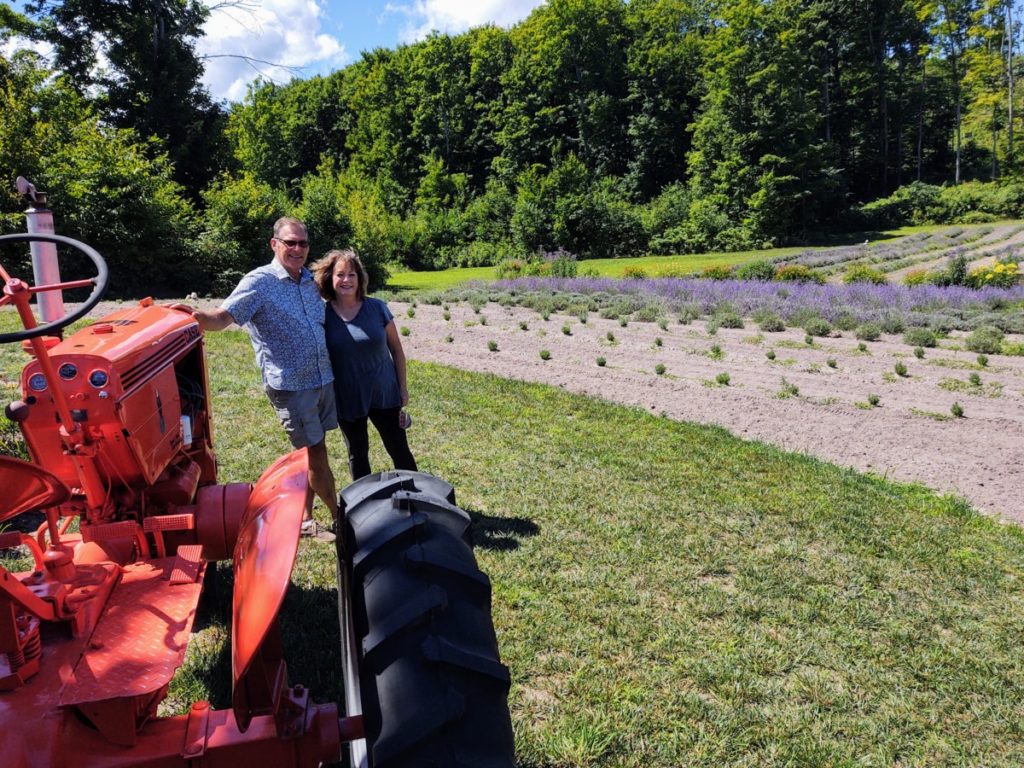
Mike and Mary Shimek have transformed their farm near Maple City from forests and cherry orchards into rolling meadows covered in swirls of lavender and dotted with lilies. We spoke with Mike the last week in July at their “Bohemian Lavender Farm” about their move from cherries into lavender.
Glen Arbor Sun: First of all, what you’ve got here is just spectacular. What prompted you to make this change?
Mike Shimek: We’ve had cherries for over 100 years, and my father, Joe Shimek, was in charge of our cherry orchard. He got older, and he got sick, and we had to put him in a nursing home five years ago. We sort of knew that the end was near for our cherry orchard at that time.
Sun: How did you know that?
Shimek: Our trees were pretty mature, and the price of cherries had dropped so far, that the break-even point for our cherries [was] way below in what we were getting.
Sun: What caused that?
Shimek: I say it’s over-production in our county here. There’s too many cherries. Also, the processors who make things out of cherries, like dried cherries, now have their own orchards, and before they didn’t. So they don’t need the little guy anymore…
[W]e knew we needed to get out. The pesticides, we were just spraying more and more.
Sun: Why is that?
Shimek: We’ve got this new fruit fly – the spotted winged fruit fly, and it’s really hard to kill. Last year, we sprayed twice as much as we had the previous year…We really don’t want to be spraying anything, using any poisons, anymore.
Sun: Was it sad to realize that the cherry industry is changing?
Shimek: I spent my whole life in cherries. There was never a sad part of getting out of it, because, after the last thirty years, my heart really wasn’t in it.
My parents made a really good living in cherries. Back in the 70s and 80s, they did really well, because there was a good demand, and the price was high. We had good crops.
Sun: Do you know other cherry growers that are…
Shimek: Oh, yeah. There’s a lot of them getting out right now. But it’s hard. We just sold the last of our equipment….It’s not like anybody else can use that stuff, so it’s hard to liquidate your machinery, because nobody’s going into it. There’s no young people starting cherry orchards. There’s no money in it. [T]here’s a lot of new orchards, but those are the people that own all the processing equipment.
Sun: Like Cherry Republic?
Shimek: They have one tree. They buy everything. They’re not a producer. They’re a customer of the cherries…
Sun: What about cherries from Washington? They always come in before the cherries here. Is that competition?
Shimek: We don’t have a big fresh pick market, because that requires, like, migrant workers to pick them by hand. We don’t have that kind of market, and we don’t have those kinds of employees here.
Sun: We used to.
Shimek: Yeah, we used to house them here. But the State of Washington, they do. That’s all picked by hand, like with scissors. We don’t have the labor to do that.
Sun: So why don’t we have the migrant workers that we used to?
Shimek: Because they can get a job somewhere else. Grapes have picked up a lot of those people, and grapes are something that you have to work every day, all season long…Cherry picking was a month or less. They would start with strawberries and go to cherries, then go to apples, then go back [home].
Sun: When did you decide to make the change?
Shimek: About seven years ago…My wife and I were both business teachers. [W]e knew how to set up a business. I retired at that time…So, we researched for a year the best business to go into for a small farm, and lavender was at the top of every survey we ever did. Lavender grows well…anywhere in the world if you’re at this same latitude.
Sun: Kind of like grapes?
Shimek: Yeah. You’ve gotta be near a large body of water, this type of a climate, sandy soil. So we had everything that it needed…[A]fter visiting a few farms, we started out small and got into it…
Sun: How many maples did you take out?
Shimek: Between four and five hundred…That was six years ago…[W]e didn’t have land to build a lavender farm on…, so we had to clear our own land.
Sun: Did you have a landscaper?
Shimek: No, I did it all…I was in the master gardening program at Michigan State, so I worked with a lot of gardens before I started this.
Five years ago, we bought 300 plants from Canada, and those were our first plants. We lost some of those plants because we didn’t know what we were doing. [See more on growing lavender LINK to sidebar]
Sun: How many cherry trees did you take out?
Shimek: We took out about 40 acres this spring.
Sun: Is your lavender organic?
Shimek: Yeah. We never water; we never fertilize it; we never spray it with anything…So, it’s 100% organic.
Sun: And your plan is to have how much?
Shimek: A quarter mile of lavender.
Sun: And what will you do with the lavender?
Shimek: The largest chunk of it now will all go into oil. I distilled last year for the first time, so I have French oil, which I’m almost out of. Next year, I’ll have both English and French lavender oil available.
When I distill, I get oil and water. Hydrosol is the flower water. I sold ten cases of it this summer so far…It’s like an essential water. Essential water and essential oil are both very popular now.
…[T]his fall, I’ll be building another barn up by the road, like this, and that will have our distillery and our candle-making in it. We do sell thousands of candles every year, too…
Sun: How old is this barn?
Shimek: The barn was built three years ago with lumber from our family barn that had fallen in. The original barn had been built in the early 1900’s with the money my grandmother had saved from being a maid in Chicago before she got married to my grandfather.
Sun: How are you doing financially?
Shimek: [The farm has been open for two years. They sell incense, sachets, sewn heating pads for the neck or pillows, baked goods, candles and bundles of lavender.]
Well, this year, …the number of people coming through has probably quadrupled, and our sales have easily quadrupled. We can’t keep up with production. Next year, we’ll start in the fall, we’ll build our inventory up, …especially like sewing goods, candles, stuff like that.
Sun: Do you do all that yourselves?
Shimek: Mary and I make everything. My son and my daughter-in-law…make the jams…
Sun: Tell me about the name, “Bohemian Lavender Farm.”
Shimek: We’ve been on this property since the late 1880s…[F]rom our property to Lake Michigan is called “The Bohemian Settlement.” That’s people who came from Czechoslovakia, Czech people, who settled that land. They were all friends or related or family. I am Czech. Our families came from Bohemia.
…We wanted to have something that looked like it came out of the old country.
The beautiful Bohemian Lavender Farm is open daily until mid-August, 10-4, and from 10-2 Sundays. They offer U-pick as well as the products above and also sell new plants beginning Memorial Day until they are gone. 8181 S Shimek Road, Maple City. bohemianlavenderfarm@gmail.com (989) 627-3125