What do visiting Danes think of the Sleeping Bear?
By Norm Wheeler
Sun editor
In the spring of 1978, just after our son Jacob was born, Mimi and I started a commune in a big white closed down dairy in Vegger, Denmark, with two other couples. The village storks stood atop our chimney every summer. Our daughter Julia was born when we lived there. Birthe and Anders Munksgaard also had a toddler, Iben. The other couple in our shared dairy, Else and Jens, was soon to have a child as well. We renovated the beautiful old building to fit three young families, shared the living and dining rooms, took turns cooking for all of us in the shared kitchen, concocted homemade aquavit, and settled into the community for two years.
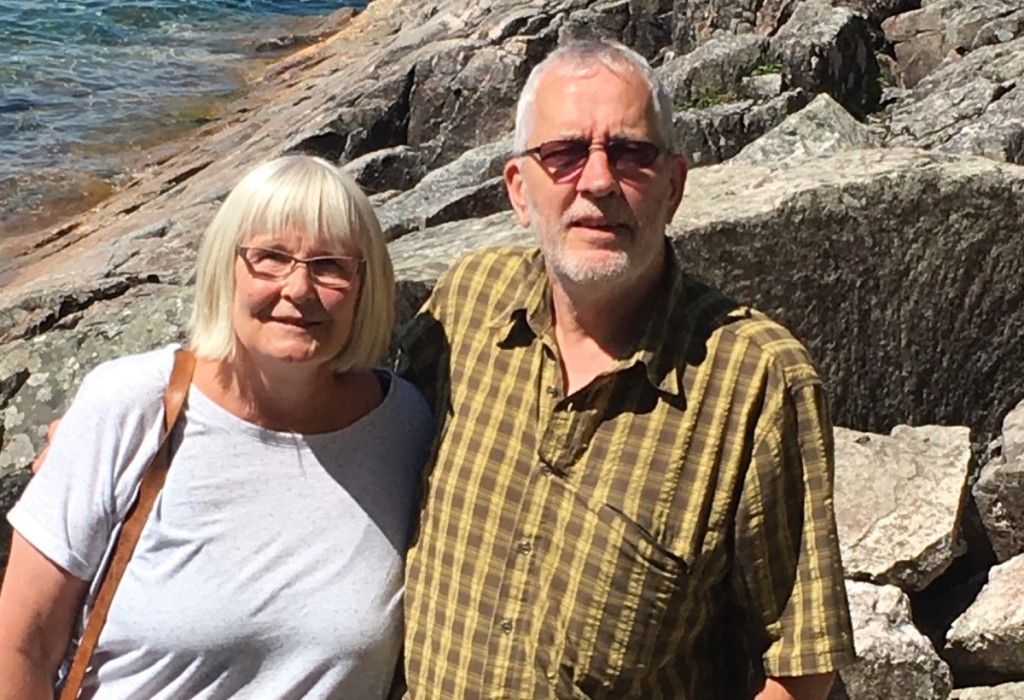
After we all went our separate ways in 1980 we kept track of each other, and whenever Mimi and I visited Denmark we’d get together to catch up and get our children back together. Sadly Else and Jens are no longer with us. Anders and Birthe Munksgaard, almost 40 years later, finally came to visit this summer. It was a wonderful two-week reunion during which we swapped stories about the good old days in Vegger and about our happily grown children, and cruised around Leelanau County, even taking a trip up to our cabin in Canada near Sault Ste. Marie to visit Lake Superior Provincial Park and Tahquamenon Falls.
The Munksgaards had never been to the United States, so before they headed back to Viborg, Denmark, I asked them for their reflections about the USA, Michigan and Leelanau County. Here are their observations:
Anders: If I as an ordinary Dane was planning to come to the USA, Michigan is not where I would come if I didn’t know somebody who lived here. It would be New York City or Los Angeles, or the Grand Canyon. In Denmark you never hear anybody say, “Go to Michigan.” So we had no expectations. We knew you said it was pretty and there were lakes here, but it was an unknown, and for us it was a trip to visit good friends. We would have had greater expectations if it had been a trip to San Francisco, for example, where we knew about Alcatraz.
Birthe: We heard about the Great Lakes in school but never knew how big they are. A lake in Denmark is nothing like this. They are small, and mud comes up between your toes and you want a shower right after. These are like seas where we come from. It was a surprise that the lakes were so huge and had white sand beaches and big waves. The phrase ‘the third coast’ of America is a perfect description. It communicates the meaning that this is a coast on the sea. There is no comparison to Danish lakes.
Anders: We heard you grew cherries here, but we didn’t understand the scale. It was a huge surprise that there were so many wineries, and there were hops growing all around the area.
Birthe: Everyone told us that people were friendly in the States, but so are we in Denmark. When we arrived everybody said, “Welcome to our country.” Everyone was genuinely welcoming and open. Scandinavians are a bit more reserved.
Anders: I had no idea how beautiful the nature would be. This is a hidden pearl that Europeans don’t know about. They know about Chicago, but not what’s north of it.
Birthe: People are really interested and talked with me (despite my broken English) about Denmark and people they knew there or who travelled there. In America the porches are out toward the street, and there are seldom hedges between the houses. In Denmark people stay more private in their backyards. There are fewer people out on the sidewalk interacting.
Anders: In Denmark the cars are smaller. The cars you drive here would be hugely politically incorrect in Denmark. Parked cars that are left running would never happen in Denmark. We are more conscious of our environment. We pay a lot more for gas and drive cars that use a lot less gas.
Birthe: I wanted to ask people in parked cars that were running to shut them off! It is so easy to turn off the engine like we do. That’s a really big difference. In Sweden, if you are stopped for more than one minute at a stoplight you must turn off the engine or get a ticket. It’s not a law in Denmark, but most people do it anyway. Gas is over twice as much in Denmark.
Anders: Our little diesel car gets 70 miles per gallon, and it has cruise control, air conditioning, everything you need.
Birthe: I’ve only seen one wind generator. Are there more?
Anders: Denmark’s goal is to have 50% of the entire country’s energy come from wind by 2020. You needn’t put them in the middle of beautiful views, but there are many places they could stand. And if you don’t like one in a certain place you can just take it down again. You don’t ruin nature by running a wind generator.
The UP was interesting. It’s a very Scandinavian landscape. The eastern UP is flat like Denmark, and eastern Lake Superior is like Sweden. The color of the water, though, is more like the Mediterranean than it is like the North Sea. It is such a deep blue shining color. The Sleeping Bear Dunes is particularly special. It’s a lot more than just a big pile of sand!
Birthe: Now we will insist that anyone coming to the USA come to the Great Lakes and to Michigan to see this amazing place.