Fibershed, Leelanau’s clothing locavore movement

By Sarah Bearup-Neal
Sun contributor
The eighth in a year-long series of articles about local art, culture and creativity.
A studio artist (that would be me) walks into a Traverse City Goodwill store looking for used clothing to repurpose (I cut up T-shirts into a knittable yarn). And as I stand there, rifling through the 25-foot long floor rack full of T-shirts, I think, and not for the first time, “There are enough T-shirts in this one store that no one needs to make or buy a new T-shirt ever again.” It seemed as though there were thousands.
Last year, Goodwill Industries of Northern Michigan diverted more than 3.8 million pounds of material goods — from computers to plastics, including 2,618,341 pounds of textiles and clothing — from the landfill through recycling and its Fresh Starts Furnishings program. According to Kristin Talaga, marketing and communications manager for Goodwill Northern Michigan, Fresh Starts receives “100 pounds of T-shirts that don’t make it to the retail floor every two weeks, to repurpose into (throw) pillows. The pillows are then sold in our stores.”
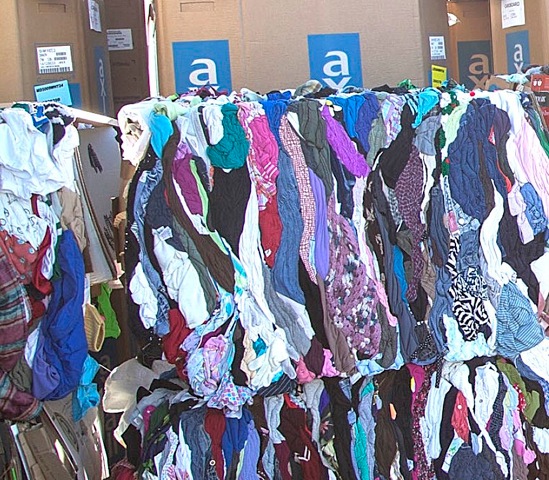
Goodwill’s operative philosophy is “Goodwill, not landfill,” Talaga said. And yet, a lot of U.S. clothing gets landfilled. Once-groovy threads are displaced by the newest, cheapest, must-have-iest clothing, available in abundance. It’s called “fast fashion.” According to the producers of the documentary film The True Cost, around the globe almost 80 billion pieces of new clothing are purchased each year, and about 82 pounds-per-person of that ends up in the landfill. Released in 2015, The True Cost asks what’s the price — ecologically, socially, holistically — for a system of disposable fashion. That question will be explored at a panel discussion and screening of The True Cost on Friday, Oct. 14, at 6:30 p.m. at Interlochen Center for the Arts, as part of the third annual Fiber Arts Weekend. How this film got to Northern Michigan is a story of interwoven connections bound by an idea that was born in a Maple City barn.
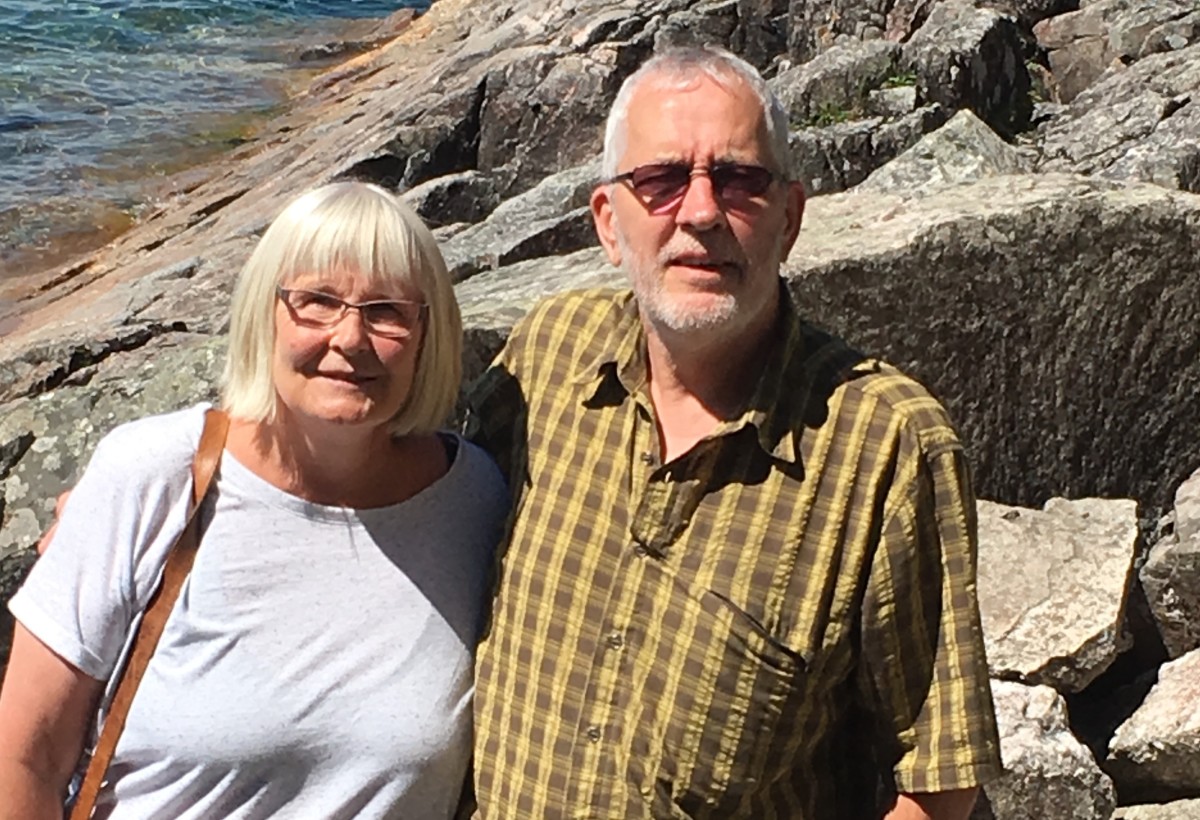
 Carol Laughing Waters lives on a 20-acres outside the village of Maple City. In 2013, this handweaver and natural plants dyer was hosting regular meetings in her studio barn with a loose-knit group of artists, small farmers, and other makers, to discuss a range of ideas, from building and living in tiny homes, to beekeeping, to organic farming. “A few of us had begun to hear of Rebecca Burgess’s thinking about the concept of fibersheds,” Waters said. And Burgess’s fibershed concept got a group of 21 people (‘mainly women”) thinking about what they wear, where it comes from, who and how their clothing is made.
Burgess is a Northern California resident credited with initiating the fibershed movement. A fibershed is a geographical designation. At the center of this land-based idea is the core belief that keeping things as local as possible — from growth, to production, to distribution of fiber goods — is key to creating sustainable communities. Fibershed, the website, covers all aspects of Burgess’s groundbreaking idea, including it’s origin story: “The project began in 2010 with a commitment by its founder, Rebecca Burgess, to develop and wear a prototype wardrobe whose dyes, fibers, and labor were sourced from a region no larger than 150 miles from the project’s headquarters. Burgess had no expected outcomes from the personal challenge other than to reduce her own ecological footprint and maybe inspire a few others. Burgess teamed up with a talented group of framers and artisans to build the wardrobe by hand, as manufacturing equipment had all been lost … more than 20 years ago. The goal was to illuminate that regionally grown fibers, natural dyes, and local talent was still in great enough existence to provide this most basic human necessity — our clothes.”
Burgess’s undertaking might be dismissed as some airy-fairy, whole-grain goofiness straight out of Northern California. But from her initial experiment Burgess was able to draw up some criteria for measuring the positive impacts of her prototype wardrobe. Fibershed enumerates. It:
• Produced zero toxic dye effluent.
• Used zero pesticides or herbicides, genetically modified organisms, or synthetic biology.
• Sustained a regional community of artisans and farmers who continue to collaborate and grow in number.
• Reduced CO2 impact in the cases by (six times) that of conventional equivalents, proving to Burgess that clothing can be made in a climate-sensitive manner.
Rebecca Burgess’s research and practice-laden story was the backdrop for that August 2013 meeting at Carol Laughing Waters’s barn. It drew 21 people from the region, many of whom were “already deeply involved in some sort of fiber pursuit,” she said. “We had Angora rabbit people, people raising sheep and alpaca who were already involved with production. There is no fiber processing facility in this immediate area … so we began to have a discussion about how to create a fibershed here.”
Jandy Sprouse, one of those 21 people, raises alpaca and Tibetan yak on a 200-plus acre Maple City ranch. The fiber she culls from each of these animals is shipped to Tennessee for processing, to a mill that handles these specific fibers. Even though there are fiber mills in Michigan, one as close as East Jordan, Alpaca fleece, for instance, can’t be processed in machines used for sheep wool because of the greasy lanolin, Sprouse said, adding “I would love not to have to send my stuff to other places. I would love for [all the processing] to be done in Leelanau County.”
What rippled out from Waters’s Maple City barn was a series of discussions, and further meetings, which attracted like-minded residents from Boyne City to Empire. What they shared was a desire to transform the fibershed concept — a big idea — into a living, breathing practice; but first they needed a map.
Crosshatch Center for Art & Ecology in Bellaire took on the project of facilitating development of a fibershed map. It’s a project that dovetails with Crosshatch’s mission to help build community “through the intersections of art, farming, ecology and economy.” Jen Schaap, Crosshatch’s coordinator of Food and Farming Programs, is the fibershed map point person. Schaap, who was also in Carol Laughing Waters’s barn in August 2013, said there are many “pieces of a puzzle” to identify and put into place as one develops a map: Who are the sellers and purchasers? Where is the mill to process raw materials? Who is farming dye plants and animals – sheep, alpaca, yak, llama, goat — from which clothing fibers come? Are there artists/makers whose work focuses on garment production? And, critically, how does one bring all these moving parts together to discover “how and if Northern Michigan can support a full-loop textile system and become an economically viable industry that uses local sources,” Schaap wrote in a recent email.
The tenets on which a fibershed is built were woven into workshops offered at the inaugural Interlochen Fiber Arts Weekend in 2014. That theme continues to be an organizing principle — people who have been involved with fibershed mapping have also helped shape the Fiber Arts Weekend, said Leslie Donaldson of Interlochen’s College of Creative Arts. Yet despite its central role in the Fiber Arts Weekend, held at such an august institution, there are still hurdles to widespread public embrace of the fibershed concept. “It’s something that isn’t in people’s minds,” Schaap said. “The mainstream isn’t thinking about how their clothing is made, and how that connects to the natural world. It’s so easy to go to the store and buy new things. ‘The True Cost’ talks about the mindset that’s concerned with needing the latest and greatest new thing.”
Identifying the infrastructure supporting fast fashion — the sartorial equivalent to fast food — is helpful if one wishes to analyze the perceived need for new clothes all the time. The system is built on human labor often played out-of-sight in third world countries where safety is Job 999. An example, Jen Schaap said, is the 2013 Rana Plaza collapse in Bangladesh. Some 3,639 people were employed here producing clothing for U.S., Canadian and European clothing retailers. On April 24, the building collapsed killing 1,130 people. There were cracks in the factory walls, which were disregarded by the building’s owners despite warnings. It is considered one of the deadliest garment-factory accidents in history.
In a 2007 article the National Institutes of Health wrote about fast fashion’s “pollution footprint,” and zeroed in on the fabric that launched a 1,000 leisure suits. “Polyester, the most widely used manufactured fiber, is made from petroleum. With the rise in production in the fashion industry, demand for man-made fibers, especially polyester, has nearly doubled in the last 15 years … The manufacture of polyester and other synthetic fabrics is an energy-intensive process requiring large amounts of crude oil and releasing emissions including volatile organic compounds, particulate matter, and acid gases such as hydrogen chloride, all of which can cause or aggravate respiratory disease.”
The True Cost looks not only at fast fashion’s ecologic impacts, but sheds light on the persuasive, insidious nature of modern, American media, and its uncanny ability to affect the human desire — especially the teenage human desire — to consume. A panel discussion follows the Oct. 14 screening at Interlochen. There is a $5 charge for this evening event if one is not enrolled in the weekend.
Jen Schaap hasn’t bought any new duds in a long time. “I don’t like to shop,” she said. So, Schaap refreshes her wardrobe at clothing swaps, a low-tech, tribal ritual, in which “six or eight of us clean out our closets, get together, dump those clothes on the floor and swap,” she said.
Another kind of swap took place at Carol Laughing Water’s barn gathering in August 2013. It was an idea exchange that prompted an action: the creation of a regional fiber guild; then another action: a fibershed mapping project; and yet another action: the screening of a documentary that asks us to seriously consider what really went into the making of that coveted Little Black Dress. Three years ago, 21 creative thinkers walked into a backwoods barn and — no joke — started a little movement. In Leelanau County. I kid you not.
For more information about Interlochen’s Fiber Arts Weekend visit College.interlochen.org/fiberartsweekend. For more information about the Crosshatch Fiber Guild and fibershed project, contact Jen Schaap: 231-622-5252 or email info@crosshatch.org.