
Up on Aral Peak, farm life is good
 By Pat Stinson
Sun contributor
On a wall clock in the dimly-lit barn, the big and little hands are both on six. A small black-and-white cat named Dora silently launches herself from the rafters and lands on hay bales beneath, then hops to her dish, where she hungrily awaits the day’s first scoops of cat chow. She’s lucky this morning. Cosmo, an orange tabby twice her size, and the gray-haired Gloria are prowling elsewhere.
 Dora’s movement rouses the curiosity of the older alpaca babies (cria), and they leave their mothers and squeeze their soft, woolly bodies through the narrow opening of the baby pen (“creep”), where they greet their purring friend and munch on grain pellets meant only for them. Outside the creep, mothers (“dams”) rise on skinny legs, their unweaned cria beside them, to graze at the hay wagons.
A few hundred feet away, at the top of a steep driveway and inside their cedar-clad home, Chris Stapleton and her husband Jim Bleyaert are awakened by wet border-collie kisses from Rose and Jolene. Twelve-year-old Alyce, a border-collie mix, waits patiently beside the bedroom door.
Chris rises first and shoos the dogs outside, then makes coffee before heading into her home office to check phone and email messages. In this quiet hour, before sunlight hits the henhouse and farm chores beckon, she begins a work routine that allows her to run a successful real estate business and live the farm life that feeds her soul.
Good privacy, pretty and rolling
A little over 10 years ago, the couple lived in a home that Jim, a carpenter, built on wooded acreage in a development next to state land in Solon Township. For Jim, a city boy from Monroe who had only ever owned a dog, this was country living. For Chris, who grew up in Oxford, Mich. — where she traded chores to ride quarter horses, and where she spent four of her teen years working for a veterinarian — the home’s neighborhood setting wasn’t “country” enough.
“He didn’t see any reason to have more land, but he was a trooper,” she says of Jim and their three-year search for a prettier, more private parcel. “We looked at a lot of properties.”
They bought a hilltop house near Aral, with “beautiful” views, a quarter-mile long driveway and 94 acres straddling the Benzie-Leelanau county line. They had no idea what livestock they might raise on their mostly pine plantation. Chris wanted animals that could sustain themselves, monetarily, but her intention was not to make money. Jim wanted livestock that wouldn’t be slaughtered. After spotting Dave and Kathy Easter’s alpacas at the Northwest Michigan Fair a year later, they cleared some land, built shelters, and bought three young females. A few years later, when the neighbor below them decided to sell, they acquired another ranch home, 54 acres, and a driveway measuring three-quarters of a mile. Jim cleared the land and planted seed for new pastures.
From their house on the hill, Chris and Jim now overlook alpaca and sheep pastures, and Jim’s regulation ball field. Views of Norconk’s asparagus farm, and Lake Michigan, where it meets the Platte River, are visible in the distance.
Down to work
A full-time farmer, Jim is responsible for infrastructure (driveway maintenance after a heavy snow or rain takes hours) and repair and maintenance for two homes, two garages, two huge pole barns, a chicken coop, a computerized well pumphouse, a pasture shelter, a 32’ x 48’ wood barn with hayloft he built, and a 20’ x 40’ hoop barn they erected themselves for studs (male alpacas) and Old English Babydoll Southdown sheep. Jim is also the groundskeeper — plowing, seeding, irrigating and mowing lawns, 15 acres of pasture and his ball field. He transports animals (logging countless hours and interstate miles) and works on farm-related projects, in addition to his estimated 15 hours a week of farm chores. Jim is also the household cook and organizer.
Chris spends 45 minutes to an hour each day feeding, watering and scooping poop for 18 alpacas, 19 chickens, 6 sheep, 5 runner ducks, 3 dogs and 3 cats. She spends two more hours, a few days a week, for other farm tasks, such as washing buckets, moving hay and extra cleaning. The alpacas are “first” in her morning chores, though Chris passes the henhouse on her way to the barn. The hens’ extra hour “cooped” is meant, she says with a laugh, to encourage more egg laying. (Once outside, their chickens roam a large pasture and also spend several free-range hours in the woods.)
They bought chickens to ensure a steady supply of fresh eggs.
“When I wanted chickens, he said, ‘Peep, peep, peep, no sheep!’ and I would respond, ‘Baa-a-a-ah’.”
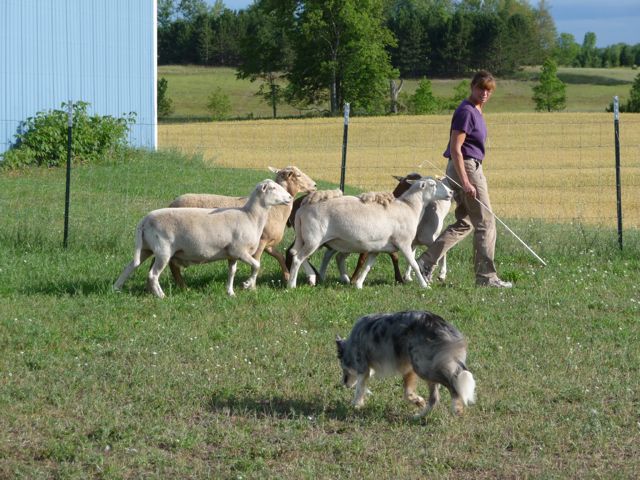
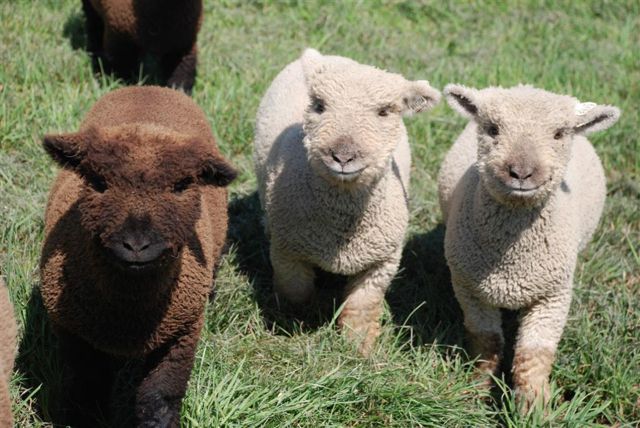
Her new lambs, purchased as pets and for herding practice with Rose, were a gift from Jim, who was against owning any animal that had to be slaughtered. He researched sheep and found the hardy Babydoll, a miniature breed (averaging 18”-22” at the shoulder) with stocky, woolly bodies and sweet personalities.
“They tend to get themselves into trouble,” Chris says of her young lambs. “They knock over anything left in the pen and get into everything. We used to have a hose in there, but one time Jim came back to the barn and found a lamb with a hose wrapped around her.”
Taking a break
Real estate work keeps Chris busy until at least 5 p.m., when she unwinds by taking the dogs for a walk, revisiting the hoop barn to feed the studs and sheep, and practicing her herding with Rose. She spends at least another hour every day (more if the day is stressful) visiting with the animals.
“The farm is my boat,” she says. “Some folks have boats, fast cars or fancy cottages, something they enjoy outside of the working world. When I’m in the barn with the animals, there’s a time warp. It’s similar to the feeling I get when I ice fish, or while I’m perched high in a tree stand, or reading a good book with only the sound of the surf in the background. All of a sudden, hours have passed and not one worry or thought of work has passed through my mind. I think it’s probably like meditation: my mind is quiet and clear. I can once again face things in the real world. “The calm and trusting nature of the animals is therapy. When you can walk into a pen where a mother alpaca and her two-day-old baby are laying, and they watch you change the water and freshen the hay, and they know you will care for them, it’s a feeling of closeness to all that is good.”
Listen to the Aral Peak Alpaca song at: www.aralpeak.com/AlpacaSOng.mp3 and visit Aral Peak Alpacas online at www.alpacanation.com. Disclosure: Pat Stinson is the Aral Peak critter sitter and Stapleton Realty advertising/marketing consultant.