
To the rescue
 By F. Josephine Arrowood
Sun contributor
Garnet pushed the loaded shopping cart into the humid gloom of the parking lot, whose lights had already been extinguished. Behind her, the storeowner said goodnight and locked the Mercantile’s double glass doors before hurrying to his Jeep.
As she opened her trunk, she felt cold, fat drops of rain hit her bare arms, and she scrambled to stow the heavy paper sacks, then pushed the cart under the covered walkway. She opened her car door and slid in as ice pellets suddenly rattled onto the Toyota’s roof and across the windshield. Then lightning stabbed the shoreline of the big lake, followed by a drawn-out grumble of thunder. She inserted her key, turned it, and felt, rather than heard, a click instead of the usual awakening engine.
Not now, she thought. A suffusion of dread swept through her, and her heart began to pound. Oh, please. Grace was waiting at home four miles away, and it was now nearly dark. She had all these groceries to haul, and exactly nine dollars and seventy-six cents in her purse. What should she do? She turned the key again several times, only to hear the same Morse code of bad news. She tried to think out the possibilities. Starter? Alternator? Battery?
Her mind swept through the limited choices. The buses, she remembered, stopped running after six o’clock, and not at all on the weekends. The Merc’s owner was long gone. She didn’t have the cash for a tow, and she hardly knew anyone yet in her new town. Her neighbor Sarah might be willing to come get her, but Garnet felt awkward asking another overworked single mom for a favor. Still … she picked up the cell phone from the car console. She pushed Sarah’s number, and waited while it rang several times. Her spirits sank as she listened to a recording telling her to leave a message.
“Damn it,” she breathed. Her heart still thudded painfully, and she took several deep breaths. Thunder rolled again, and now heavy rain pelted the car, slushing the ice pellets piled along the windshield wipers. She called her house, and Grace answered.
“Mom? Are you on your way home?” she said. She sounded breathless and uncertain, much younger than her 15-year-old self. Garnet knew that being alone at night wasn’t Grace’s favorite thing, especially in a thunderstorm, especially in a strange, new place out in the boondocks.
“Sorry, honey,” Garnet said. ”This stupid car won’t start. I’m in the Merc parking lot with the groceries. Trying to figure out what to do.” She rested her head on the steering wheel, hoping for inspiration.
Grace complained, “Damnit, Mom! It’s dark out here. You know I hate that …”
“Grace, would you mind not cursing? I don’t need to hear that right this minute. I’m trying to think what to do.”
“Why don’t you call that old guy we met at the farmers’ market this morning? You know — that mechanic you were thinking of interviewing?”
“What?” Garnet was distracted. “Mr. Gentry? I don’t even really know him.”
Grace said, “Well, he called here a while ago to see about the interview. I think he’s lonely, Mom. Hey, maybe he can give you a ride home, and we can all go out for pizza. Not that hanging out with old people is my number one choice in life, but I’m getting really hungry.”
“Oh, no, honey,” Garnet started to dismiss the idea, then reconsidered. Bard Gentry was a retired auto guy, so he might be able to give her some clues about this stinking heap of metal. He had seemed kindly this morning, when they’d chatted over the fresh produce at the market about his early life down in North Carolina, his move to Detroit’s “Arsenal of Democracy” during World War II, his retirement up north, and his wife’s death a decade earlier.
“Wait, did he leave a phone number?” she asked.
“Yeah, hang on,” Grace said. She rattled a piece of paper, and read off the number. “Mom, could you hurry? I’m starving, and I really don’t like it here by myself.”
“Mmm, hmm,” Garnet murmured as she wrote the number down. “Did you close the window blinds, Grace? And did you let the dog in? She could be a comfort while you’re waiting for me.”
“Oh, right,” Grace scoffed. “Oh, crap! I think I left her outside. She’s probably on the porch.” Garnet heard a door open, and a couple of sharp barks. Grace said, “Call Mr. Gentry, Mom, okay? I gotta go, Holly’s got mud on her feet.”
“Bye, honey, I’ll be there as soon as I can.” Garnet sighed, ended the call, and tried Bard Gentry’s number. After several rings, she heard a quavering tenor with a thin layer of grit rolling along underneath.
“Hi, there,” she said. “Mr. Gentry? This is Garnet Roberts calling you back.”
He laughed. “Oh, yes, it’s so good to hear your voice,” he said. “Now, who did you say…?”
“Garnet Roberts,” she repeated. “I met you this morning at the farmers’ market. We talked about your work at the Rouge factory?”
“Oh, yes!” he said. “Did I know your father at the old plant? So many southerners came for the good jobs there during the war, you know.”
She squinted at her rain-glazed windshield, now starting to fog up. If he didn’t even remember her, she could hardly ask him to come out to help her in the middle of a stormy night. The thought of melting groceries in the trunk and Grace waiting fearfully at home resolved her. She tried again. ”You called my house this evening, my daughter said?”
“Why, yes, I did,” he agreed. “I was hoping you’d be free for supper. We could talk some about the old days, you know. I thought that’d be real nice.”
Garnet said, “Thank you, Mr. Gentry, I’d enjoy that. But I have a problem. I’m here at the Mercantile, which is closed, and my car won’t start. I wonder — would you be able to drive over here? I don’t know what else to do,” she trailed off.
Bard said, “Ye-es, I could do that, I think. I don’t like to drive at night, as a rule. Rain is the worst, with the glare and all. You’ll tell me the way to go?” His question echoed a children’s song that Garnet used to sing to Grace, and it went absurdly through her mind now. “Show me the way to go home, I’m tired and I want to go to bed …” She suddenly felt gray with fatigue, but her day wasn’t nearly as over as she wanted it to be.
“Yes,” she said. “I’m in the parking lot of the Merc, a red Toyota.”
“All right, young lady,” Bard sounded brisk suddenly. “I know exactly where you are. You just wait there, and I’ll be along to help you. Bye, now.” The call ended abruptly, and she put the phone down, feeling a little apprehensive, yet comforted by the thought of the old man coming to her rescue. It least now she could get home.
Bard firmly set the black handset of the phone on its cradle. He would go and fetch the young lady stranded at the Merc. Garnet. That was a mountain name, surely an easy one to remember. He conjured up a picture of her from that chance meeting over the morning’s red tomatoes, asking him so many questions about his childhood in North Carolina, his move to Michigan, his job and family life in Detroit after the war years.
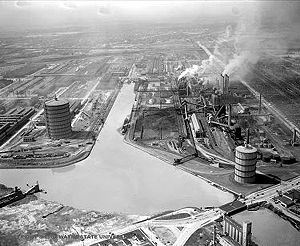
He recalled the first time he’d gone to Detroit, after his cousin Ray, a security guard for old man Ford, gave his kin an easy way into the jobs they’d all heard of down South: five dollars a day, buy anything you’d like — or so the recruiters had proselytized. They hadn’t borne witness to the press of sweat, hot metal stench, syncopated clang and clamor amid shouts, curses, grunts. Endless belts drawing the fresh-pressed metal past, endless loop of the clock-hand drawing the mind sluggishly toward the salvation of punch-out time. They hadn’t testified to the men sleeping in shifts in rundown, overcrowded boarding houses, the piercing loneliness for wives and children and cool southern mountain air. They hadn’t rained damnation on the line speed-ups, wildcat strikes, union-busters with axe handles and bats, and layoffs that started each June during the model changeover. Then he’d pack his one rucksack, have a last smoke, shake hands and good luck all round with the fellows, and get aboard a train at the Michigan Central Depot to Toledo, Knoxville, and the Carolina Express to Asheville.
He’d move back to his folks’ homeplace each summer, helping to scrape a thin living in burley tobacco and corn off the mountain soil, but with five brothers, their 20-acre farm just couldn’t hold them all. After the threat of war that had loomed for so long finally broke with the thunderclap over Pearl Harbor, he’d returned to Detroit to stay, to the town so strangely flat and gray against the swiftness of its cold, wide, spackled river, the hopped-up crowds of whites, negroes, foreigners all bumping and spilling across sidewalks, squeezing onto noisy double-decker buses and loaded streetcars jerking in their steel tracery. Back to the god-awful rowhouse shacks, the Ford plant’s straw boss and shop steward’s frown, and the fatigue that cloaked his mind like the sluggish clay of the Ford plant’s River Rouge.
Rouge … Garnet. Oh, Lord! Bard bolted upright in his seat. She was waiting for him this minute, and he’d promised to help her. His large hands that had seen too many shifts of factory work pushed against the arms of his lounger as he stood up quickly. Hip and ankle joints counseled against this rashness, and his right knee throbbed viciously.
More carefully, he made his way over to the entry closet and retrieved his faded work jacket, stitched with the Ford logo and his union chapter. He patted his shirt pocket where his glasses lay, took his blackthorn cane and car keys from the hook, and went out into the rain-driven night.
Strong headlight beams cut through the misted up windows of Garnet’s car, and a long, wide shape pulled into place beside her. The rain had settled into a steady light pour, and the diminishing tympanum of thunder seemed to have moved out over the lake. She opened her car door, and caught sight of Bard at the steering wheel of a powder blue Lincoln Continental that looked like a refugee from her sister’s 1979 wedding party. He opened his car door, but she already had grocery sacks balanced in her arms.
“I made it!” he said, grinning. “Excuse me not getting out, but my knee is acting up a bit with this rain. I’ll just pop the trunk for you.”
“Thanks.” Garnet piled the goods in, pushed down the lid, and went back to her vehicle to get her purse and cell phone. She pulled open the heavy door of Bard’s car, and got in.
“Thank you,” she said again. “I really appreciate your help, Mr. Gentry.” She looked over at him in the dim interior. He was still smiling, and light from the dashboard reflected in his glasses and gleamed green and red in his thick white hair. A slightly befuddled knight on a kindly errand, she thought, smiling back.
“You’re welcome,” he said. “I’m always happy to help a lady. Please, call me Bard, now that we’re almost neighbors.” He glanced at her silent, dark car. “Should we try to get her running, you think?”
Garnet waved the Toyota away. “Tomorrow, maybe,” she said. “Right now, I need to get this food home, and my teenager is waiting for me.” She pulled on an elaborate seatbelt harness, and fastened it. He geared into drive, and they headed west.
“This is quite a ride, Bard,” she said.
“It is,” he agreed. “They don’t make them like this one anymore. It’s got real steel in the frame, and could probably last forever,” he reflected.
“Unless the rust gets to her,” he amended after a moment, laughing. “Like me.”