
All-Michigan website weaves community
 By F. Josephine Arrowood
Sun contributor
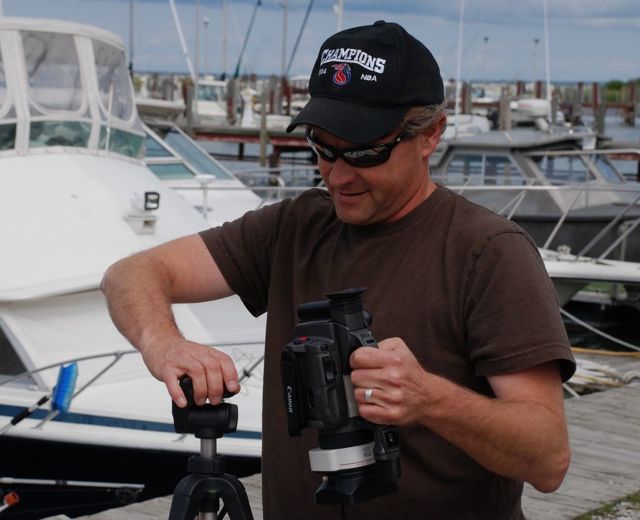
Chances are you’ve seen Andy McFarlane hard at work, although you may never have met the 44-year-old web designer and indefatigable entrepreneur. His comprehensive website Absolute Michigan hosts, promotes, and provokes lively interchange, showcasing a multitude of Michiganders, Michigania, Michitwitters, and much more.
The “All Michigan, All the Time” site has been up and running for five years, but its roots go back to the Internet’s early days in the 1990s. The Leland native had earned a degree in political science at Michigan State University, and returned to northern Michigan, where he found work as a writer. “I kind of stumbled into [the Internet], when I was working for Lake Country Gazette at the time,” says McFarlane. “It became obvious to me that I could do a lot with a web-based business.” In 1996, he began his successful web-design firm, Leelanau.com, with college chum and business partner Steve Johnson, who is based in Lansing. Their work includes the Traverse City Film Festival and State Theater sites, among many others. (Leelanau.com also hosts our website, GlenArborSun.com.)
The Absolute Michigan endeavor began in 2004, when McFarlane and Johnson realized that they needed a larger outlet than Leelanau.com to showcase the beauty and the bounty offered by the entire state. ”It sprang from both of our love for Michigan. People get obsessed about different things, I guess,” he says half-jokingly. ”We worked pretty tirelessly for five months, building this thing up, launching it, then working on it the next four years. The site’s becoming a lot more popular now,” increasing its exposure exponentially, through Facebook, Flickr, Twitter and other social networking places.
McFarlane reels off heady statistics: “We have 20,000 Michigan businesses, organizations and blogs, 5,000 stories. You go in there, types in a word like ‘cherries’ — boom, there it is! We have a pool of 2,000 photographers, almost 75,000 photos, taken by people from all over the state. Anything we’re writing about, we don’t have to dispatch a photographer. Chances are, we already have it.” The site boasts a quarter-million visitors and total web content of over a million pages, so people are definitely connecting — for and about the Great Lakes State.
He continues, “The Internet is a confusing and chaotic place, so we said, ‘We’re just going to talk about Michigan.’ It’s a community effort to promote what we’re all doing, make it easy for people to have fun, use it to find out what’s next to you: connect the data with location,” the ultimate in going local.
“Locals” include Traverse-area folk musician and community activist Seth Barnard, with whom McFarlane is working on a new webshow. Another is downstate wine enthusiast and writer Lorri Hathaway, whose mother is Glen Arbor, Michigan’s own Linda Ihme. Hathaway and Sharon Keggereis blog regularly about the fruits of Michigan’s grape harvest through their site MichiganVine.com. A quick scroll through some of the thousands of other links reveals a Native American art gallery in Calumet, a Detroit valet parking service, legal representation for computer-related businesses, production companies, a central Michigan business offering clay projects for kids and adults, vacation rentals statewide, and a blogger promising tips on metro Detroit’s hip urban scene.
“If you like food, you’d be a fool to live anywhere else,” McFarlane shares one of his own obsessions. “We help people appreciate it more. What incredible resources!” Bloggers, like Ann Arbor’s Kitchen Chick, feature prominently on the website, sharing recipes and information about restaurants, caterers, markets, farms, food products, hunting and gathering, and foodie events.
Government, nonprofits, culture and history are also represented. “We swap content back and forth with the archivist of Michigan, Mark Harvey,” whose Department of History, Arts and Libraries is threatened with closure and dismantlement in October, due to state funding cuts.
McFarlane says, “We’re trying to reach out to more people, to say, ‘Take a look.’ Absolute Michigan connects not only with what’s going on now, but with what was there before, as we’re talking about redevelopment and change,” in the state.
“We do look at big issues like Flint or Detroit: what are they going to do when they demolish two-thirds of the city? Things aren’t really working — what can we do to make it better? The possibilities afforded by change are really amazing, like the old Russell Industrial Center in Detroit.” The former auto body factory is being redeveloped as artist lofts and businesses, 285 at last count.
McFarlane stresses the positive coming out of the harsh economic times, which includes the permanent loss of our century-old manufacturing base. He attended a Creative Cities Summit in Detroit last fall, inspired by economist Richard Florida (whose 2004 book The Rise of the Creative Class foreshadowed the upheaval and promise of a new socioeconomic order). “The institutions here are amazing, but we’ll have a hard time keeping them all. It’s a tough time, but cool. We’re trying to be positive about it. A lot of people are saying, ‘There go the auto jobs, let’s make something new.’” Absolute Michigan highlights it all, facilitating exchanges of views, stirring up emotions, and galvanizing active participation in community. In a roundabout way, the former political scientist’s early interest in Third World development initiatives has resurfaced in the global era, paradoxically seeking salvation in local focus through a worldwide connective web.
He emphasizes that the site is not just another online media outlet, competing for breaking news. Perhaps Absolute Michigan is one of traditional journalism’s modern successors, however, establishing diverse and collective forums, and showcasing many facets of the daily information we as a society crave — whether it be news, cultural events, business enterprises, features about interesting people, or sounds and images that entertain us or teach something new. Like the demise of other manufacturing in Michigan, the end of the old way of mass communication — dozens of staff writers, photographers, editors, press operators, delivery trucks, newsprint, and vendors — seems to be opening up new opportunities for visionaries like McFarlane and Johnson.
He sees Absolute Michigan (and other Internet media) as a different model than that used by traditional large daily newspapers in America, which have been failing at a staggering rate in recent years.
“The papers that you really see crying and moaning are the big ones,” trying to be too much to too many. “A ton of money, energy and resources goes into big, daily newspapers,” exclaims McFarlane. “Those artificially cheap resources we had are gone. What [traditionally] sells ads is the ‘cover-to-cover’ model. But there’s so much media choice now,” so people aren’t looking to one source for their daily dose of information and features.
“The smaller papers like the Glen Arbor Sun and Leelanau Enterprise are doing better because they’re covering and responding to their community. They’re not predicated on size.” Absolute Michigan does offer hard news stories through its many links to statewide newspapers, magazines, alternative press, video and radio, including Interlochen Public Radio and Michigan Radio. And the media doesn’t stop at the state’s borders, real or virtual. Recent thoughtful, well-researched articles on Michigan, available on the site, include pieces in Time magazine and Guernica, a monthly publication of arts and politics.
“I’m not a journalist, although I have been one,” he explains. “Sometimes I’m a storyteller. Michigan in Pictures is the best site I do. Every morning, I wake up, run to the computer, and look at the pictures, then I tell a story,” about one photo each day. “It’s fun, like being in school again!”
“I don’t ever want to be in a position where I have to cover what happened in a city council meeting. I want to deal with people doing and creating things, and let them tell the story,” about the city council or anything else that’s newsworthy. “Somebody needs to get out there and put all this stuff together. We re building the stage — unlike big newspapers, where you might only have five points of view, we’ll get 25 people whose viewpoints are diametrically opposed to each other, but are coming together to talk.”
He enthuses, “I’m a connector, trying to connect people with their lives.” He gives an example: “You could walk on the beach. While you’re there, you can appreciate that you’re able to do that, and that you’ve got this incredible resource right here! If you then get angry because you see some [pollution], you can contact your congressman or someone,” and help to fix the problem.
He concludes, “The more that people are connected, the more they’ll protect something,” like his beloved home state. His words echo those of Traverse City Film Festival blogger Cherie Spaulding, who noted, “After all, what value does life have without connection?” For Michigan, that link is Absolute.