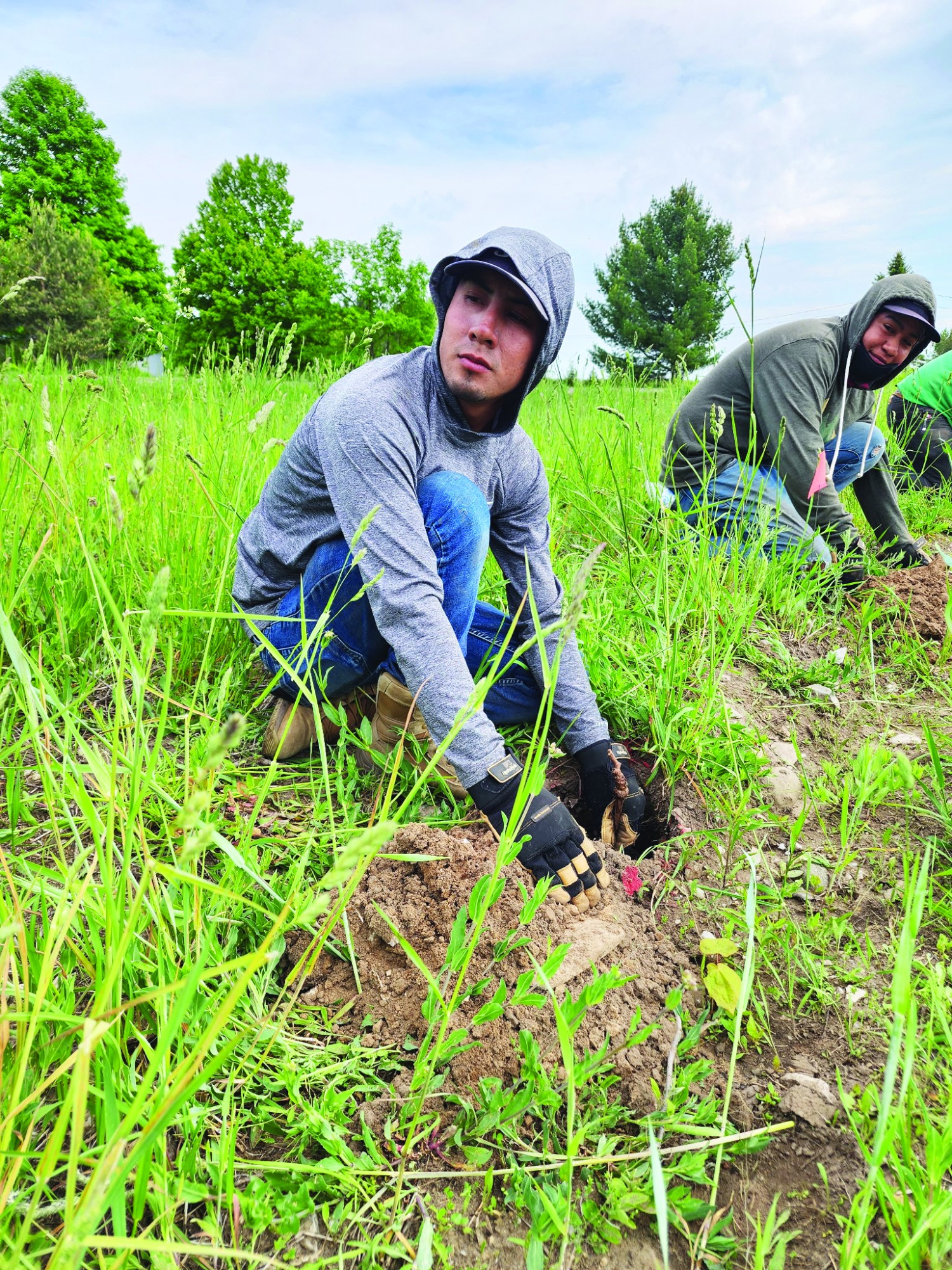
Teenagers picking cherries: a migrant farmworker’s memoir

Photo: Fuentes returned to Leelanau last year to dip his hands in fresh cherries.
By Robert “Carlos” Fuentes
Sun contributor
Here’s an excerpt from Fuentes’ self-published book, The Vacation: a Teenage Migrant Farmworker’s Experience Picking Cherries in Michigan—a coming-of-age story that intertwines the bonds of family and friends, emphasizes the importance of heritage, captures the sweetness of first love, and showcases the quiet dignity of hard work.
According to Rubén O. Martinez, professor emeritis at Michigan State University’s Julia Samora Research Institute, Fuentes’ story, which is set in 1969 not long before the introduction of the mechanized cherry shaker, “provides a window to family, religion, race relations, and short-term community life among migrant farm working families through the experiences of an adolescent boy who is coming of age in a migrant camp and the orchards of cherry growers.”
Fuentes, a retired Michigan State University student affairs advisor and supervisor, dedicates The Vacation to “the farmers and migrant farmworkers of America. Your relentless labor, often performed without recognition, sustains our nation. The fruits of your toil nourish our tables and enrich our lives.”
The Vacation is available at Leelanau County bookstores:
 “We’re ready to start the work day. Dad put the Igloo, full of water, in the back of the pickup. We all walk to the main barn to get our pails and cherry harness/support straps. Some are cleaner and in better condition than others. Since we are the last family to arrive to pick, we can’t be too picky with what is left. The one-gallon galvanized pails have small holes on each side where you put the two clips attached to the supporting straps. The supporting straps are made of sturdy, white-colored cotton mesh. The three-inch-wide straps crisscross your back. After assessing the available straps that are my size, I try one on. Every time I put on one of these supporting straps, I feel like I’m a soldier from the Revolutionary War or the War of 1812 because of the criss-crossed white wide straps. I like the feeling of the straps. I choose a pail with cherry stains, leaves, stems, and a little sand on the inside bottom. I clip the straps to the pail. I’m ready to pick! Mom tells Dad, “Honey, hurry up. We can’t be the last ones to the orchard!”
At around 9:40 am, we head to the orchard. All the pails and support straps are loaded in the back of the pickup. All of us kids, except Timmy, sit on the tailgate while Timmy is in the cab with Mom and Dad. I spot the tractor in the orchard and hear its putt-putt sound. A few cars trail behind it as Dad follows Aunt Maruca’s brown 1963 Oldsmobile 88 station wagon up the gently sloping two-track trail in the orchard.
We all love sitting on the tailgate with our legs hanging down as Dad drives slowly through the orchard. We feel every bump, and it makes us laugh. We pass other pickers on the sides, parking their vehicles and getting things ready to start picking. Each family chooses a row to pick. We pass by where Lety and her family will be picking. I only get a glance at her because we are moving farther up the orchard. We pass by an area with neatly stacked orchard ladders and a large mound of empty cherry lugs a few yards away. Dad takes the next available row and parks the pickup a few trees down the row.
All pickers are busy getting ready to start picking. I see some heading toward the ladders and cherry lugs. Other pickers snap on their pails and walk to their trees; a few are already picking.
We prepare ourselves for work. Since there are a lot of mosquitoes around us, the first thing we do is spray on mosquito repellent. Dad takes the first tree in the row, Mom takes the second, Junior takes the third tree, and I take the fourth one. Mom and Dad start walking to their trees to start picking while Junior and I, along with Sandy, Tito, and Timmy, go to the pile of empty cherry lugs to get a bunch of lugs we will need. We all choose the newest and cleanest lugs. With the new ones, you can smell the pine wood. I love that smell. Like the lugs we saw at the Esch Farm yesterday, they have names of various cherry growers and canning companies from around the Traverse City area imprinted on the sides. Junior and I carry four lugs at a time. The rest of the kids each carry one. Timmy is struggling with his. He takes a lot of breaks. I coax him on and tell him he’s doing a great job.
As we walk back to our site, I hear cherries falling into the pails of those who have begun picking. I like the metallic sounds the cherries make as they land at the bottom of the pail. We find a spot by one of our trees and drop the lugs. We go back two more times and now have sufficient lugs to keep the family supplied for a while.
Junior and I go back to get our ladders. They aren’t fun to move, so we drag them back to our area. We make several trips to get ladders for Mom, Dad, Junior, and me.
I hesitate to start because I don’t look forward to getting more wet. There’s so much rainwater on the trees and the tall grass surrounding them. My pants are already wet from carrying the lugs and ladders. It’s also still a bit chilly. I’ll feel even colder with my body wet. My walk to my cherry tree stirs up a bunch of mosquitoes. Now they know I’m around for their bloody delight. I approach the lush branches that droop under the weight of ripe, sweet black cherries. The rain enhances their shimmer, making them even more stunning.
I implement my plan on how I’m going to pick. I stand and focus on an area where I remain stationary and pick everything within my reach. I usually start with the branches that have the most cherries. After picking everything within my reach, I get on my knees and pick everything within reach. When all the cherries are picked, I move left or right of where I started picking and do the same routine. After picking all the cherries on the tree’s exterior that are within my reach, it’s time to find a place under the canopy to start picking. After I finish the interior, it’s time to get a ladder to begin picking the cherries that are higher up and out of my reach.
Plink, plink, plink is the sound of cherries hitting the bottom of my pail. Before I get serious with picking, I satisfy my desire and have a short dessert time! A clump of cherries catches my eye. I rub them dry to get as much pesticide off as possible. In my mouth, they go. As usual, they are as tasty as they are plump.
I return to picking as I chew and savor the crushed cherries. The nippy air and rainwater make my fingers not want to cooperate as well as they should. The sky is still filled with grey clouds that drop spurts of light rain on us, only adding to my discomfort. I find a loaded branch, start at the top, and work my hands and fingers down as the cherries detach from the branches. It feels like I’m massaging the branch as the cherries fall into my pail. What a lovely sound they make as they enter my pail. My pail is half full from just this branch! This motivates me; it’s just what I need to get my work rhythm going. This will help me warm up as well. The front of my pants and my long sleeves are all wet. The crisscross straps and bucket in front of me keep my torso relatively dry.
With all the moisture in the air, there appear to be more mosquitoes. My mosquito repellent does wonders and keeps them at bay. However, that doesn’t mean I’m unbothered by the pests. Some fly close to my head. Though they don’t land on me, it’s annoying to hear their buzzing sound, which adds to the discomfort of my wet and uncomfortable body.
After picking another loaded branch, I fill my pail. Carefully, I unload my first pail of cherries into the lug I placed close to my tree. It almost fills half the lug. They look marvelous as they lie in the lug. A few more cherries go into my mouth as I walk back to start again.”