
Sustainable development Up North
 Op-Ed By Keenan May
Glen Arbor, Michigan’s once dichotomous sister village, Glen Haven, is a restored logging village and maritime station that boasts an experience of true authenticity. Glen Haven’s utilitarian identity is a picturesque example of what attracts most people to this area. Over 100 years ago, a $5 boat fare from Chicago’s pier initiated a secondary source of income for the timber-dependent economy. This archetype was to be followed by generations until the depletion of natural resources stranded the industry and shifted the primary land use to tourism. The rustic setting revived the American Dream, which was negated in urban environments, by allowing an ideal opportunity for home and land ownership. This is a place where one can come to face the natural beauty of one’s surroundings, escape urban life, and most importantly become part of a community.
Reason to Leave/Come
The sentimentality of the phrase “Up North” has spread like a wild fire. What is now an American ideology and branded into every other local business, the phrase describes an ambiguous movement that has been directing families into areas like Glen Arbor for over a century. The need for such geographical change is a byproduct of any ingrained lifestyle, however suburban culture demands it like none other. Most suburban environments appear more comical than communal, an affect of the disposable architecture and immoral planning of the1970s and ‘80s. This has made “Up North” a necessary refuge for humanistic revival.
Current Situation
To this day, quaint but ostensibly young, the area may still appear as an emerging town. Surrounded by miles of forest and lakefront, Glen Arbor, Michigan is tightly woven into the Sleeping Bear Dunes National Lakeshore. It’s a beautiful condition that has made the village into an idyllic rural setting. Homes scatter across the township, speckling ridgelines and hugging lakeshore. Of the 36 square miles of land in Glen Arbor Township, only six are privately owned and able to be developed. The township’s population has seen an increase of more than 20 percent in the past 10 years, and due to “Baby Boomer” retirees, the number of year-round residents is expected to double in the next 20 years.
How to grow
While these numbers may sound inspiring to those hurting from the current decline in real estate value, the growing population worries a lot of locals. How do we double the population of an area with such physical constraints? More importantly, how do we do so without harming the general aesthetic of the land and maintain its image as a sanctuary of Michigan tourism? Historically, the tourism industry simply adapted to the minimal infrastructure that the township had to offer, and over decades of inhabitants, the village began to take shape.
Unforeseen Limitations
Proper growth should spur from the town center outward, however the density near the center of the village is not much different from what is sprawling five, or even 10, miles away. The past 20 years of growth reflects disdain for public space and the absolute adoration of private space. This is the definition, by characteristics, of a suburban mindset. What was created in auto-centric microcosms of Detroit and Grand Rapids is slowly being reproduced “Up North”. It’s a battle that is nearly impossible to win. Glen Arbor’s obsolete planning grid is unable to accommodate suitable neighborhood development. Consequentially, many new multi-home developments completely reject the opportunity to support future density and pedestrian connectivity within the community.
Density and Planning
Expect Glen Arbor to build more like a tiny city than a suburb. Instead of pushing out into the countryside, edges of growth that are not already National Park boundaries should be envisioned impermeable. The core of the township has plenty of room for growth and agricultural land should not be sacrificed for unnecessary use. As the decline of the automobile becomes more apparent, residents will want to be closer to resources. Future planning assumes improved mass transit will have a stop in Glen Arbor that will connect residents to the surrounding villages and to Traverse City. Density within the downtown will support healthy living habits and create an even more desirable village. The community’s integrity is built by daily interactions, for example a walk or bike to the coffee shop and grocery store. Simplicity and efficiency will go a long way in the venture that is creating a sustainably attractive Glen Arbor.
Neighborhood Development
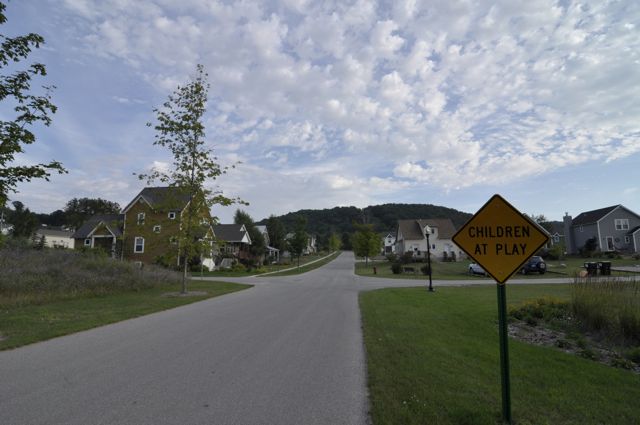
South of Glen Arbor is one of the area’s newest housing developments, Empire’s “New Neighborhood”. As an extension of the historical grid, the village has an authentic vehicular, pedestrian and spatial connection to future homes. The sizes of the lots are proportional to the small village of Empire and will allow for increased interaction and community growth without acting as a single entity. Amazingly, this is a privately developed part of the community that doesn’t look like a gated community! One of the developers, Bob Sutherland, has recently built a new home in Glen Arbor that is just steps away from his local business, Cherry Republic. This is one of the most recent homes to incorporate a retail space in its first floor, honoring a progressive requirement for residences within the business district. Sutherland’s New Neighborhood and home should be seen as models for new development in or around downtown Glen Arbor.
Density and community
As the village is increasingly realized as a home instead of a destination, those who have been “grandfathered in” might demand peak population. Density can be an intimidating term to use. It may be what the vacationer is attempting to escape when going “Up North”. However, the dynamic created between locals and tourists allows for a friendly close-knit atmosphere among crowds, different from the interaction among strangers in urban environments. You will most likely never see dads and daughters dancing while out to eat at Applebee’s; you may see this on the deck at Boone Docks, however. Density here equates to community and it is a sense of public unity that brings strangers together. Without building density, you might never create the convergence necessary to even know your own neighbors.
It is crucial to the integrity of Glen Arbor to not only respect its iconic role as a natural conservation area but also that the village has the ability to change and continue to grow. Encouraging smart growth and sustainable development will keep Glen Arbor on the map as not only a resort destination but also a beautifully kept centerpiece for the Sleeping Bear National Lakeshore.