Stepping on toes. Tariffs, boycott of U.S. goods, threaten Farmer Foot Drums existence
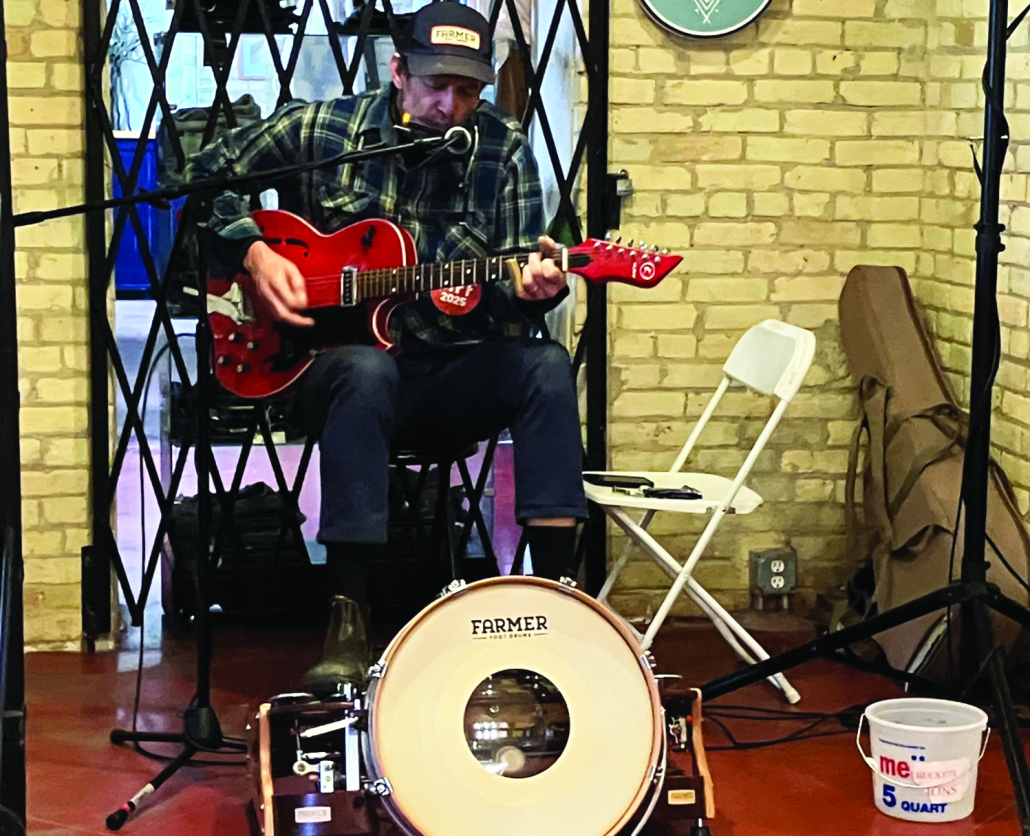
Photo: Pete Farmer jams at the Indoor Folk Festival in Traverse City on Feb. 23.
By Jacob Wheeler
Sun editor
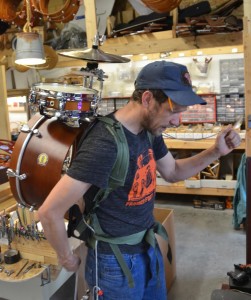 Pete Farmer doesn’t project the air of someone who might lose his business—what he calls his “identity.”
The founder of Farmer Foot Drums, who builds craftsman instruments from a pole barn at his and wife Kate’s property near Cedar, boasts a light, playful energy. When we met for coffee on a steamy mid-May Friday in Traverse City, Farmer was toweling off from the sweaty bike into town on the Leelanau Trail. Clad in blue jean shorts, colorful striped socks, a worn Farmer Foot Drums t-shirt and a Sendero ballcap, he carried the buoyancy of a young athlete, even though the entrepreneur and musician turned 50 earlier this year.
But Farmer was clear: the Trump administration’s tariffs on Chinese and Taiwanese goods—and the boycott of products made in the United States resulting from Trump’s policies and threats—might cost him his business.
Sales are down by 80 percent since April 2, when Trump declared “Liberation Day” and launched his trade war. Farmer has also weathered canceled orders and issued refunds. He estimates that one-third of his customers are outside the United States. Some of that is Canadian animosity toward American products, in the wake of Trump’s threats to annex our friendly neighbor to the north. (Our story, “Disgusted at Trump, Canadians boycott Michigan travel” published in the May 8 edition.)
Combine that with an additional $3,000 that Farmer paid for imported components, including brackets and bolts. The brackets he buys from China cost 30 cents each, with an additional 20 cents to import them.
“I tried hard to get this ‘Made in America,’” he said. But because he orders a relatively low quantity of 100 brackets at a time, domestic suppliers would charge him $3 per bracket—10 times the amount he currently pays. “Suppliers in China have an amazing sales staff, and they’re really good at what they do. They’ll answer a call in the middle of the night.
“Nobody’s gonna make a 30-cent bracket here.”
Unlike during the last great economic crisis when the global pandemic shut down business worldwide, Farmer said the government is working against him, not supporting him.
“During COVID we were bound together as a world to defeat something that was part of nature,” he said. “The government had our back. The only reason we survived were the COVID relief funds. Now the government is hostile to my brand. ‘USA Made in America’ is not liked right now.”
Farmer Foot Drums was born nearly 20 years ago in Bellingham, Washington, near his hometown of Seattle, where he busked on the streets while in his 20s and stumbled into the world of foot percussion. After listening to John Lee Hooker in his wood shop, Farmer sketched out a rough design for a foot-played acoustic drum kit with multiple sounds. The business launched in 2006 as a nights and weekends project in a rented, single-car garage as he worked by day at a local high school. Following the economic recession of 2008, “the universe conspired and pushed [me] into the business full time,” wrote Farmer.
Kate, also a teacher, gave birth to twins in 2013, and the family moved to Leelanau County during the polar vortex of 2014. The Farmers learned quickly that people up here have their driveways plowed during real winters. Since settling near Cedar, their business has made foot drums and other instruments for the likes of Bob Dylan, Mick Fleetwood, Les Claypool (Primus), Ben Bridewell (Band of Horses) and Garrett Dutton (G. Love & Special Sauce).
Last week, Canadian-American singer-songwriter Neil Young bought a harmonica holder from Farmer Foot Drums. But that’s a notable exception. Canadians aren’t buying U.S. products. One would-be customer wrote to Farmer on Feb. 3: “Unfortunately, due to the situation Trump caused, I won’t go any further with this order. Sorry about that …”
And with lingering fears about a Trump-induced economic recession, many people, regardless of where they live, aren’t spending money on extra amenities.
“You don’t need my products, you want them,” said Farmer, whose products range in price from a harmonica holder at $50 to a 12-pedal drum kit for $4,000. “People are holding onto their money. Our customer base is working musicians—people who perform in brew pubs to make a living. They tell me they get better gigs when they play with foot drums.”
Farmer said one of his goals is to travel the world some day and meet those who have purchased and play his foot drums.
“My customers are the most diverse and interesting people you’ve ever met. Oftentimes they are husband and wife duos. One of the greatest complements I got was when a retiree came down from Petoskey and told me what he wanted to do is play guitar with my foot drums at folk festivals. I had a customer in Japan who got the backpack drum kit after he lost his wife in childbirth. He said, ‘This is what makes me happy.’ Eric Dane Jaqua (previously with the band the Pistil Whips in Petoskey), has bought every product I have made. He told me, ‘I need to make music to be happy.’ To many people, music is the most important thing.
“I make an instrument that only I make. You’re going to give me $3,000-4,000 for an instrument you’ve never seen before or never heard what it sounds like. You’ve never met me. And I say I’ll give it to you in four months.”
But Farmer’s customers tell him that venues’ live music budgets are going down.
“Our large-ticket items, which cost $1,000 and up, are not happening right now.”
Farmer said he currently has $70,000 worth of parts and $60,000 in molds, tooling and dies in the shop. He currently has two employees—one full-time and one part-time—and estimates he needs to make an average of $1,000 in sales per day to keep the business afloat but currently draws in about $200 per day. He’s unsure whether to fire his employees and himself but keep the website going and issue a plea for help on his customers’ electronic mailing list—a move he knows he can only make once.
“Do I tell people, ‘If you’re thinking about getting a foot drum, this is the week to do it.’? Because it feels like I’m going out of business.
“I don’t have $100,000 in the bank to help me wait this out.”
The news of Farmer Foot Drums’ potential closure landed heavy with their children, ages 12 and 14.
“My daughter was emotional. Lucy has for a while thought her first job would be working for her Dad.”
At the Traverse City coffee shop, Farmer and I laughed when a bird flying overhead shat on my keyboard the moment he mentioned Trump by name. Then he sat back in his chair and grew reflective.
“I don’t make a lot of money. I do this job because I love it. This is my identity. It’s what I’m good at. This is also what the world wants. If you want to be Bert’s one-man band from Mary Poppins, this is what you get.”
Farmer said he didn’t want any pity if Farmer Foot Drums goes under.
“This is not about me not knowing how to run a business. Everything was fine until [Trump] came along. I don’t want pity, I just want people to know, this is an unforced error.”
Visit FootDrums.com to learn more about Farmer Foot Drums and Pete Farmer.