Stephanie Schlatter: Finding the Extraordinary in the Everyday
By Katie Dunn
Sun contributor
For centuries, the arts have recognized and illuminated the profundity of everyday life. The practice of depicting ordinary, shared social spaces as enduring images is what art historians refer to as genre painting: works that transform the familiar into the extraordinary, revealing the poetry, light, and rhythm embedded in lived experience.
Think: from the crowded, unvarnished portrayals of taverns and markets by Adriaen van Ostade (1610-1685), to the smoke-filled cabarets of Montmartre immortalized by Henri de Toulouse-Lautrec (1864-1901), to the closely observed cafés of Paris captured by Édouard Manet (1832-1883), and then to the bustling urban gathering places depicted by John Sloan (1871-1951).
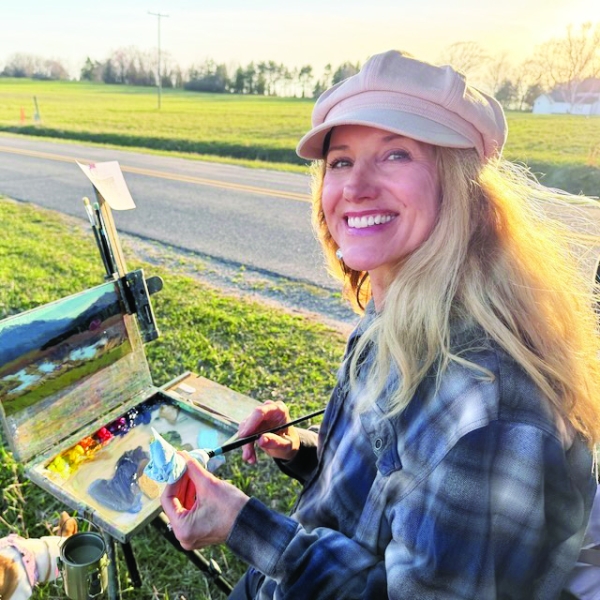
Stephanie Schlatter
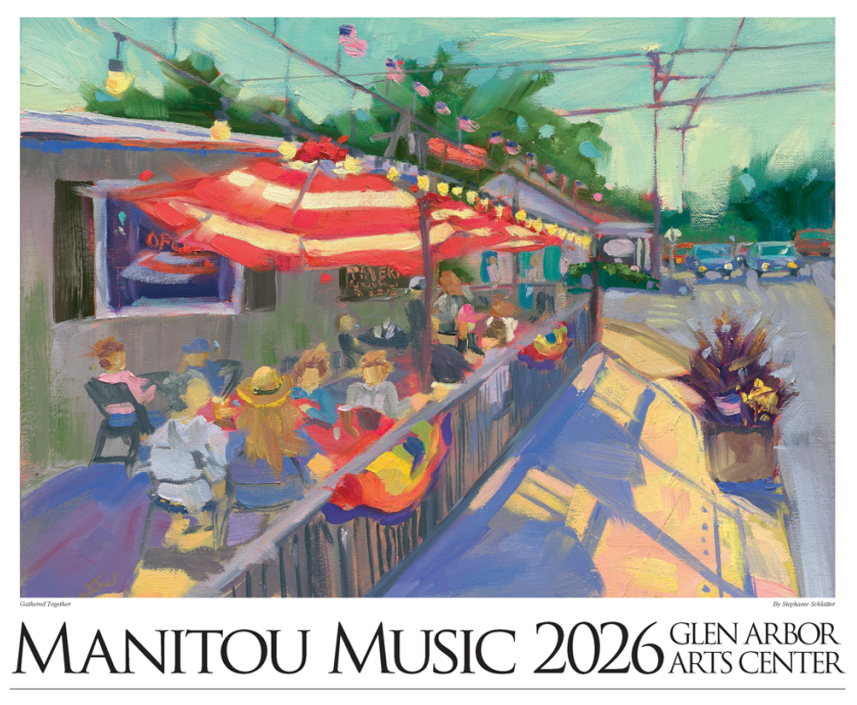
It is within this tradition that Stephanie Schlatter’s painting, Gathered Together, finds its place.
Renowned for her luminous landscapes—renderings of water, sky, and the shifting light of northern Michigan—Schlatter departs from that familiar creative practice in Gathered Together. She instead turns to a more intimate, human-centered scene: the vibrant summer atmosphere at Art’s Tavern in Glen Arbor.
This emphasis on a buoyant, communal vision led to Gathered Together’s selection for the 2026 Manitou Music Poster. Sarah Bearup-Neal, GAAC gallery director and chairperson of the poster committee, explains:
“Stephanie captured a moment that has universal meaning. It’s not just a painting of Art’s. Even though Art’s is, arguably, as iconic a Leelanau landmark as the Sleeping Bear Dunes, the painting isn’t promotional: Stephanie’s painting conveys the pleasures of being together with friends. I think that suggests an element of life in a smaller village that many people value—the joys of hanging out on the village square. Many people have used the adjective ‘happy’ to describe what they see in Stephanie’s painting.”
The artwork featured in the annual Manitou Music Poster is chosen through a collaborative process guided by the poster committee, with Bearup-Neal helping to shape the process through her engagement with artists across the region.
“When it comes time to choose artwork for the poster, we meet as a committee and review images, debate and discuss, then vote on the work or works we feel are the best fit for the project,” she explains. “The poster competition evolved into an invitational project several years ago. Although we accept submissions, we no longer put out an open call for work.”
Historically, the Manitou Music Poster series has centered the region’s most defining natural landscapes—the Sleeping Bear Dunes, Glen Lake, Crystal River, Port Oneida—a reflection of northern Michigan’s identity shaped by water, sand, and sky.
Intermittently, the series has also featured heritage structures such as D.H. Day Barn, Glen Haven Cannery, and North Manitou Shoal Light Station—sites preserved within Sleeping Bear Dunes National Lakeshore that function as enduring markers of regional history.
 Schlatter’s subject occupies a different category altogether. Art’s is not a preserved historic landmark in the conventional sense, but it is nonetheless iconic—a veritable cultural institution. In that sense, Gathered Together extends the Manitou Music Poster tradition beyond landscape and heritage into something more immediate: lived experience.
“We’ve published posters that have in them buildings that are known to all. But Stephanie’s painting goes a step further… Stephanie’s painting moves beyond memorializing a static building. She infused it with life,” Bearup-Neal says.
Schlatter, who has long been drawn to strong contrasts of light and shadow, immediately recognized the scene’s potential. “While I was waiting for a table at Art’s Tavern, I saw this painting waiting to happen—friends, families, couples, all creating memories,” she says. “The color and shadows were irresistible.”
Gathered Together reveals a sunlit moment on Art’s patio: umbrellas scattered, tables filled, glasses glinting, and the familiar rhythm of summer unfolding. Rendered in Schlatter’s signature brushwork, the scene bursts with color, vitality, and levity. The interplay of shadow and warmth shapes not just a place, but a mood: cheerful, inviting, and entirely emblematic of the season. Through her use of color and composition, Schlatter translates the quotidian into the iconic.
For Schlatter, the subject transcends the visual toward human connection. “As a painter, you are really always painting light, but as a human being, these scenes of gathering were calling to me,” she says. “Community is the very heart of our humanity. Yes, the beauty here can’t be beaten, but it’s the people who make it oh so special.”
Schlatter’s painting is instantly recognizable and deeply resonant, reflected in how it is received by those familiar with the scene.
“I love the Art’s Tavern picture that has been selected… I love seeing a painting of a place that I recognize and know exactly what it is and where it is… where the light hits and the road leads,” says Jennifer Jones, part-time Glen Arbor resident and longtime admirer. Of Schlatter’s work, she adds, “Her choice of vibrant colors and the ability to capture a moment in time—it’s really special.”
This year’s Manitou Music Poster also carries a notable symmetry, a convergence of two timelines unfolding in parallel: Schlatter’s first year as a full-time Glen Arbor resident and Barbara and Paul Olson’s first year of stewardship at Art’s. For Barbara, the piece speaks most directly to what Art’s represents in the everyday life of Glen Arbor:
“Gathered Together—I love the title. It evokes a love of Art’s, captures its spirit, and that spirit is why we bought it,” she says.
“Inherently, we need to be together. Art’s provides social well-being, community, connectivity. The painting is a perfect snapshot of togetherness, sunshine, and joy.”
That sense of connection to place and community, so manifest in Gathered Together, is grounded in Schlatter’s long relationship with Leelanau County.
For more than 30 years, Schlatter has returned to this magical corner of northern Michigan from her hometown of Grand Rapids, first drawn by the natural beauty of Leelanau County and then by a deeper, almost instinctive sense of belonging.
“It was love at first sight,” she recalls. “Each visit pulled me more and more to the area.”
In 2017, Schlatter and her husband, Marc, purchased a cottage on the southern shore of Little Traverse Lake. Months spent painting outdoors from May through October, immersed in the natural landscape, gradually altered her sense of place, with Leelanau County becoming more of a center of gravity.
That long, quiet magnetism ultimately resolved into permanence. “Moving to Glen Arbor [this past February] has felt less like a decision I made and more like a journey that unfolded naturally,” she says. “If you’ve ever felt an inexplicable pull toward something, where everything seems to align perfectly, you’ll understand what I mean.”
Schlatter’s roots in the Glen Arbor arts community have strengthened through her new volunteer role with GAAC’s communications and marketing committee. Georgia Gietzen, GAAC board member, emphasizes the importance of artists like Schlatter participating directly in the organization’s leadership and visioning process:
“We are thrilled to have Stephanie join our communications and marketing committee. It’s very important to the Glen Arbor Arts Center that we have artist voices on our board of directors and at the committee level. We speak to many different audiences and that needs to include the many artists that are members and users of GAAC. By having Stephanie on that important committee, she will be a voice for artists and a conduit for feedback from that community as we help shape strategic vision for GAAC marketing and communications.”
Gietzen further underscores the broader significance of Schlatter’s presence in the region’s arts ecosystem:
“The Leelanau Peninsula, with all its natural beauty is a mecca of sorts for artists, and I think Stephanie’s year around presence here will benefit not only the Glen Arbor Arts Center, but her creative practice and the greater Glen Arbor community… I believe in synergy so the more art we can bring to the community, the better for all of us that value creativity and appreciate the beauty that artists in our area bring into our homes.”
Schlatter’s engagement has continued to deepen, extending from participation at the GAAC into a more established role within the region’s gallery landscape. As of 2024, she co-owns Arbor Gallery in Glen Arbor with Paul Czamanske and David Westerfield, the latter a two-time Manitou Music Poster artist, and the only artist to receive that distinction.
Westerfield notes Schlatter’s arrival has brought renewed vitality to the space. “Having Stephanie join Paul Czamanske and I as a partner in Arbor Gallery has brought some great new energy to our business. Her colorful palette and dedication to her craft have been an exciting addition to our space,” he says.
As part of a broader engagement in the local community, Schlatter recently donated several works from her earlier studio practice to Samaritans’ Closet, the resale shop component of Leelanau Christian Neighbors where proceeds support its food pantry and associated ministries. “This will feed the people of our community,” she said.
Schlatter’s Gathered Together selection as this year’s Manitou Music Poster marks part of a larger unfolding. “This area has always resonated with me,” she reflects. “I show up, I pour my love and creativity into the land, and opportunities arise. It reaffirms my deep-seated belief that this is my home, these are my people, and it was all meant to be.”
To be chosen for the Manitou Music Poster carries a particular weight in her artistic trajectory. “I am so honored and humbled to be among so many great artists whom I admire,” Schlatter says. “It’s hard to explain what a big deal these posters are here locally.”
Over the years, the posters have become fixtures in homes throughout the region and beyond—collected, framed, and revisited.
“People get excited every year,” she adds. “I used to look at them when I was a budding painter and think, ‘Maybe someday.’”
That “someday” now places Schlatter within a lineage spanning more than three decades—a local pantheon reflecting both artistic excellence and an authentic reverence for place. From Suzanne Wilson, a founding force behind the Glen Arbor Art Association (now GAAC) and the first Manitou Music Poster artist, to esteemed contributors such as Westerfield, Margo Burian, Lou Heiser, Barbara Reich, Greg Sobran, Richard Kooyman, Stephen Duren, George Peebles, Jim Frixen, Sally Wille, and Randi Ford, the collection charts an evolving visual history of the region.
Among those who witnessed and participated in the nascency of the Manitou Music Poster tradition is my 83-year-old mother, Kathleen Dunn, whose dune grass painting of Glen Haven Beach was among the first selected for the series.
Recently, sitting together at Art’s, Dunn inquired about the story I have returned to each year in the pages of the Sun: the Manitou Music Poster series. What began as a recurring assignment for me has, over time, taken on a more personal resonance. It is less an obligation than an inheritance, and, in some quiet way, an homage to her.
When I showed her Schlatter’s Gathered Together, Dunn recognized something immediately—not only the social landscape, but its spirit, the enduring pull of a place that never stops revealing itself. Absorbing the piece, she said, “It feels like coming home.”
In that sense, Schlatter’s Gathered Together does what the strongest works in the Manitou Music Poster tradition have always done: it transforms a familiar scene into an experience of belonging. And in doing so, it reflects what the series has come to hold over time—a record not only of place, but of return.