Scratching the right itch

By Dan Wanschura
Sun contributor
Adapted from Interlochen Public Radio’s podcast Points North
 Ron Reimink knew how uncomfortable and annoying swimmer’s itch could be. He spent much of his adult life trying to eradicate it in lakes across northern Michigan. Then one day, he realized he was completely wrong.
Glen Lake is one of the most beautiful lakes in the world—clear turquoise-colored water, with Sleeping Bear Dunes National Lakeshore off in the distance. It was an ideal setting for Reimink’s summer job.
One particularly beautiful day, Reimink, who’s a biologist, was walking around the lake, through the water, up and over docks, doing research on ducks. Then, a couple hours after he’d wrapped up for the day, he started to get this sensation in his legs. He looked down, and there were all these red spots popping up. Each one was around the size of a nickel. They started to itch like crazy.
“And I literally scratched many of them until they bled,” Reimink said. “It was so intense.”
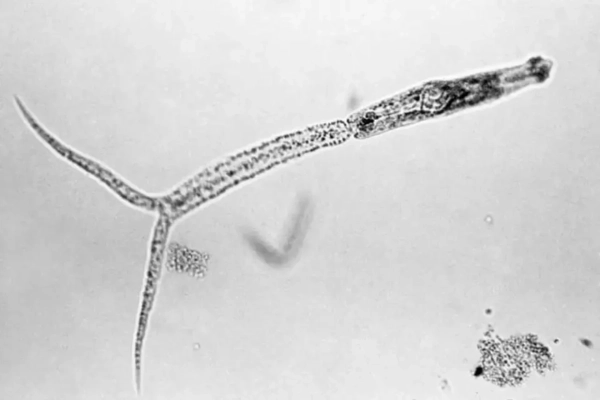
Reimink had a bad case of cercarial dermatitis. Otherwise known as swimmer’s itch. It’s caused by parasites found in lakes across the country, but is especially common in the Great Lakes region.
 Ironically, as a biologist, Reimink spent the better part of 30 years trying to eradicate swimmer’s itch from lakes across northern Michigan. He did this by trapping and relocating common mergansers—a duck that’s often a main carrier of the parasite that causes swimmer’s itch.
But as technology progressed, Reimink realized he had it all wrong. He shouldn’t try to eradicate swimmer’s itch from the lake at all. We needed to change our behavior, not change the lake.
The day Reimink was counting ducks on the lake, he did it on foot, so as not to miss any hiding under docks. He put on his swimsuit, laced up some old tennis shoes, and started walking.
“I was gonna go right along shore hopping docks. In and out of the water,” said Reimink.
Glen Lake is big. Over 6,000 acres. And Reimink walked around most of it that day. Then he got out.
“A few hours later, I started to get this sensation in my legs and about just above the knee down, I started to itch like crazy.”
These red spots appeared. They were big. He says each one was around the size of a nickel.
“My legs were a mess. It would be like if you had a mosquito bite, but you had 150 on each leg… And I literally scratched many of them until they bled. It was so intense.”
For about a week, Reimink caked his legs with calamine lotion, avoided wearing pants and just tried to lay on the couch and not move his legs.
“Because anytime you’d rub against anything, they’d all start to itch again.”
So, what was going on with Reimink’s legs? He knew right away: cercarial dermatitis. AKA swimmer’s itch.
On a scale of 1-10 how bad was it?
“Well, it’s a tough question cause 1-10, it’s not like I had cancer and was going to die…but as far as being uncomfortable, it was up there, you know, eight,” he said.
Reimink’s legs would be back to normal soon enough. But this experience gave him a whole new perspective on just how bad it is.
“You know, you hear stories of grandpas and grandmas like …‘Grandkids don’t ever wanna come back to the lake because they got hammered with swimmer’s itch.’”
Reimink spent close to 30 years trying to solve the problem of swimmer’s itch. Until one day he realized he had it all wrong.
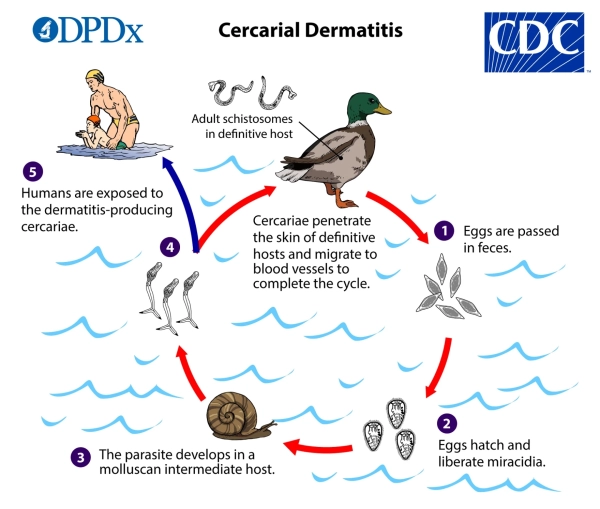
What exactly causes swimmer’s itch? I’ll try to keep it simple. It’s basically this never-ending cycle of parasite soup. Let’s start with ducks. They’re swimming around, eating plants, bugs, fish—all sorts of stuff. And then they poop. Tiny parasites swim out of the poop, looking for a snail. When they find a snail—BAM—they infect it.
Eventually, that snail starts pumping out more parasites. Now these parasites swim to the surface hunting for a duck to infect. This cycle happens over and over again back and forth, back and forth, duck to snail, duck to snail.
But sometimes the parasites get confused. And instead of burrowing into a duck, they burrow into our skin. And some of us have a painful allergic reaction which makes all those red spots. What’s crazy is an infected snail can produce on average two to three thousand parasites a day. And each one of those can cause a red bump on our skin.
Swimmer’s itch was discovered in northern Michigan in 1928 on Douglas Lake. But it’s not just a Michigan problem. It can be found throughout the world and is really common in the Great Lakes region. So a bunch of those states have been trying to fight it for years.
Back in 1980 Robert Karner had just wrapped up his master’s program in biology at the University of Michigan. He taught for decades as a biology teacher at The Leelanau School in Glen Arbor. He also worked as a biologist on Glen Lake.
“I could take over the swimmers itch control program, principally putting copper sulfate in the water to kill snails,” said Karner.
There was a lot of mystery around swimmer’s itch back then. But the thinking was pretty simple: snails carry the parasites that cause swimmer’s itch. So…
“Killing all the snails might be the silver bullet,” said Karner.
Copper sulfate would kill just about everything else too—fish, plants, bugs. But Karner didn’t think much of it. It was common practice back then. So starting in 1981, he’d look for the spots with the most snails in Glen Lake and then dump copper sulfate there.
“It would sink like stones to the bottom, take about two hours to dissolve those stones. And that was when the copper sulfate was poisonous,” he said.
It wiped out all the infected snails. But to Karner’s surprise the swimmer’s itch would eventually come back. So the next year, 1982…
“We doubled or tripled the amount of copper sulfate at great expense. And also employed a crop duster airplane to take the stones and spray them in a broad way over large amounts of where people were swimming.”
Karner says that all cost about $40,000, but still ended with the same result. He remembers speaking at the Glen Lake annual meeting that year.
“People would stand up in the audience and say, ‘What the heck is going on?’ And, and I would tell them, ‘We did our best. …and it didn’t work, and we gotta do something different.’”
That was a turning point for Karner. He knew they needed more information about the parasite they were dealing with. So he called up a biology professor at Hope College who told him the silver bullet wasn’t the copper sulfate. They needed to go after the ducks. And they zeroed in on the common merganser. Mergansers are these diving ducks. The females really stick out because they have this crazy looking mullet.
“We found that the mergansers were fully loaded with the parasite.”
said Reimink. “They had a number of broods on their lake, and they move around a lot. And so we thought, ‘Well, let’s catch them and treat them with a drug and put them right back in the lake.’”
At the time, that didn’t seem that unreasonable. Praziquantel is a drug used to deworm cats and dogs. Maybe it would work on ducks. So they got experimental permits from the federal government to try it out.
Giving all the ducks drugs “did seem like a good idea because, ‘Wow, okay, you only have maybe at most 100 ducks.’ And if you could trap them, … it seemed like … that would be a really good approach,” said Reimink.
But catching the mergansers was really tricky. These ducks are super fast. And they can do this thing where they like run in the water. Then as you close in on them poof they just dive below the surface. So, Reimink and the other researchers tried shining them. Basically head out in a boat after dark and stun ‘em with a powerful flashlight.
“You keep hitting them with a bright light, and they don’t know which way is which because they’re like blinded,” said Reimink.
Reimink would usually be driving the boat. Another guy would be up front wearing a helmet with a spotlight attached to it trying to scoop the birds up with a giant net.
“And so we did that for several years where we were going out, and you wouldn’t even get back till two, three in the morning.”
If all that seems crazy, Reimink said it was. But this was what they were getting paid to do. When they did catch a merganser they’d grab hold of it and either shove the drug down its throat or inject it.
Did the drugs work?
“We did some studies showing that, ‘No, … it doesn’t work. It kills the adult worms, but it doesn’t kill the developing worms that are in the duck,” he said.
That wasn’t the answer people living on Glen Lake wanted to hear. Whatever it took. They wanted it fixed. So Reimink and the Glen Lake Association came up with a plan for the mergansers.
“Well, let’s try to get rid of ’em.”
They made “wanted” posters—wild west style—with the ducks on them. Merganser hunts were encouraged in the fall. In the spring, the birds were scared away with pyrotechnic guns. And if there ever was an unlucky duck that decided to settle on the lake, state and federal agencies gave Reimink’s team permission to catch them and relocate them. Usually to Lake Michigan or Huron.
But they just needed a different way to catch them. Cause Reimink wasn’t thrilled about staying up until some ungodly hour of the night trying to catch the ducks from a boat. At this point, he’d already been doing that for about five years. He came up with a bunch of ideas for trapping mergansers. One involved a chicken-wire fence.
“But they’re so quick that they would sneak out the side.”
He made rafts with spring-loaded nets.
“They wouldn’t go and sit on our rafts.”
He tried dropping nets from docks. He even made a trap that was hooked up to a truck on shore.
“We couldn’t even get the net up. It was so heavy. …It broke. It’s a bit embarrassing to share all of these things that we spent money on and tried and tried and tried until we finally got something that really worked.”
The thing that really worked was a trap that used clear gill netting—about 300 feet of it.
“Underwater in a V shape…with a corral at the end.”
Reimink would wait for the ducks to get in just the right spot and then he’d push a button.
“And boom, the net goes up.”
Then, he’d run over, scoop the ducks up and move them somewhere else.
“And ended up where we actually got rid of the birds.”
No more mergansers left on Glen Lake. But yeah, it still didn’t work. All that money the state and lake associations threw at the problem, all the hours and hours of work Reimink did. Swimmers were still getting the itch.
“We’re kind of like, ‘What’s going on?’ We didn’t really know.”
Then something happened. It was 2015. Reimink had studied swimmer’s itch on and off for almost three decades. And he met Patrick Hanington. That’s when Reimink’s whole take on swimmer’s itch started to change. Hanington is a parasitologist at the University of Alberta. When he heard about Reimink’s approach—trapping the mergansers then relocating them—he was completely baffled.
“The parasitologist in me was kind of like, ‘There’s no way that this will work because in Alberta we just have so many species that can cause swimmer’s itch.’,” said Hanington.
Hanington knew that other ducks, geese, swans, all sorts of other birds had parasites that also caused swimmer’s itch.
“So if you got rid of one, … you’d probably have no noticeable effect,” said Hanington.
“We didn’t know, we didn’t have the technology to discover that,” said Reimink.
Reimink didn’t have it, but Hanington’s lab did.
“Ron needed the tools that we had. … So it was really like a perfect match,” said Hanington.
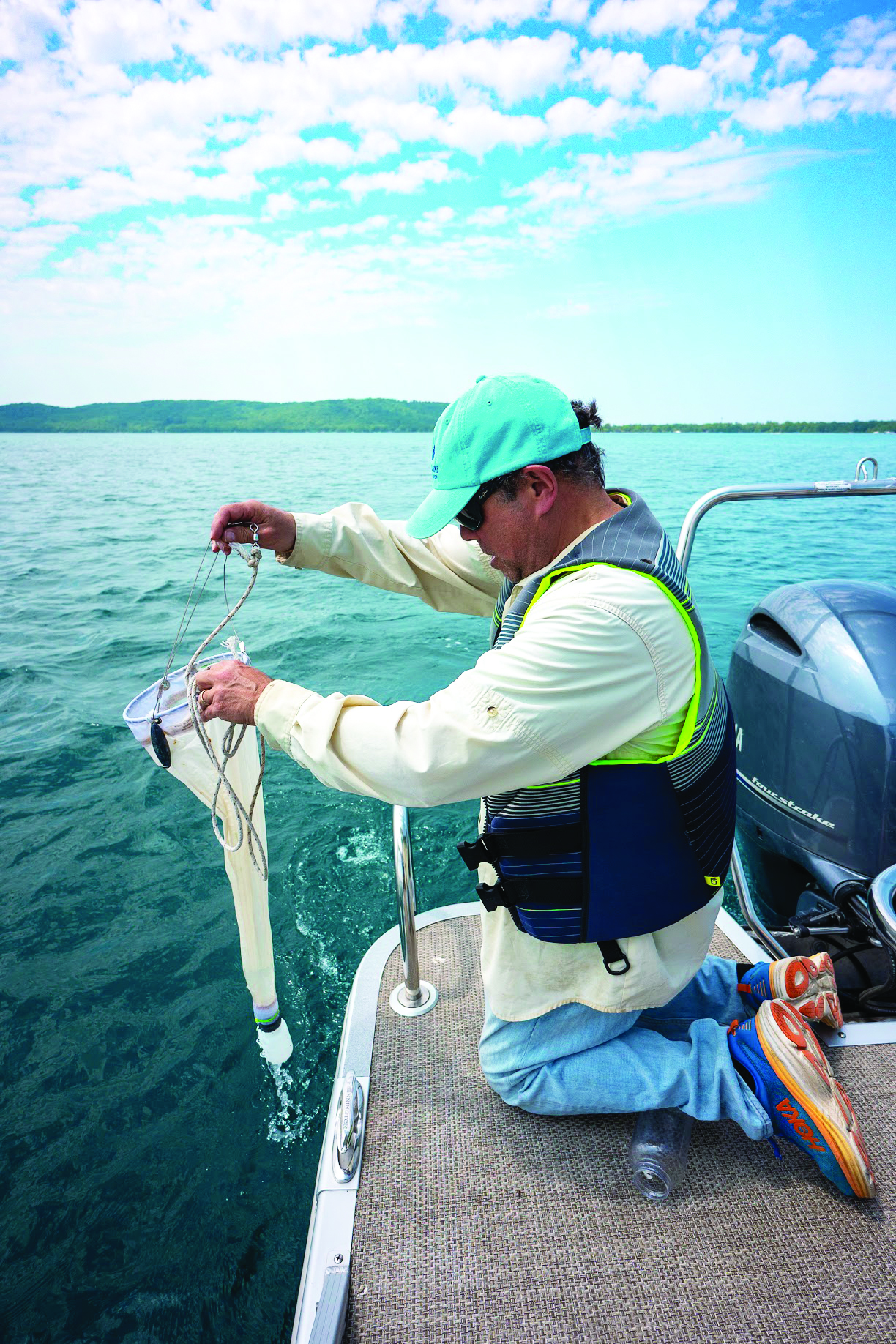
Reimink had been sampling duck poop, which was kind of limiting because it was hard to figure out the amount of parasites actually in the water. But Hanington’s lab could analyze the water itself. Reimink would send them samples. And they’d look at how many different parasites were in there and what birds they were coming from.
“We’ve probably learned more in the last five to seven years than I did the previous 30 years because of the technology,” said Reimink.
What Reimink learned from those water samples was really surprising. Sure, mergansers were still public enemy number one on Glen Lake. They had a lot of parasites. But Mallard ducks and Canada geese had a lot of swimmer’s itch parasites too.
It was a huge, eye-opening experience, said Reimink. He realized that trapping and relocating was just not going to work. He really couldn’t keep mergansers, mallards, and Canada geese off the lake all the time. Around that same time he learned something even more important too. More research started coming out on the parasite larvae. Yeah, they cause incredibly miserable swimmer’s itch, but it turns out they’re a really important part of the food chain. All sorts of aquatic creatures like larval insects and fish eat them.
“The newest science that is out is that these parasites that are coming from the snails are vitally important to the ecosystem,” said Reimink. “And they’re measured in … it’s hard to imagine, but tonnage, the tons of these worms that are being produced every day in the, in these waters. … It’s a massive amount of biomass that is there, because these things are food.
If you have that many parasites, it’s a different way to look at it, but that’s a really healthy thing because they are part of the food chain, part of the food web.”
By this point, Reimink had spent years of his life trying to get rid of swimmer’s itch. He had an entire business built around getting mergansers off lakes. But now he started to realize he had been wrong about it all. It was nearly impossible to get rid of swimmer’s itch, and by trying to get rid of it, he had actually been hurting the lake ecosystem.
“I don’t know if embarrassment is the right word, but you know, they put money into us for years. Lake associations funded what we were doing, and we were telling them, ‘This is the way to go, and this is the way to go.’ And then we realized, … it’s not the way to go. … Many people have the misconception that science, you get the answer, and that’s that. That’s not how it works. Science is a continual, let’s do more research and learn more. And as we learn more, we change our views.”
Just like Reimink did. He did a complete 180. Instead of trying to get rid of swimmer’s itch he started educating people about how to avoid swimmer’s itch. Like don’t change the lake. Change your behavior.
“Empower the people. Empower the people to prevent it, you know, show them ways to prevent it, and they can do it themselves.”
Reimink says you should think of swimmer’s itch more like mosquitoes.
“How do we prevent mosquitoes from ruining our barbecue that we’re gonna do? … Put long-sleeve clothes on, you can put deet … repellent on, you can screen in your porch. … And so there are different ways where you can still grill out and have fun even though the mosquitoes are there, and you’re not interrupting and disrupting the ecosystem.”
So he looked at the results from the water samples and figured out what people should do to avoid swimmer’s itch. One thing he learned was that the parasites were more concentrated in the morning when the snails release them.
“So yeah, okay, go do something else in the morning and swim more later in the afternoon.”
Reimink also figured out that wind and waves push the parasites toward shore. So swim in deeper water. Other things you could do, wear a rash guard, use a baffle, and there’s also preventative creams and lotions you can use.
“Do you want a breathing, diverse lake ecosystem that’s healthy? Or do you want a swimming pool? … It’s a behavioral change. You have to change your behavior.
Alright. I am here at Glen Lake. It’s about five o’clock. … I figured a good way to end this story would be to put my money where Reimink’s mouth is, which is to say I am going to swim late in the afternoon like this. I am going to move quickly through the shallow part of the water, try to get to some deeper water real quick, and hopefully not get swimmer’s itch. Wouldn’t that be ironic?
The water temperature is pretty nice. I can see snails on the lake bottom. … I’m gonna go all in here. Alright. Wish me luck. Here we go.
Changing your mind can be hard. Especially when new scientific research puts more responsibility on us and less on someone else’s silver bullet.
But if you think about it, we actually have a bit more control now. We don’t have to wonder if researchers managed to get rid of swimmer’s itch. We can take matters into our own hands.
Alright guys. It’s just past 8 pm. It’s been a few hours since I went swimming in Glen Lake. And happy to report no signs of swimmer’s itch.
So I’m only a sample of one, but it looks like Reimink is probably right.