
Revisiting the Empire shoreline—beach boulders, concrete slabs, and high water
By Mary Sharry
Sun contributor
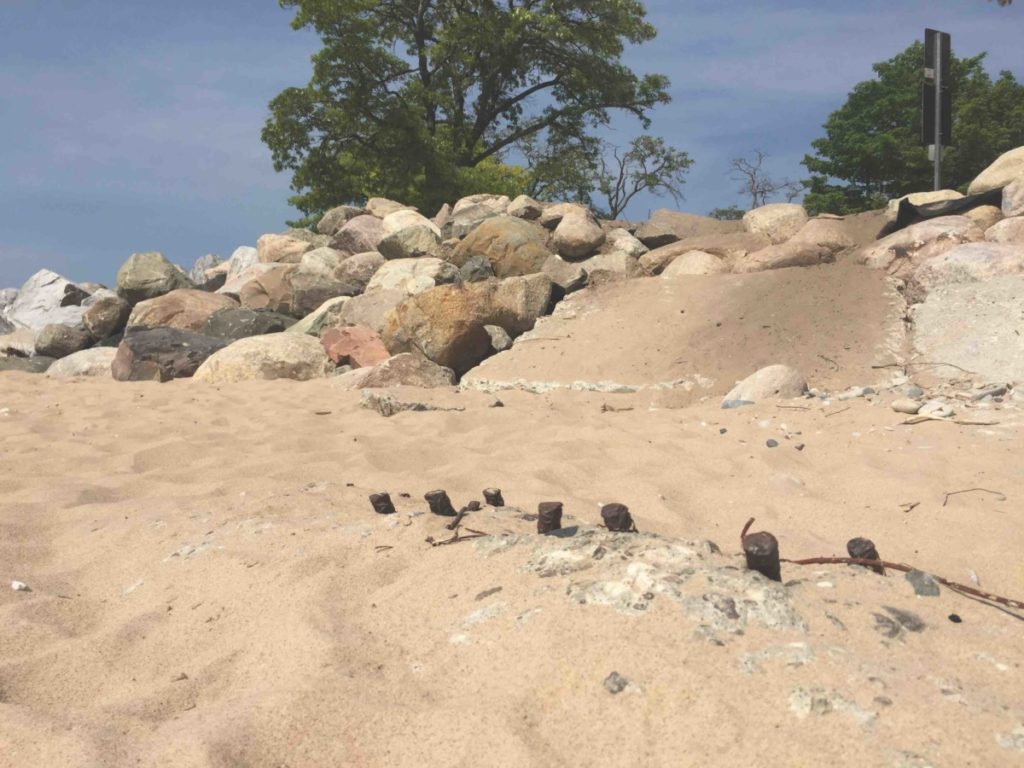
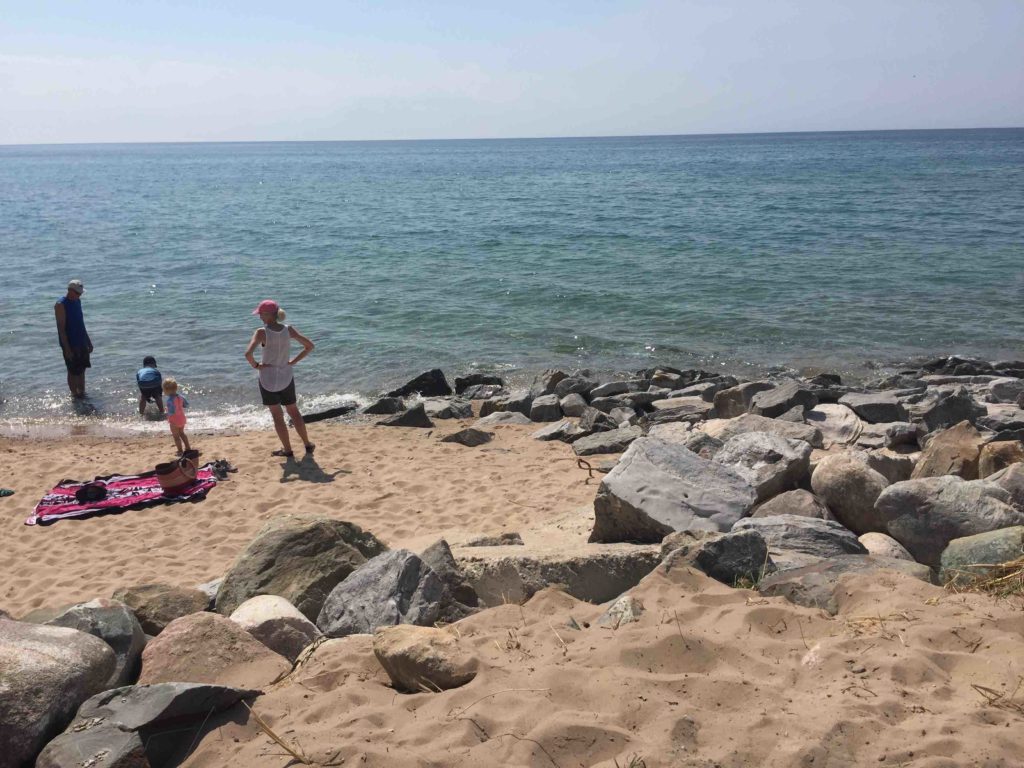
High Lake Michigan water levels—which set a modern-day record in 2020—and wave energy likely deflected by the beach boulders and rock armoring erected last fall by Storm Hill Association homeowners south of the Empire public beach have made it more challenging to walk the shoreline toward Empire Bluff in the Sleeping Bear Dunes National Lakeshore. The period of high water has also re-exposed concrete slabs that were placed on the public beach shoreline in the 1980s to protect the parking lot area. 1986 marked the previous high-water record before it was eclipsed last year. The Empire Village Council is considering using sandbags to make it easier to climb across the concrete slabs to access the beach. — Editor
Decades after writing the piece “Wind, waves and healing solitude,” I revisit the shoreline to the bluffs along Lake Michigan accessed from the south end of Empire beach. Years ago, in order to protect the shoreline there were concrete slabs positioned at a steep angle so that it became a tricky maneuver to reach the shore. Agile younger folks managed by using quick running steps over the slabs. This old lady found that going backwards on all fours was the safest way down. Fortunately, sand was recently piled atop the slabs affording easier access to the shore.
Mother Nature has played with the shore, exposing rip-rap and once-buried concrete slabs placed on the beach years ago by the village in an effort to prevent erosion. It seems to be a perpetual battle of change. The one thing that does not change, though, is the sense of soulful renewal from the solitary walk upon those changing sands of time, so it is worth the effort to get there.
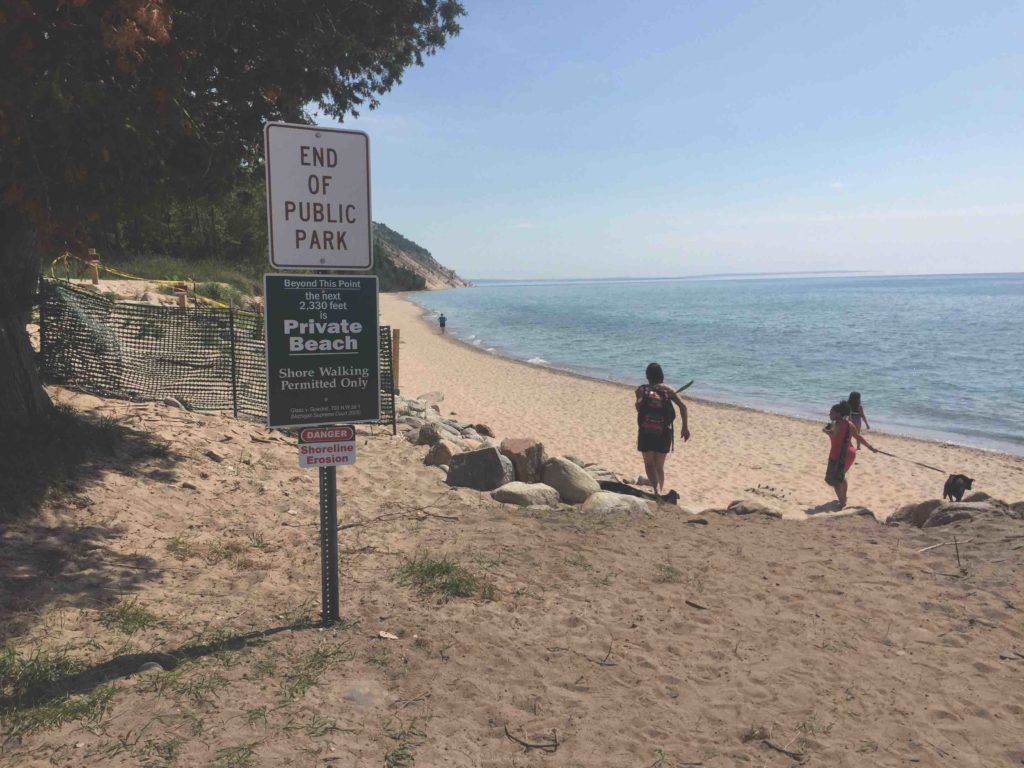
Different today from the three decades since my earlier walk in solitude are signs that read, “End of public beach,” along with a private property sign indicating the State of Michigan Supreme Court ruling in 2005 that permitted shoreline walking. [The United States Supreme Court reaffirmed the public’s right to walk the shoreline along the “ordinary high water mark” even along privately-owned beaches in February 2019 when it declined to hear an Indiana case filed by riparian landowners who live along the south shore of Lake Michigan. Incidentally, the plaintiffs lived in Long Beach, Indiana—the childhood home of Supreme Court Chief Justice John Roberts —Editor]
The court ruling offers an ambiguity in interpretation because shoreline walking is permitted below the high-water mark, a changing factor of the Great Lakes. The Court ruled that beachgoers can walk along the public trust of the beach. Landowners on private, beachfront property are not allowed to restrict anyone from walking within that public trust of shoreline. Just pay attention to the high-water mark. The implication is that when in doubt, walk as close to the water as possible—walk, don’t loiter, don’t sunbathe and don’t set up a beach fire on the shared shore of someone’s private property. Respect riparian rights. It’s a fair trade.
Concrete slabs and rip-rap installed to prevent erosion are not the adversary. If there is one, an enemy to personal and community property, it’s Mother Nature or the lake itself, but change in many directions is inevitable and the lake is a fantastic force. For well over a year we’ve been confined because of a worldwide pandemic. A walk along the Lake Michigan shoreline offers a sense of release from that restrictive period.
My hope is that the many who come to visit the village of Empire and those who live there, too, may continue shoreline walking for the clarity of vision and soothing of soul that the experience offers while at the same time respecting the right of the few property owners along the way. Shorelines were meant for walking and gazing to the far horizon. Refreshing renewal can be found along the changing lakeshore; to get there shouldn’t be a challenge.
Wind, waves, and healing solitude
By Mary Sharry
Originally published in the Detroit Free Press on May 5, 1993, and republished in the Glen Arbor Sun on June 20, 2002.
There are various means of dealing with the complexity of loneliness. For me, a solitary walk along the shoreline of Lake Michigan in the Leelanau Peninsula offers resolution. The northern air, heavy with mist or light and crisp in sunshine and coolness, revives me. I also like to lose myself in minute discoveries along the shore.
I scan the horizon, the expanse of water and the sand where I walk—sand that is heavy and wet from the swell of the tide. I leave footprints, then turn to watch as they are washed away. Sometimes my footprints fall side by side with those of a deer that came down to the water for a drink earlier in the morning.
I pick up a wet, colorful stone and slip it into my pocket—something to take home to show my children.
A snow fence leans in the sand where someone placed it years ago. The once-bright orange wooden slats have grayed with age. The tilt of the fence creates an arc in its shadow. It reminds me of the subtle mystery of an Andrew Wyeth painting—a shadow of something left unsaid that pulls the viewer into a detailed element in the scene.
Old pilings from a dock of another era poke out of the water. From a distance, they look like the heads of seals off the California coast.
A dog follows me on this walk. Head high, he sniffs the air as he trots along. He seems to search for something ancestral to fathom his reason for being here.
For me, however, out here under the expanse of sky, with this enormous body of water before me—this is reality. Nothing else seems to matter at the moment. This solitary walk is my serious business. For the time being, this is the real world.
When do I return? When do I sense I have gone far enough? Usually a feeling of fulfillment or resolve comes to me. Perhaps it is because of the exertion of walking in the sand. I am ready—renewed, refreshed, sometimes enlightened, always uplifted. Sometimes I walk my way out of anger or hurt, confusion, sadness, loneliness, all the emotion human individuality bears.
Vital as human contact may be, there is another side—the singular, the solitary self—that needs to be touched, too. It requires the nourishment of nature. The walk along the shoreline of this great lake soothes and calms.
Sometimes, too, I walk along the beach for no other reason than that it is there. The urge to see distance is fulfilled. I am given a sense of freedom in open space, as I watch clouds build up over blue water.
What a gift! What a treasure—Lake Michigan, the Leelanau Peninsula.

