Protecting Our Own

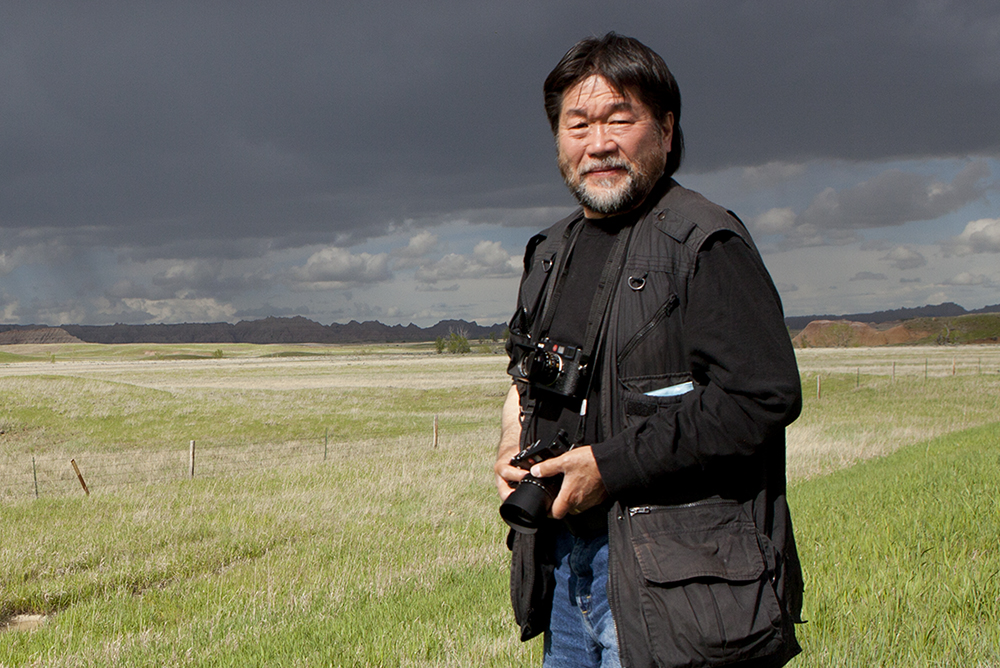
Caption: This photo taken by a motorist shows an undercover agent from U.S. Customs and Border Patrol shortly after detaining a Leelanau County man on March 22.
Leelanau community rallies around family in crosshairs of immigration enforcement
By Jacob Wheeler
Sun editor
The meals, the donations, the hugs kept arriving—from neighbors, from friends, from the community at large. The door never stopped opening and the telephone never stopped ringing for an immigrant family who has lived in Leelanau County for nearly two decades but faced the specter early this spring of being torn apart by the politics of U.S. immigration enforcement.
“People kept arriving to help,” said the wife of the immigrant (who will remain anonymous because his legal case is not yet resolved). “Some we knew. Some were friends of friends. Others were strangers.”
An online “Meal train” was established to coordinate food deliveries for the family during the nearly four weeks the detained immigrant was held in the Chippewa County Jail in Sault Ste. Marie, Mich. Every day boxes arrived containing balanced meals of meat, bread and fruit.
“I visited and saw that her table was covered in Manila folders, and so I offered to make her a dinner,” said Suzanne Couturier. “She was nervous about leaving the house, and so buying groceries was not something she could do easily. She felt the need to stay close to her kids and not take any risks. Every time I was there, we were interrupted by people stopping by—people she barely knew—who had heard about what happened and simply wanted to help. Some had armloads of groceries and household goods like toilet paper. One person even brought Easter Candy.”
After the immigrant returned home, community members continued to visit to welcome him home.
“This place has long felt like home,” he said. “Now we’re even more grounded because people have shown their love. I have always thought this was a good place to live. Now I strongly believe that.”
“I was surprised, to a certain point. There are nice people around here, but I didn’t know they would help us that much.”
The immigrant was detained on the morning of March 22 by undercover U.S. Customs and Border Patrol agents who, witnesses observed, were staking out a county school and waiting for the individual to drop his children off at school. This despite Border Patrol’s “rules of engagement” stated on its website that typically deter the federal agency from operating in sensitive locations such as schools, churches, health care facilities, and public demonstrations.
The detained immigrant has been a longtime fixture in the Leelanau community.
“[He is] a very hard-working man and [has been] part of our community for years,” said Tracy Smedes-Hepler. “He [recently] worked all day at his own business and then came to my house and spent five hours painting because he wanted to help us get our house ready to live in again after our son died in December. I adore this family and am so sad for them.”
“I’ve known the family for 10 years and they are valued community members in Leland,” said Megan Grosvenor. “It’s not Leland without their family.”
Following the arrest and before being transported to the Sault he was allowed to send a single text message to his wife, under the surveillance of the arresting agents.
Startled and scared, she didn’t respond at first. Her first thought was protecting their children and preventing them from learning at school what had just happened—in broad daylight on a Leelanau County highway.
“The hardest moment was telling our kids that he had been taken away,” she said. “I told them when they came home from school in the afternoon.”
Nearly a month later, the immigrant’s young daughter cried and hugged him when he walked in the door around dinner time.
“He looked so thin when we picked him up from jail,” said a family friend who delivered him home from the Sault. “We took him to an Applebees to eat on the way back. His wife had told me to feed him,” she laughed.
His wife made his favorite Mexican meal that night—molè served with beans. He wasn’t immediately hungry but tried to eat a little at a time. The small food portions in jail must have made his stomach shrink, he surmised. Bit by bit, his appetite returned. The molè was delicious.
Nervous about the situation, the family hopes to maintain a low profile, even as they express gratitude to the community for helping them. This summer, they hope to spend time at the beach, swimming, picnicking and enjoying life on this beautiful peninsula they call home.
“Children need to feel safe,” said Molly Grosvenor, program director at the Leelanau Children’s Center. “This is absolutely essential to healthy emotional development and critical to their ability to learn. Families who are living in fear of a family member being separated and potentially deported are under so much stress.”
“The fact that so many people are speaking out in support of this family speaks volumes about the family but also about the community becoming more educated, understanding, and compassionate about the issues surrounding immigration and how it pertains presently to our neighbors, our kids’ classmates, and our friends who have sometimes come to this country and this community through complicated circumstances and history.”
The immigrant has a message for the wider American community during this time of caustic debate over our immigration policy:
“If people just knew a person who’s in my situation, maybe they would sympathize. People shouldn’t just form an opinion based on what they see on the news, but they should meet someone in my situation. We just want to be together as a family.”
Did Border Patrol violate its “no go” zone?
The arrest, and the manner in which it happened, sent shockwaves through the community.
Rob Sirrine was dropping off his children at the school when he witnessed what he described as a black F-150 Ford pickup truck parked next to an adjacent church, allegedly monitoring people as they entered the school. He then observed the pickup leaving the neighborhood at an elevated speed. Minutes later, Sirrine saw the black pickup had pulled over a minivan on the side of a county highway. It was two undercover Border Patrol agents, wearing what he remembered as flannel shirts, sunglasses and winter hats. Under different circumstances, he might have assumed they were construction workers or students late to class.
“They are lurking around schools and driving unsafely,” Sirrine wrote on Facebook later that day “You would think that with all of the issues around schools, the federal government would have more tact than that.”
Border Patrol operates within a 100-mile “border zone” and since Michigan is surrounded by the Great Lakes, the federal agency considers the entirety of the state as falling within that zone. Recent immigrant arrests in northern Michigan have been attributed to Border Patrol rather than to Immigration and Customs Enforcement (ICE).
But both Border Patrol and ICE typically observe rules of engagement that deter them from operating in what they term “sensitive locations”. According to the Border Patrol’s website: “locations covered by these policies would include, but not be limited to:
- Schools, such as known and licensed daycares, pre-schools and other early learning programs; primary schools; secondary schools; post-secondary schools up to and including colleges and universities; as well as scholastic or education-related activities or events, and school bus stops that are marked and/or known to the officer, during periods when school children are present at the stop;
- Medical treatment and health care facilities, such as hospitals, doctors’ offices, accredited health clinics, and emergent or urgent care facilities;
- Places of worship, such as churches, synagogues, mosques, and temples;
- Religious or civil ceremonies or observances, such as funerals and weddings; and
- During public demonstration, such as a march, rally, or parade.
Both schools and churches are seemingly included in Border Patrol and ICE’s “no go” zone.
“Enforcement actions may occur at sensitive locations in limited circumstances, but will generally be avoided,” the federal website continues. “Officers and agents may conduct an enforcement action at a sensitive location with prior approval from an appropriate supervisory official, or if the enforcement action involves exigent circumstances.”
Customs & Border Patrol public affairs officer Kristoffer Grogan confirmed the March 22 incident. The arrest, he wrote in an email, “was the result of a traffic stop and did not occur at a high school.”
“Our Agents do not stake out at schools,” Grogan added in a follow-up email from his Macomb County office. That claim directly contradicted Sirrine’s eye witness report.
Leelanau County police played no part in the March 22 detention. Sheriff Mike Borkovich and other deputies maintain they had no prior knowledge from any federal agency that an arrest was about to happen. Borkovich was out of town, in Florida, watching his son pitch in a Minor League Baseball game.
In fact, shortly after the arrest, Undersheriff Steve Morgan, acting on a tip from someone else who saw the arrest taking place, took it upon himself to visit the home of the detainee and speak to his wife to learn what had happened.
“I told her we’re local law enforcement and had no part in this,” Morgan said.
The increased U.S. Customs and Border Patrol presence here exposed a rift among Leelanau County officials, and a terse email exchange between Sheriff Borkovich and other elected officials in early April. Using a Freedom of Information Act request, the Glen Arbor Sun acquired the email correspondence, which is available here.