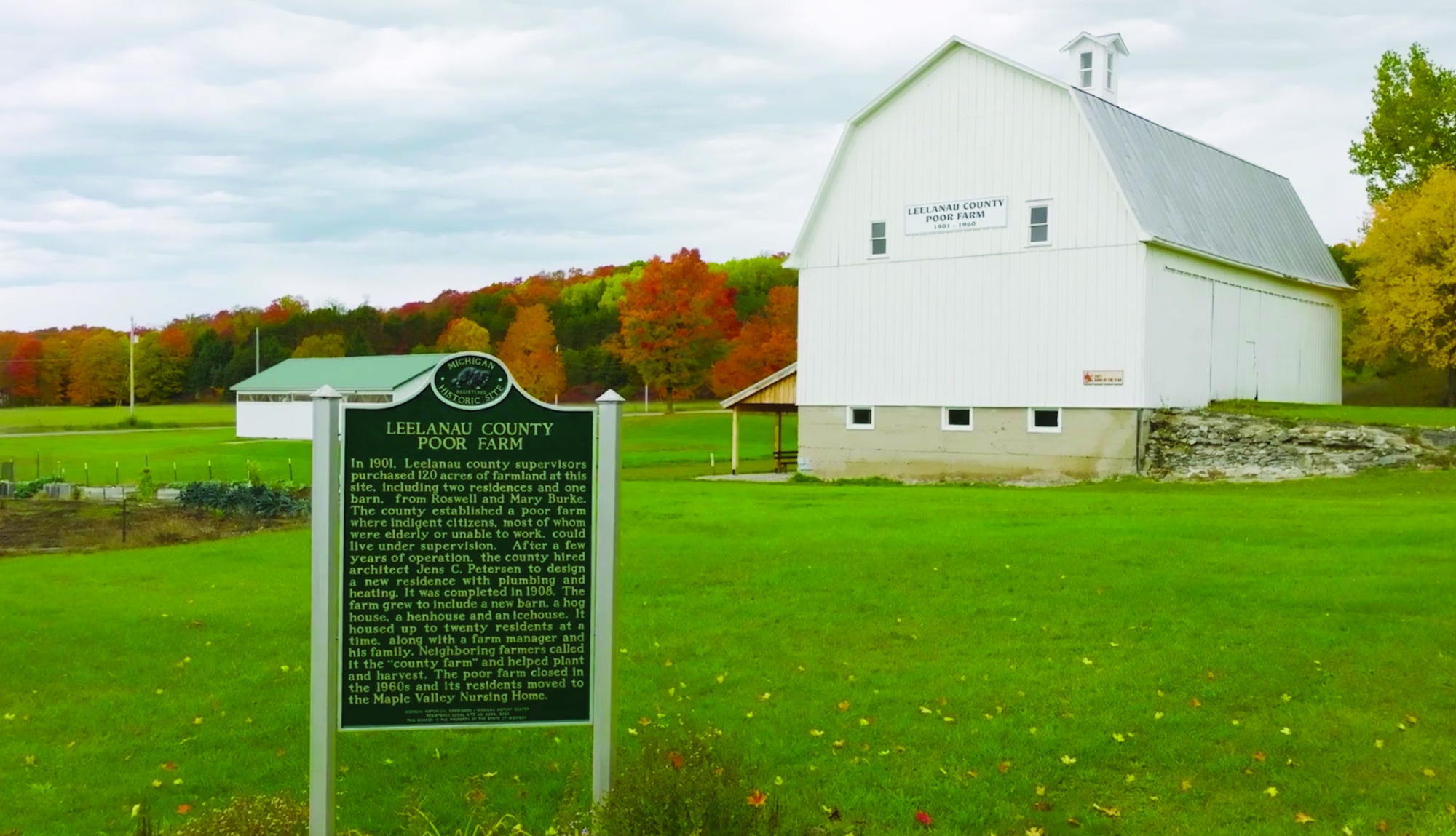
Poor Farm Barn gets Michigan historic marker

From staff reports
The Leelanau County Historic Preservation Society (LCHPS) is pleased to announce that a public dedication of the Michigan Historic Marker for the Leelanau County Poor Farm and Barn will be held on Saturday, July 10, at 11 am at the Leelanau County Poor Farm, located at 1110 W. Burdickville Road near Maple City.
The marker honors the Leelanau County Poor Farm and the Poor Farm Barn. The Michigan Historical Marker Program was established by the Michigan State Legislature and signed into law in 1955. Since then, more than 1,700 markers have been placed all across the state and in several other states and Europe, making Michigan’s program one of the premier marker programs in the nation.
Each marker reflects important stories of place, events and people noting the importance a community places on its heritage and legacy. A marker dedication ceremony is an event of commemoration and celebration that introduces a lasting area resource for heritage, education, and cultural tourism.
In 1901, Leelanau County supervisors purchased 120 acres of farmland at this site, including two residences and one barn, from Roswell and Mary Burke. The county established a poor farm where indigent citizens, most of whom were elderly or unable to work, could live under supervision. After a few years of operation, the county hired architect Jens C. Petersen to design a new residence with plumbing and heating. It was completed in 1908. The farm grew to include a new barn, a hog house, a henhouse and an icehouse. It housed up to 20 residents at a time, along with a farm manager and his family. Neighboring farmers called it the “county farm” and helped plant and harvest. The poor farm closed in the 1960s and its residents moved to the Maple Valley Nursing Home.
In the 1970s the Cedar-Maple City Lions Club transformed the Leelanau County Poor Farm land into the Myles Kimmerly Recreation Area. This barn is the only surviving structure from the farm. It is architect-designed, which is unusual for a barn. Petersen designed it to replace a barn that burned in April, 1911. He incorporated the latest materials and techniques, including a concrete foundation and plank framing. His design featured a gambrel roof before the style became commonplace. John Schettek built the barn during the summer of 1911 at a cost of $1,400. It contained four work horse stalls, nine milking stanchions and seven hay chutes.
In 2017 the Leelanau County Historic Preservation Society formed to save the barn from demolition and began rehabilitating it.