Moraine and SMQ Consulting launch Leelanau Business Digital Vitals Dashboard

Dashboard highlights most prevalent website issues & online opportunities, based on recurring analysis of more than 100 Leelanau County businesses
From staff reports
Moraine (owned and curated by Leland resident Kelsey McQuown: read about Moraine here) and SMQ Consulting (her husband Steve) have partnered to create an interactive online dashboard to visualize the key factors, pain points, and opportunities for Leelanau County’s expanding online business ecosystem. During a time when a business’ online presence is more crucial than ever, the Leelanau Business Digital Vitals Dashboard seeks to help local business owners, chambers of commerce, and economic development organizations identify—and efficiently act on—the most potent opportunities for online business growth and optimization in 2021.
The Leelanau Business Digital Vitals Dashboard compiles, compares, and tracks the public digital vitals of more than 100 Leelanau County businesses—anonymized and aggregated for comparison by location and business sector. This group-level analysis protects individual business data, while exposing clear trends and broadly actionable insights across focus areas of Website Health, Site Speed, Structured Data, Backlinks/Authority, and Social Media.
The Glen Arbor Sun caught up with Steve McQuown to ask about the Dashboard, and about his and Kelsey’s story.
Sun: Tell me a little about you and Kelsey, and how you landed in Leelanau County?
Steve McQuown: Kelsey and I met in Chicago, where we were introduced by a mutual friend from my college a cappella days at Northwestern University. At the time, Kelsey was a developmental psychology researcher at the University of Chicago, and I was deeply embedded in Chicago’s performing arts scene.
A lot has changed in the decade since we met, with Kelsey turning sharply to pursue a new (yet felicitous) career as a jeweler, visual artist, and arts advocate, and with my own departure away from the arts into a career as a digital strategist. We’ve always prioritized independence in our professional lives, and sought to create businesses that would allow flexibility of both the projects we take on, and the places they take us. We left Chicago and bought a camper van in New Zealand, followed by a year or two in Minneapolis building a health-tech startup. Despite the fantastically varied cuisine, bars, and art venues on every corner (I do miss that), our time in Minneapolis firmly solidified our hunch that the city life just wasn’t for us, and we decided to find a place much more suited to build our first home.
As a Michigan native—originally from Frankenmuth, and a graduate of the University of Michigan—Kelsey knew just where to start the search; on her recommendation, we headed to Michigan’s west coast. We arrived in Leelanau County in 2017, bought land, got married, and broke ground on our home the same month as the wedding. I’m truly surprised we made it through, and that we’re here to talk about it today.
We were drawn to the Leelanau Peninsula by the lakes, the dunes, and especially the sunsets over Lake Michigan. Kelsey truly aches to miss a good sunset, and I’d drive or hike farther than I’ll admit to explore a wetland, boardwalk, or cedar swamp. We found in Leland a quiet, secluded place to build a home, while embracing the vibrancy and energy of the Leelanau community, which offers a unique blend of natural beauty, artistic appreciation, and entrepreneurial energy. We’re thankful everyday to live in such an incredible place.
Sun: What was the impetus for you creating the Leelanau Business Digital Vitals Dashboard, and why is it necessary for the community?
McQuown: When we first arrived in Leelanau County, we were struck by one particular, unexpected inconvenience about the area. No, it wasn’t the M-204 turkeys in the middle of the road, or the slow-moving Subaru drivers (I think I am one). It was the difficulty we faced finding accurate, up-to-date information online about the businesses we hoped to visit and patronize; we found ourselves heading to stores that Google Maps insisted were open for hours yet, only to find they had closed for the night, moved across town, or shut down for the season. It became clear to me that having a robust, up-to-date online presence was not a priority for most local businesses—and at that time, in this beautiful, peaceful place, perhaps it didn’t really need to be.
Then, 2020 brought an especially tumultuous year for small business owners. With in-person shopping and dining on pause, businesses of every shape and size were forced to pivot to rely on their online presence, often piecing things together as quickly and frugally as possible, with limited online experience and expertise, and a global pandemic to contend with. This has been a challenge for businesses across the country and across business sectors, and (I’m finally getting to your question) it is a challenge that I felt we’d be uniquely suited to help address.
As a digital strategy consultant, I’ve spent years advising enterprise businesses on how to better understand, optimize, and leverage their online presence, but I have admittedly struggled to find ways to apply that same expertise to hyper-local small businesses (which often have extremely limited time and available resources). Kelsey, being a creative small business owner herself, has been integral in taking those same key strategies and making them attainable at smaller scale. The Leelanau Business Digital Vitals Dashboard is a first step toward making enterprise-level digital strategies and tools accessible to Leelanau County’s small business owners.
We’ve found that the majority of website issues and opportunities are common across Leelanau’s online businesses; the Dashboard helps us to identify and elevate those specific issues, to spark conversations about these important topics, and to provide some widely-applicable guidance for improvements moving forward.
Sun: In short, how (and where) can Leelanau County businesses expand online? Can you offer a couple tips?
McQuown: High level, businesses will be best served by maintaining their presence across a range of digital channels—their website, social networks, local business listings, email newsletters, digital advertising, etc. Time has shown us that apps and social networks come and go; like diversifying your stock portfolio, diversifying your online and in-person efforts will help protect your business in the long-term.
More tactically speaking, your website should be the center of your business’ online presence, as it’s one of the few digital channels that you fully control. Focus on optimizing your website for two main audiences—humans, and search engines. Humans will appreciate a fast-loading website with clear calls-to-action, useful and engaging content, and intuitive mobile-friendly navigation. Search engines consider pagespeed and site infrastructure as well, but also rely on certain technical elements in order to understand—and drive traffic to—your website. Page titles, meta descriptions, structured data, and image alt tags are a few of these essential elements, which, if ignored, can have a major negative impact on your website rankings and traffic (even if your website does look great to humans).
Lastly, I can’t stress enough the importance of checking in on your digital analytics regularly. Make a point to review your progress on a monthly basis, and set goals for the month ahead. Your digital efforts are (or, will be) the most trackable—use that wealth of data to stop guessing what works, and start making data-driven business decisions.
Now that I’ve got your head spinning with advice—here’s the most important thing. Don’t let yourself get bogged down in the pursuit of perfection. Instead, focus on using whatever available time and resources you have to make progress on the digital areas that are most important to your business. Even an hour can be enough time to make progress, if you know where to start. We hope that the Dashboard can help you to find that starting point.
Sun: I’m taking a look at the beta version of your dashboard now. What are the key ingredients to make a website “healthy”?
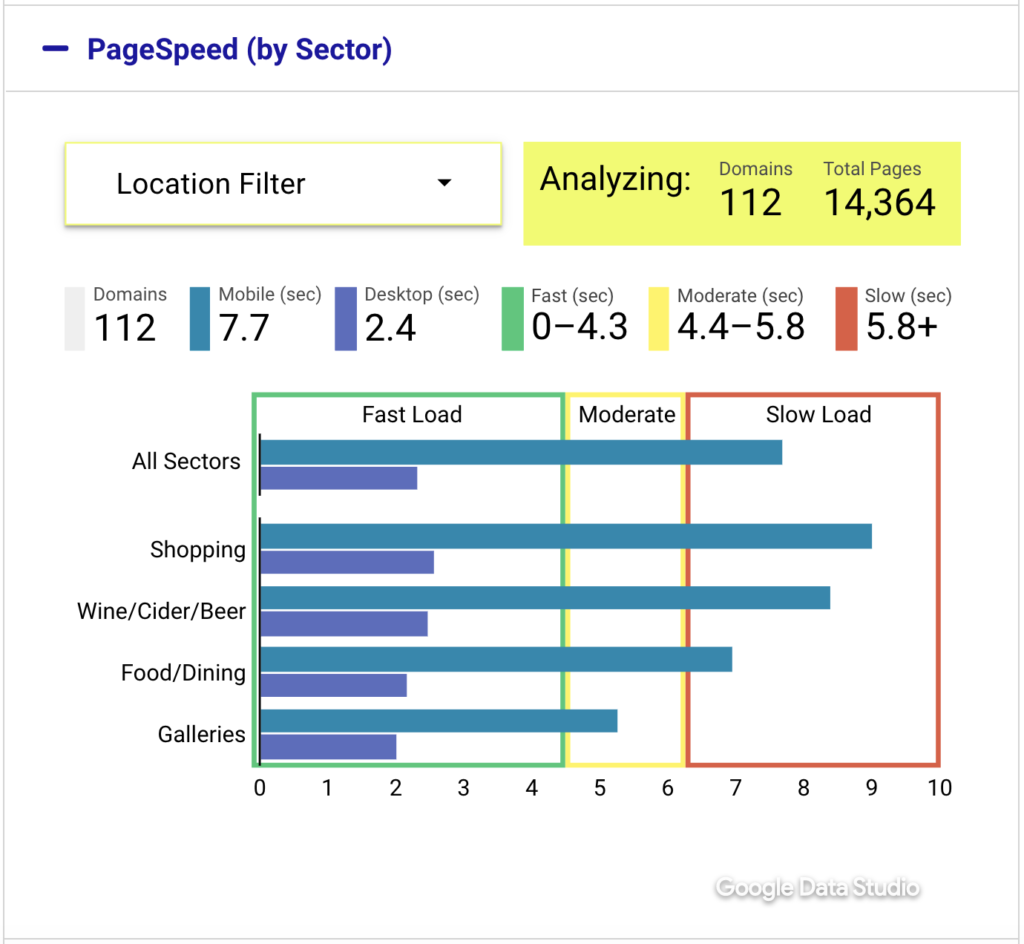
McQuown: In this Dashboard, we’re scanning each page of every website for over 110 different health factors, which can be roughly grouped into categories of PageSpeed, Crawlability, Security (HTTPS), Performance, Content, Infrastructure, Markup, and Backlinks/Authority.
Admittedly, it’s a lot to consider. However, the goal here is not perfection—but instead for each business’ website to be as “healthy” as needed to effectively achieve their business goals. Improving site health is not the goal, but instead the means to an end of driving increased online authority, website traffic, revenue, and customer satisfaction.
Sun: It looks like only 3 percent of websites of Leelanau businesses are considered “healthy”. Why are we faring so poorly?
McQuown: That particular “Healthy Pages” stat represents the number of webpages (out of over 14,000 analyzed) with no issues whatsoever—it’s a very, very high bar. That stat looks particularly concerning, but it’s actually not too far outside the norm for small businesses. In fact, websites for businesses at any scale are prone to be rife with technical errors, if not specifically prioritized and addressed — it’s not just a Leelanau County affliction.
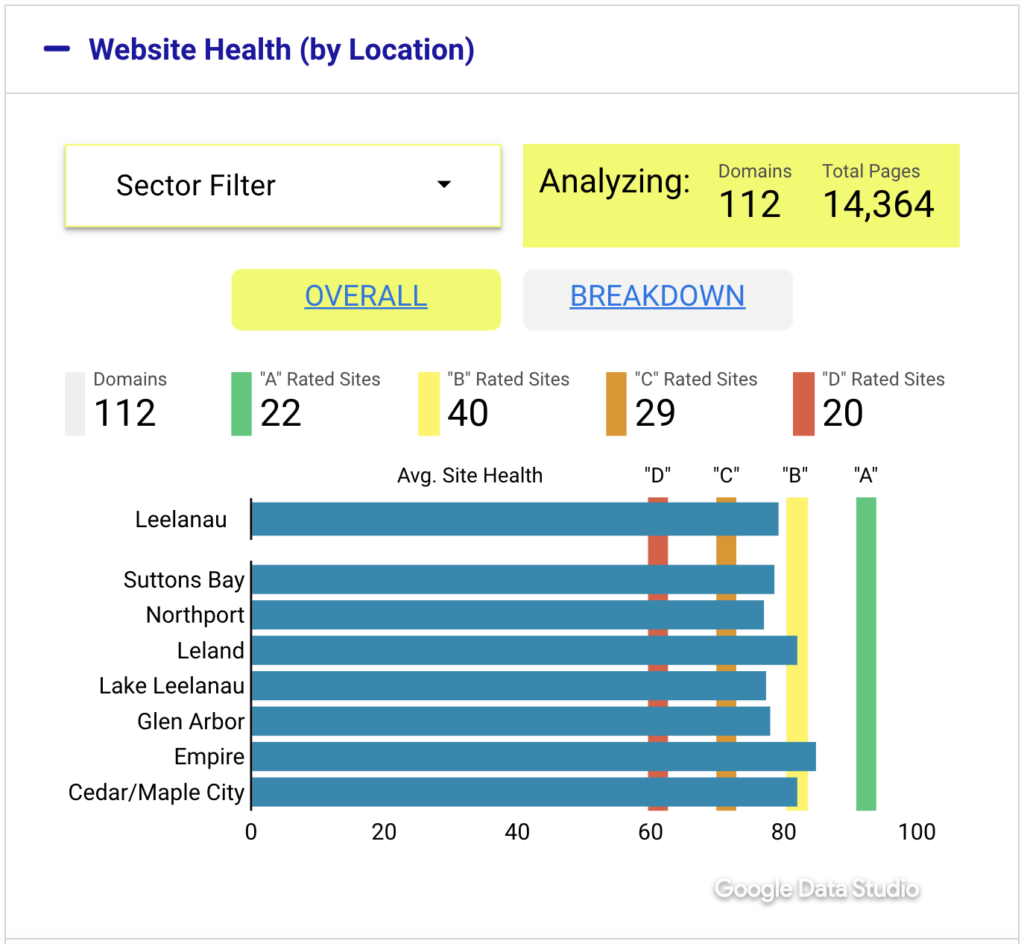
We’ve recently added some additional charts which will be even more useful in gauging overall success and identifying specific site health issues and opportunities. Overall, Leelanau County businesses achieve an average website health score right around 79%, with most falling in the “B” to “C” range. A full list of issues is included in the Leelanau Business Digital Vitals Dashboard; the most prevalent issues include:
- Duplicate content, title tags, and meta tags
- Broken internal links
- Markup errors
- Non-HTTPS content
- Redirect chains and loops
- Slow load speed
- Large image files
Sun: Which towns are doing better than others—and what are they doing right? Which businesses offer exemplary examples of good websites?
McQuown: This is a great question, but a challenging one to answer. The reality is that, when a company’s digital presence is exemplary, there’s actually not much to notice, besides a seamless user experience and robust, engaging content. Technical issues are much more noticeable, and easier to point to, than technical excellence. Business owners should try using their own experience (as consumers themselves) as a guide, keeping an eye out for positive or frustrating online experiences they encounter, and considering how their observations might apply to their own website and customer journey.
The differences in digital aptitude from town to town are driven by myriad factors, and especially by the difference in primary business sectors located there. For example, the Wine/Cider/Beer sector companies have, on average, nearly 3x the number of social media followers as any other sector, and vastly more backlinks as well; these companies tend to have more widespread market reach, and (most likely) better-funded marketing budgets to build their social following and online presence.
In terms of social media engagement, however, the more hyper-local businesses in the Food/Dining, Gallery, and Shopping categories manage to outshine the Beverage sector, often by sharing particularly engaging photos and creative specials, and by prioritizing involving the local community.
The Dashboard is not primarily focused on social media, and instead considers it as one aspect among many. Social media, is, however, one of the more visible and public embodiments of digital strategy, and therefore it is the category best suited for highlighting top performers and inspiration. A few companies on the list of social media top performers (in terms of engagement per follower) during our most recent analysis include: marthasleelanautable.com, baybooksmi.com, newbohemiancafe.com, lelandgal.com, hannahs.shop, mimarketsuttonsbay.com, artsglenarbor.com, and sbsurfandkayak.com. These brands exude personality on their social media platforms, while posting consistently with engaging content and high-quality photos/videos — that’s a winning combination.
Sun: How do you think online commerce might continue to evolve once the pandemic (hopefully) subsides and some retail shopping returns?
McQuown: Even as in-person shopping and dining resumes, consumer preferences will continue to necessitate a move towards more robust online experiences. Business owners will be smart to continue building their online presence over time, and to prioritize it as a key part of their business strategy for 2021 and beyond. Such diversification will help businesses to weather whatever storm is next on the horizon, and to grow beyond the constraints of their brick and mortar locations.
Businesses will need to learn how to balance their new online focus alongside their traditional in-person product and service offerings. The pandemic has forced a quick-pivot to replace in-person efforts online; but moving forward, businesses should work to make both channels sustainable and symbiotic long-term.
From a technical perspective, there are major shifts occurring in the ways that consumers navigate the web. These days, more and more interactions happen directly within Google, with users able to get directions, find answers to their questions, manage reservations, and even make some purchases right there on the search engine results page (using Google’s “Rich Results”). Also, consumers are relying more and more heavily on emerging technologies like voice search and smart home devices; these technologies draw information from websites using page tags (e.g. page titles, meta tags, structured data, schema markup), and your business may only be eligible for inclusion if you’ve taken the necessary steps on the back-end of your site. A study by Adobe last year found that 48% of consumers use voice for “general web searches”, so this is a trend that cannot be ignored.
The Leelanau Business Digital Vitals Dashboard is provided in partnership between SMQ Consulting and Moraine. It will be updated regularly, and the associated resources will evolve over time based on community interest and feedback. The Dashboard is publicly available here, and Leelanau County business owners can request complimentary access to their own specific digital business information using the request form on that page.