
Megan Budd “living the dream” at Mawby Winery
By Madeleine Hill Vedel
Sun contributor
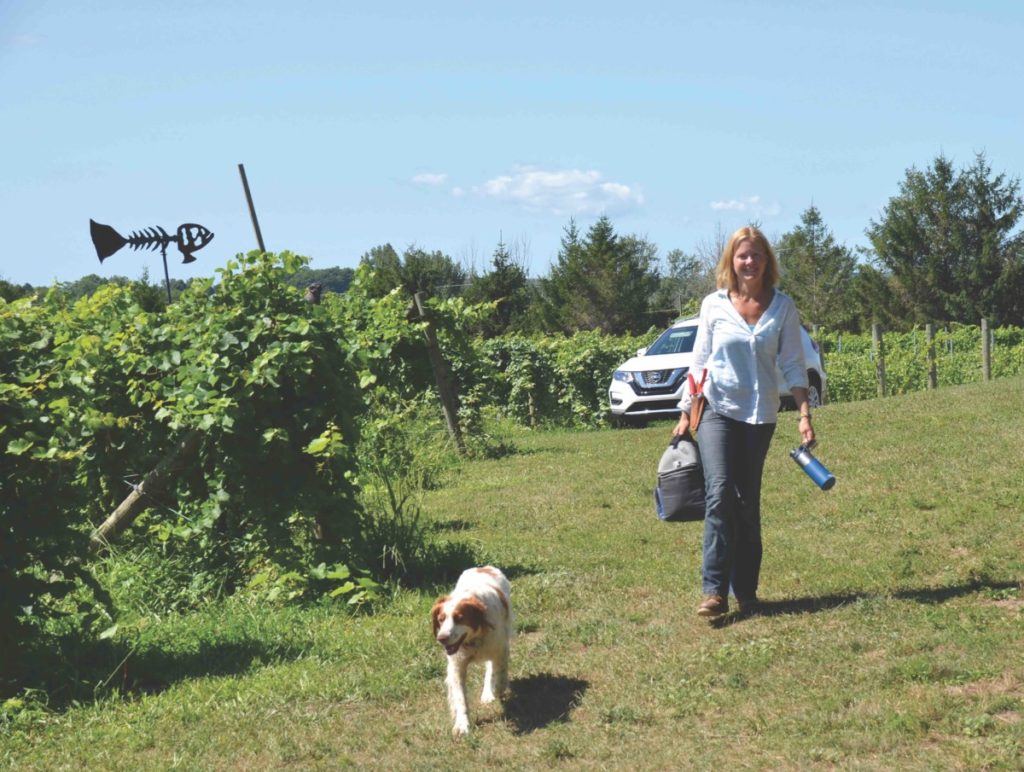
I am sitting on the patio at Mawby Winery, admiring the lush green vines stretching out from this point, covering the slopes rising from the bowl of the valley where Mawby’s tasting room and original facility is located just south of Suttons Bay. Within minutes, I see the slender form of Megan Budd striding towards me, her blond sun-brightened hair waving in the breeze, her packed lunch in an isotherm bag swinging in her hand. Ellie, her 10-year old spaniel (aka the vineyard dog) trots at her heels.
Budd is the vineyard manager at Mawby and Big Little Wineries. It is she who manages the combined 28 acres of vineyards that produce the estate wines for each winery. She joined the team in January of 2017. “Mawby is the place that from college I’d always wanted to work. They approached me to be their vineyard manager. They came seeking me. I got a random email one day [from Mike Laing] and when I opened it I was ecstatic.”
At the time Budd was tending the young vines at the Petoskey-based Mackinaw Trail Winery & Brewery, where she assisted them in the establishment of their estate grapes—10 acres of which were planted just before she came on board. There, she put in the trellising, nurtured the young plants, and as wine is not made from a vine before it has three years (or more) in the ground, she did a bit of everything else that needed doing, including bottling, cellar work, offering tastings, etc.,
Budd is living her dream. From her first visit to Mawby Winery—he year she graduated from Michigan State University with her Bachelor of Science in Horticulture, and a specialization in viticulture—she wanted to be the person responsible for the more than 30-year-old grape vines that produce some of the most beloved bubbly in Michigan.
Managing a vineyard is a job governed by the seasons, embroidered by the weather, and punctuated by stress, joy, physical exhaustion, worry, and contentment. A year might bring a hailstorm, an abundant population of pests eager to lay eggs in the fruit, a polar vortex, too much humidity, encouraging disease, or maybe a cold summer, hampering the fruit’s ripening to its full potential. But then another might be just perfect. Every year is different, particularly when you live in these challenging times of climate unpredictability.
“I love this work. I can’t visualize myself doing anything else than this,” Budd says, and when queried on the white stuff that covers our region for months every year, “I love winter. I love that I have to go outside everyday. It gets me out there. I have really good clothes. Pruning [which is done when the plant is in dormant mode brought on by the cold] is the least stressful time I have the whole year. I can take my time. Fewer curve balls in the winter, except extreme cold.”
At Mawby/Big Little, Budd is fully occupied with the vineyard, and its many challenges. “It is a very, very old vineyard as far as Michigan vines. That’s really awesome — the trellis system is very old. The vines are very old … Every vine and every row are unique. You can’t manage the vineyard as a whole. You have to micro-manage. It is another one of the primary reasons I wanted to work here. Mechanizing is necessary in our industry, but not necessarily how I like to manage, not the most enjoyable for me. I like to be very hands-on. Because our rows are very narrow, the vines old, the trellises short — they have to be managed by hand.” And outside in the vineyards, Ellie by her side, is where you will find Budd. During harvest, as the fruit hangs but two feet off the ground, you might even find her on her knees, kneed pads cushioning the pressure, alongside her team.
She describes to me how she manages the two vineyards (Maybe and Big Little) differently. She might leave more fruit on the Mawby vines as they are destined for the sparkling, which don’t require as much sugar or ripeness. For Big Little, more leaf pruning to increase sun exposure and encourage full ripening (and sugar content) in the grapes is desired for their still wine.
When asked about her picking crew and how she manages harvest period, Budd admits that it has been one of the top challenges—finding people to hire. Whether it’s that the work is physically challenging, or a reflection of the presence of Immigration and Customs Enforcement (ICE) vehicles and the individuals from our immigrant communities who’ve been picked up, the workers are just not there. “They’re spread too thin now.” She says. “Crews I used to be able to call. They just aren’t available. They have too much of their own work, and too many other vineyards that need them.”
Budd is the only female vineyard manager in Leelanau County, and perhaps the only one in the state of Michigan (if you know of another, please let us know!). In addition, she is one of only a few vineyard managers in the area, and adds consulting for other wineries and winery start-ups to her already busy weekly schedule. “The industry is very collaborative,” she says. “There isn’t a lot of competition among the wineries. We’re all in it together. The problems that affect one affect the others. And, as our wine industry is based on tourism, having more wineries is not a negative. It brings more attention and more acknowledgment about being a quality region… I don’t think anyone tries to keep their employees from helping other wineries.”
With the clear-eyed focus and passion she has brought to her career, from her internship (and subsequent job) with Sandhill Crain Vineyards in Jackson during her college years until today, Budd does not come across as a woman who has ever considered her sex as having held her back in her chosen field. When pressed she does have a couple of experiences to share: “It’s a subtle thing. When a man tells someone that they’re a vineyard manager, or a farmer, there are different follow-up questions asked. I get questions like ‘Oh is it a family operation? Are you the daughter?’ They can’t picture me doing the job. ‘So do you do all the spraying then. Are you out there every day? Are you doing the pruning?’ I don’t think men get those questions. They can picture the men out there doing it. I’m also young for my industry. That’s the main thing that I get that other people don’t. But that’s not a big deal.”
As I depart, wishing her a healthy and plentiful harvest this fall of 2019, I realize I have joined the growing number of individuals impressed by Megan Budd and her choice to daily face the challenges and demands of her chosen expertise.


