
How the Glauz family discovered Glen Arbor
By Grace and Donald Glauz
Sun contributors
Thanks to Mary Sutherland for sharing this with the Sun. She received it from Bill & Barbara J. Glauz of Leewood, Kansas.
It was the first week of October 1923. We had had no vacation all year. This Monday morning when my husband arrived for work he was told he could have a week’s vacation. He immediately phoned me. I called my mother to ask if she could come and stay with our two children for a week. She promised to come.
We set out to look for a place to build a summerhouse. Our destination would be Glen Arbor, where a friend’s wife spent a few weeks every summer at Glen Lake. They were so enthusiastic about the lake that we wanted to see it. We stopped along the way up north at several small lakes but found nothing to please us. One man in Beulah offered us a lot if we would build on it. It was on a high ridge overlooking Crystal Lake, but it did not interest us.
As we approached Glen Arbor from the south, we were thrilled by the lovely, arched bridge across the narrow channel between Big Glen Lake and Little Glen Lake. The gravel road around the lake was ablaze with the yellow leaves falling from the many birch trees. As we entered the village of Glen Arbor we were delighted to see the arch of beautiful trees over the roadway.
We asked at the village grocery (Hilton’s General Store on the site of the present Anderson’s IGA) if we could get a cottage for a few days. We were told there was nothing open so late in the season, but we might find lodging at the (D.H. Day) State Park two miles away. The caretaker there, a Cap (Captain) Dorsey, said there was nothing there, but if we would take the flag down at sunset and put it up again in the morning, so he could go home at night, we could use his tent. We gladly accepted his offer.
When he returned in the morning he gave us a breakfast of fried fish, eggs, and toast, which was very delicious. We then went fishing off the (lumber) dock (at Glen Haven) where Chicago pleasure boats (steamers) docked every day. A school of perch was running in Lake Michigan so we caught a ten-quart pail full in less than an hour.
(Cap Dorsey took us for a train ride on the logging train, which ran from the sawmill on Little Glen Lake (near the present public bathing beach) over the hill (called Day’s Dugway) and down to the Glen Haven dock. This train was a tourist attraction for many years at Clinch Park in Traverse City. The lumber was loaded onto boats called Lumber Hookers and sent down the lake. At the mill a launch was towing a lumber raft across Glen Lake. The logs had been cut from around the lake.)
My husband was so enthused that he began asking if there were any places for sale. Cap Dorsey said the only place he knew about was a 17-acre tract in Glen Arbor which was in probate court. The owner had died and his wife would like to sell it. It had been timbered off and so was worthless (he said). At this we pricked up our ears. Ah, but we only wanted a 50 ft. or 100 ft. lot to build on. He said, “Why don’t you stop and see his wife on your way home, but leave your nice car by the road and walk up to the house?” This we did, but the wife said she could do nothing until the estate was probated; she would let us know. So we left Glen Arbor without seeing what we hoped to buy. Later in the fall we received her letter giving us a reasonable price, and we took it.
Finally vacation time arrived the next summer (1924). We had been planning for it all winter. We had a tent, an oil stove, a hammock, and all the camping equipment we could carry in our car. It was a pleasant surprise when we arrived in beautiful Glen Arbor to find our eastern boundary was Lake St, the main gravel road down to Lake Michigan. Our southern boundary was Rt. 22 (M-22 and M-109), with a nice family hotel (the Sylvan Inn) on one corner, next to a nice rooming house Andreason’s). On the north was Lake Michigan. There were many beautiful pine and oak trees scattered about the 17 acres (in spite of having been logged off).
We drove in over the remains of the old logging trail and discovered the tumbled down remains of three small shanties (or old homes). The floor in one was still intact so we could pitch our tent on it. It took us a long time to get organized as we stopped often to admire a view of Lake Michigan or a lovely group of pine trees.
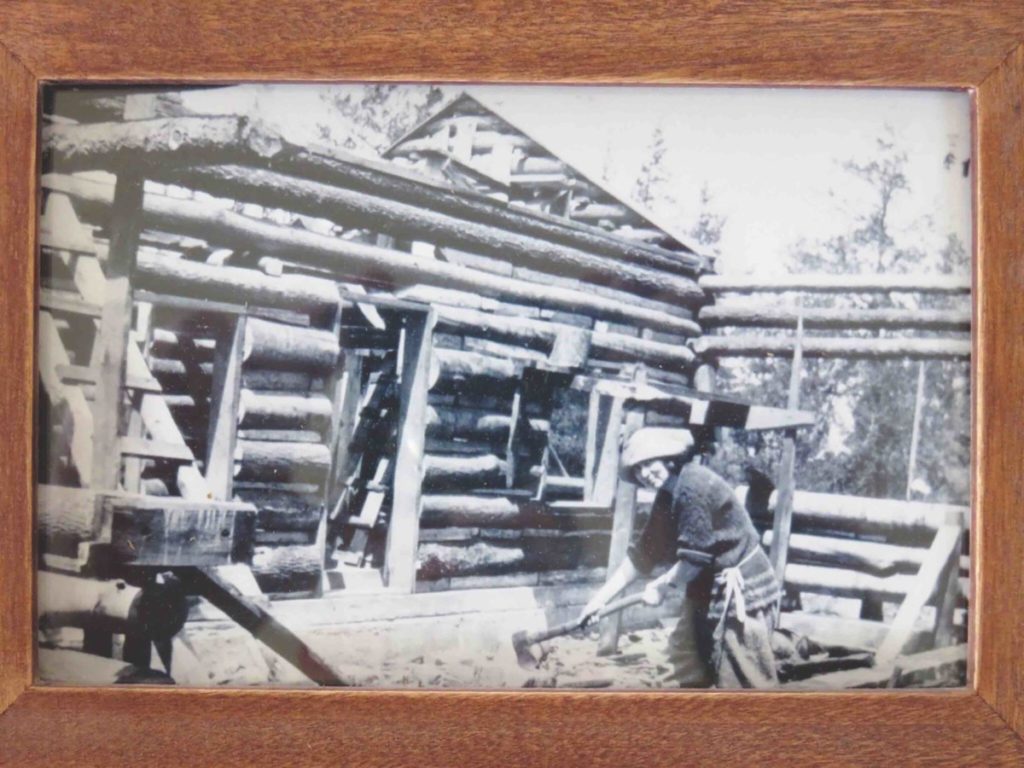
Then we drove up beautiful Rt. 22 to Leland to engage the county surveyor to survey and plot out our 17 acres into building lots. To our surprise our one building lot we had been looking for turned out to be 73 lots. We selected a lot (site) centrally located for our building, five feet from the lot north of this one (with a beautiful Red Norway Pine and a large cluster of Juniper for out cottage). We wanted to build a real log cabin, no varnished logs, but leave the bark on to look as primitive as possible. Cap Dorsey knew two builders he could hire and (he) would work with them. The cabin was to be completed by Memorial Day (the next year, 1925).
My husband drew up the plans for the cottage (with a water well in the kitchen). A well was to be driven so we could have water in the kitchen, and bathe. There were to be no trees cut from our land. Cap said he would cut trees on his place and haul them over in the winter, and there were to be no pine logs put in the cottage. (There were a lot of weather-beaten boards around the old shanties to be used for roofing boards, with the weathered side down to give a textured effect on the inside).
When we arrived at Glen Arbor for the Memorial weekend in the summer, we were met with many disappointments. The first thing that met our eyes was a small hand pump in one corner of the lot (next to the road). When we asked why, Cap Dorsey replied, “don’t you suppose we had to have it by the cement mixer?” The cabin was built five feet over the lot line north on the next lot. The four walls of the cabin were up but not chinked in. The roof was on, which meant we had to get a well driven outside the kitchen and pipe across.
We found four of our pines had been cut and were in place. No floor in the cabin, only in the 10-foot x 30-foot porch, where we put up a folding cot for our son and one of his boyfriends. The cottage furniture we had brought was piled on the other end of the porch. Cap said now he had to quit and start working at the State Park for the summer. He would get a man to work on the cabin in his place.
When we returned to spend the summer, the walls were not yet chinked. The roof was on, but the roof boards were put on haphazardly. Some had the weathered side down and others did not. The darned juniper had been chopped down as it was in their way. The only floor was on the porch so we put all the furniture etc. on one end of the porch and lived on the other end. The whole family spent the summer chinking logs, soaking newspapers, wadding them and wedging them in the cracks. We mixed cement and cemented over the chinking. The stone for the fireplace and footings was brought in by boat from Pyramid Point. My father, Harry, and Donald helped the stonemason by cracking rocks, mixing cement, and carrying stones. I can still hear the stone mason call out “More Mud!”

