
Glen Arbor Art Center’s Sky exhibit more than just cosmic wallpaper
By Katie Dunn
Sun contributor
 “Blue skies smilin’ at me. Nothin’ but blue skies do I see. Bluebirds singin’ a song. Nothin’ but blue skies from now on.” Willie Nelson’s words and voice carry a certain kind of optimism that feels infinite, much like the sky itself.
Similarly, Khalid’s Skyline (2022) imparts a buoyant, skyward message: “Won’t you take my hand, hop into my skyline. It’s only just a rebuild, but I swear it feels real.”
And there may be no other song as celebratory of the abounding sky, and its metaphoric power, than The Allman Brothers Band’s Blue Sky (1972). Its verses are effortlessly recitable: You’re my blue sky, you’re my sunny day. Lord, you know you make me high when you turn your love my way. Turn your love my way. Following those indelible lyrics, Duane Allman (1946-1971) and Dickey Betts (1943-2024), alternately, turn to their guitars with soulful mastery, imploring the sky—and love itself–for something eternal.
The visual arts, likewise, can invite us to revel in the wonder of the sky—literally, allegorically, emotionally, and otherwise.
The Glen Arbor Arts Center (GAAC) is honoring the sky with its first exhibition for the 2025 calendar year: The Sky Is Always There. The show explores that vast atmospheric expanse through a variety of creative offerings.
Sarah Bearup-Neal, gallery manager of the GAAC, is the visionary behind this exhibition. It fosters a reconnection with the sky’s dynamic grandeur and gentle profundity.
 “The idea for the sky show was hatched in 2017. The members of the newly formed Exhibitions Committee were discussing themes for the first show [that] the GAAC would install in its then under construction gallery in 2018. We wanted that inaugural show to be a celebration of this new space, and all the possibilities it offered. For the Exhibitions Committee members, the sky was a great metaphor for the step forward the GAAC was taking by creating a bona fide gallery. The phrase that was bandied about during that meeting was: ‘We were looking up,’” Bearup-Neal related.
How relevant. In modern times, humans are habitually hunched over handheld devices, myself included, only occasionally looking at the sky above with purposeful observation. Unless, predictably, it is a sunset or something equally dramatic.
“In the purest and most constant way, the sky is always with us. During the early phase of developing this show, I began wondering if the sky—this enormous thing—was so familiar, so very much with us, that it becomes just more psychic wallpaper. Just another screen saver in people’s busy lives. There was a time when the sky was a place of awe for people who weren’t bombarded and numbed by an infinite number of images, input, and ‘information.’ People used to look at the sky for answers to the great questions that plague humans, like: why are the gods laughing at us? The sky had the power to humble mere mortals,” Bearup-Neal said.
In Glen Arbor, we have our very own Nicolaus Copernicus (1473-1543) in Norm Wheeler. For 34 years, Wheeler taught English and Astronomy at The Leelanau School and remains at the helm of the Lanphier Observatory. In this corner of northern Michigan, there may be no one better equipped to weigh in on the import of the sky.
“Because the night sky is eternal and predictable, with the same arrangements of stars moving across the ‘heavens’ the same season every year, humans projected their creation myths, legends, heroes, gods and goddesses, onto those patterns. Each culture connected the dots in their own way. The Ojibwe, for example, see the sacred Fisher in what we call the Big Dipper. How Fisher went to Skyland is a wonderful myth about the origin of the seasons,” Wheeler said.
In anticipation of the first show of the new year, Bearup-Neal leaned into Susan Jacoby, acclaimed painter who divides her time between Chicago and Glen Arbor.
Jacoby’s work very much conjures up that of H.M.W. Turner (1775-1851), renowned English Romantic painter and a veritable wizard at portraying the sky as both a physical and emotional force, manifest in his Rain, Steam and Speed—The Great Western Railway (1844).
“My work is almost always about big expansive vistas where the sky is the prominent image, and sometimes the only image…I love how he [Turner] captures the mood of the scene without being very literal. His works can almost look abstract… The sky is so intriguing because it provides endless inspiration. It can be mysterious, moody, immense—and provides an endless array of patterns and palettes. You can absorb yourself in it. And, it’s universal—we’re all under the same sky,” Jacoby said.
For The Sky is Always There, a total of 23 exhibitors participated, representing a variety of artistic mediums—painting, photography, ceramics, mixed-media and sculpture.
The juried exhibition opened on Jan. 10 with a lively reception and an awards presentation in the GAAC Main Gallery. The outpouring of support from the local community was tremendous.
Kate McCarty, lifelong Glen Arborite, was in attendance and most impressed with the quality and variety of artwork. She also was struck by the strong turnout, especially given the cold and blustery evening.
“This exhibit was particularly enjoyable as it brought together so many different styles and ideas about the nature of the sky, and the many different emotions and ideas it produced in each artist’s mind…I love that the Glen Arbor community supports its artists and the arts culture so strongly. The turnout was great for a cold, early January night. Celebrating art with friends and neighbors is always such a fun way to commune together,” McCarty enthused.
Lori Irish Cryan, another local art aesthete, echoed that sentiment.
“I was in awe of the creative, beautiful display of art works at the opening night of The Sky is Always There. The GAAC’s new display is stellar,” Cryan shared.
Rita and Bill Witler, pillars of the Glen Arbor art community, were a reliable presence, generously dedicating their time to serving wine, looking after guests, and ensuring that the entire event unfolded seamlessly.
“It is always interesting to see how the artists are inspired in different ways to interpret the exhibition’s theme. Then the visitors always have their own interpretations of the artwork, too! It certainly makes for a fun and interactive time,” Witler said.
The exhibition will remain on display through March 20. Additionally, an “Exhibition Walk + Talk” is slated for Feb. 8 and March 8, where Bearup-Neal will lead a conversational discussion about the show.
The true distinction of the inaugural exhibition lays not just in community enthusiasm, but in its remarkable depth, breadth, and pithy insights of the works displayed.
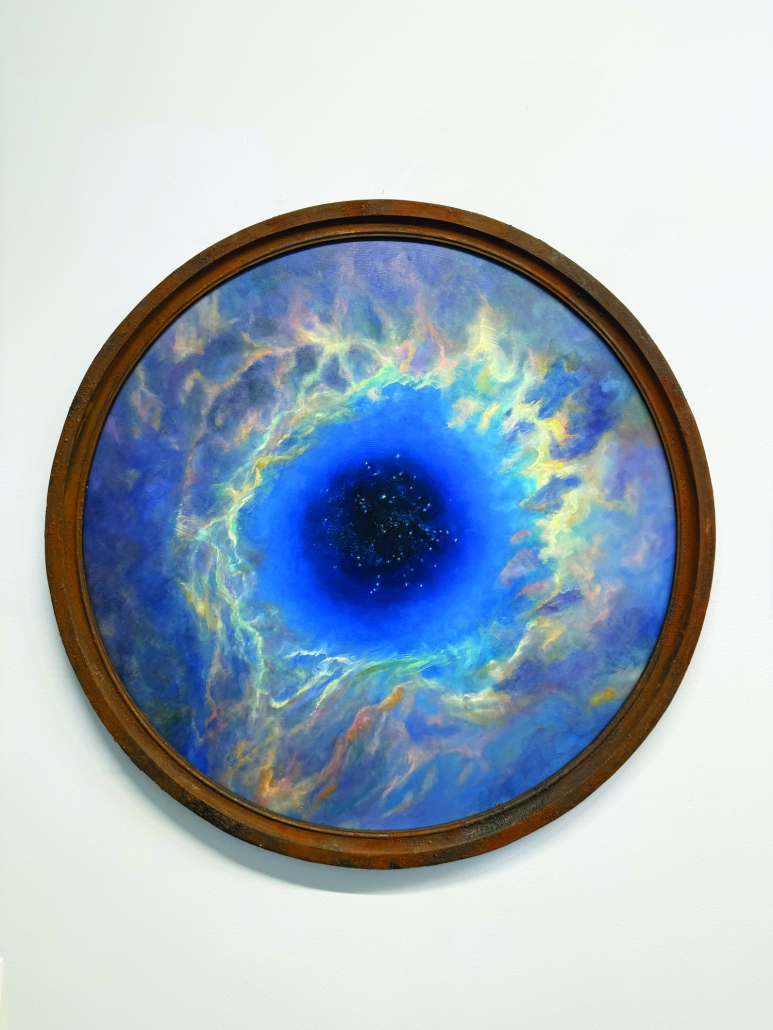
Catherine Peet, Royal Oak-based artist, won “Best in Show” with her #2689 The Forever Turning, a mixed-media painting that strikingly resembles the iconic imagery of the evil eye with its central blue form suggestive of a pupil and iris. The piece exudes a palpable magnetism, drawing the viewer in with its intriguing and almost hypnotic presence.
Its circular frame directly influenced the design of the artwork, establishing a harmonious connection between the two. Peet’s painting also conveys a sense of movement, simulating the spinning motion of the Earth as it orbits within the universe.
“This work was inspired by the shape of the frame, the image of the sky—one that I found aesthetically interesting—and my thoughts about the reality of being on and of this earth[ly] planet. The feeling of turning and rolling when I think about the movement of the universe and universes,” Peet stated.
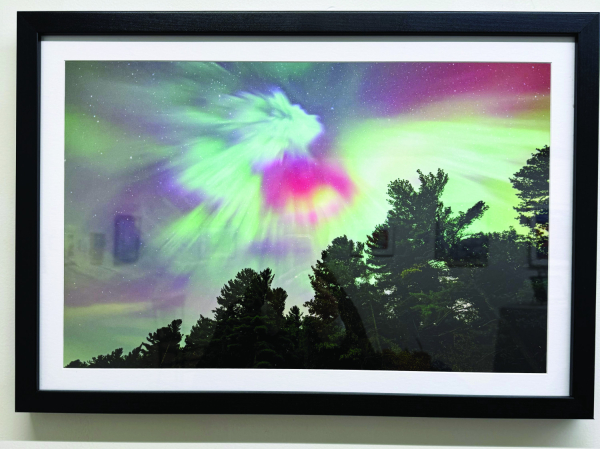
Photography has a unique ability to immortalize the natural world, distilling its beauty and complexity into a single frame. Michele Aucello, Glen Arbor resident and renowned “Aurora Chaser,” masterfully demonstrates the power of this medium in her two works: A Midsummer Night’s Rainbow and Siren in the Night. (Both were quickly acquired, the latter by beloved fixture of the community, Corinne Cochran). Aucello’s pieces are digital photographs of the northern lights, taken in August 2024 and October 2024, respectively.
“Siren of the Night” depicts the corona of the aurora borealis—a rare, stunning phenomenon that occurs when the aurora’s intensity is at its height.
“On Oct. 11, 2024, the sky once again lit up, and the northern lights were strong enough to produce a corona. This happens when the auroral activity is at its peak—bright, fast and structured. Look directly up into the aurora and you will see all the rays and banded rays converge together. This is the crown, or corona. This particular shot seemed to capture the profile of majestic woman,” Aucello said.
With an energy as boundless as the sky itself, Aucello dedicates countless hours in pursuit of the northern lights. Her photographs transform the inky night into a symphony of color. Each a testament to her personal connection to the phenomenon. For Aucello, the aurora borealis is not simply a visual marvel. Rather, it is a calling, and her photographs reflect a devotion unmatched in its fervor and artistry.
“I have a deep appreciation for what is out up there in the sky, that we take for granted…It’s just magical, watching it [the northern lights] unfold with your eyes or on camera…So get out there even if the lights do not shine. It’s just so peaceful,” Aucello said.
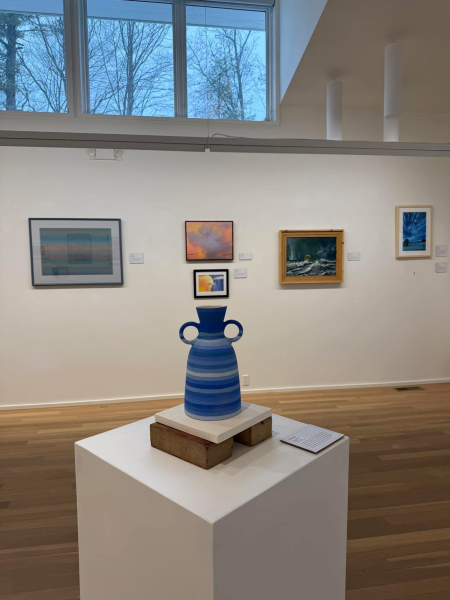
Ceramics may seem to be an unlikely medium with which to enshrine the magic of the sky. Natalie Santoro resoundingly disproves this assumption. Santoro, a ceramicist based out of Chicago with deep ties to Leelanau County—Glen Arbor in particular—contributed to the exhibition a ceramic piece titled September Skies. Formed from porcelain clay and wheel-thrown, the vase features an exterior glazed in varying striped hues of blue. During the entire month of September 2024, Santoro set her alarm for noon each day to photograph the sky, carefully documenting its subtle changes. Each glazed stripe on the vase represents one of the consecutive 30 days of September, with the colors meticulously matched to Santoro’s sky photographs.
“I already had a daily habit of checking in to see the color of the sky each day even before hearing about this gallery prompt. It’s something I do to ground myself and remind myself to notice the things around me, even the ones I’ve lived my whole life looking at. So, I don’t really have a preference on color so much as I find the variety we get daily the most exciting. I will say though…I have a deep affinity for the color of a plain blue sky in the fall, and how it contrasts with the orange leaves,” related Santoro.
One piece from the exhibit cannot be overlooked as it is so singular in its non-representational consideration of the sky. A Bag Full of Sky, by Chicago-based artist, Ann Cibulskis, is comprised of found single-use plastic, a cardboard box, marker, pens, wood, and acrylic paint. It rightfully received the “Couldn’t Be Ignored” award.
Her piece pays homage to the legendary iconoclastic French artist, Marcel Duchamp (1887-1968). Duchamp was a pioneer of the Dada Movement (1916-24). His most recognizable—and equally controversial—work, Fountain (1917), is a repurposed porcelain urinal that he defiantly signed “R. Mutt” and flipped on its back. Like Duchamp, Cibulskis challenges notions of art by questioning what qualifies as “art” and who gets to decide that.
Cibulskis’ work, assembled from discarded materials, also carries significant environmental implications.
“We think of the sky as far above and unreachable—it is blue or sunset colors or solid with gray clouds or black with stars. But really the sky begins all around us, made up of the air we breathe in and exhale. Sometimes we worry that the sky is being polluted; other times we just enjoy it. This bag is full of sky and may itself be thrown away and shredded or burned with other trash, to become a part of the sky. With almost every package, you get a delivery of the sky,” Cibulskis stated.
The sky should, indeed, always be there. But if considered in the context of climate crisis, will the sky as we know it always be there? The same question looms over our waters, our land and the delicate balance that sustains life itself.
Greta Thunberg, 22-year-old Swedish climate activist, with unflinching clarity, has urged world leaders to act on the climate: “Our house is still on fire and you’re fueling the flames.”
Similarly, Stephen Hawking (1942-2018), British physicist, cosmologist, and ever the luminary, warned that we are at the most dangerous moment in the development of humanity: “One can see from space how the human race has changed the Earth…We cannot continue to pollute the atmosphere, poison the ocean, and exhaust the land. There isn’t any more available.”
Joni Mitchell’s Big Yellow Taxi (1970), reiterates those sentiments with its haunting refrain: “Don’t it always seem to go that you don’t know what you’ve got till it’s gone.”
 The Glen Arbor Sun, which celebrates 30 years in 2025, is a free community publication supported by local advertisers and subscribers. Thanks for your readership and support.


