“Disagreeing without being disagreeable.” Leelanau citizens find Common Ground across political divides
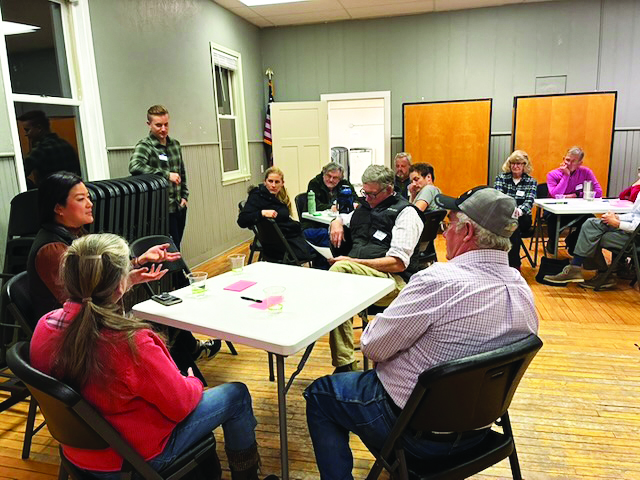
Photo: Rotary Charities’ Sakura Takano (l) speaks at a Common Ground meeting in March.
By Jacob Wheeler
Sun editor
The comedian and clown Patch Adams was onto something when he said, “Humor is an antidote to all ills.”
Leelanau County residents Skip Pruss and Jim White may disagree on politics, but Pruss drew a chuckle from White when he joked, “I’m known as the shit man in Lansing,” during their conversation about septic policy earlier this month.
Pruss, who has pushed unsuccessfully for 30 years for a statewide septic code, steered Michigan’s clean energy initiatives for former Gov. Jennifer Granholm and co-founded 5 Lakes Energy. White, who is wary of government overreach, chairs the county’s Republican Party, and has run unsuccessfully in 2024 for a seat on the County Commission.
They shared a table and bantered during a Common Ground meeting on May 13 at the Friendship Center in Suttons Bay. The monthly gatherings, which were held from January until May and will resume this fall—prior to November’s national midterm elections—are an attempt to break through the caustic national political divide and give citizens of different backgrounds an opportunity to break bread together, discuss local political issues, and find common ground.
A couple important ground rules include: avoid national (and international) politics, and listen but don’t try to change someone’s mind.
Sam Getsinger teamed up with Josh Bareman to launch Common Ground this past January following a Red/Blue workshop facilitated by the group “Braver Angels” in 2024. A dozen people attended that gathering, from both conservative and liberal “sides,” remembered Getsinger.
“Toward the end there was a moment that seemed like we were beginning to see each other and find common ground,” she said. “I wanted to continue these conversations to see if we can have more of these moments and make progress toward better understanding each other.”
Getsinger, an 82-year-old retired kindergarten teacher, and Bareman, who serves on the Leelanau County Land Bank Authority, invited leaders who represented different political persuasions from a variety of sectors, including agriculture, legal, business, non-profit, government, and education.
The group’s goals were “to find common ground among important thinkers and leaders in Leelanau County and determine the groups priorities; and to break down barriers of thinking so we can listen to one another and work together.” The purpose was to “cultivate a respectful, inclusive, and meaningful environment where individuals from diverse backgrounds can gather, share, and connect.” The meetings established a cheerful, grateful and respectful tone.
Common Ground attendees have included: County Commissioners from both political parties, and notably Rick Robbins, who has served the commission both as a Republican and as a Democrat; nonprofit leaders including Taylor Moore of Food Rescue, Sakura Takano of Rotary Charities and Bekah Tenbrink of LIFT; farmers Jim Bardenhagen and Don Gallagher; county prosecutor Joe Hubble; judge Steve Paciorka; entrepreneur Larry Mawby, and educator and interpreter Beatriz Moreno. Each month the roster has included liberals and conservatives alike.
“We need to tone it down and have a rational conversation, rather than cutting at each other’s throats,” said Steve Yoder, a Republican who represents Leelanau’s seventh district. “We’re neighbors. We can love our community at the same time as we disagree on certain issues.”
Ty Wessell, a Democrat who represents Leelanau’s fourth district on the Board of Commissioners, said that focusing on local issues in which neighbors share common interests helped keep the conversations civil.
“We had respectful dialogue, showed respect, and had fun,” said Wessell. “It was a good reminder that it is possible to disagree without being disagreeable, and that despite the disagreements, we do have shared interests and mutual concerns.”
5 Loaves 2 Fish provided nourishing and delicious dinners during each of the five gatherings. Following the meal, Bareman led breakout discussions where those seated at each table discussed the pros and cons of issues such as: nonpartisan local election ballets, taxpayer subsidized housing, property taxes, alternative energy, a living wage, Michigan single-payer healthcare, a statewide septic ordinance, driver’s licenses for migrant workers, and taxpayer subsidized childcare.
At the April meeting, Corey Fernandez, a local executive coach at the consultant firm Humanergy, shared the Native American “rule of six” practice, which encourages one to think of six reasons why someone with whom you disagree has reached a certain conclusion or taken a particular action.
“We were able to not agree on everything but at least we could communicate,” said Rick Robbins, who represents Leelanau’s first district and has occasionally served as the commission’s swing vote. Robbins currently identifies as a Democrat but was a Republican during his first term on the board.
“We need to think local. I joke that ‘I’m not out to fix Washington, I’m not out to fix Lansing. I’m out to fix our own backyard’.”
Bareman said it’s unclear whether the Common Ground gatherings will impact political discourse outside of this intentionally safe space. At county board meetings, for example, conservatives and liberal attendees flock to their own camps on opposite sides and rarely interact across the aisle.
“The whole goal is that conversations won’t just stay in this room,” said Bareman.
By the May meeting, attendees told Bareman they were more willing to sit with someone with whom they disagreed or even felt uncomfortable. Armed with a roster of participants prior to the May 13 meeting, Bareman and Getsinger applied a seating chart for the first time.
“People came up to me in the end and said, ‘I wish I would have sat with so and so’,” said Bareman. “I didn’t expect that to happen.”
Bareman concluded that the differences in the room were sometimes less about ideology and more about personal familiarity with each other.
When it came to local issues that affected everyone, participants reached more common ground than they otherwise would have.
“No one could find a con for affordable housing,” Bareman offered as an example. “People now have more complexity with how they view issues.”