Designing a Timberpeg lifestyle in Cedar

 By Pat Stinson
Sun contributor
She loves their structure and geometry and always wanted to renovate one and move in, but after researching what it would take to bring an old livestock barn up to human habitability, Anne Noble had a change of heart.
“I decided it’s for the animals,” said the Cedar area resident, her blue eyes glinting as she smiled.
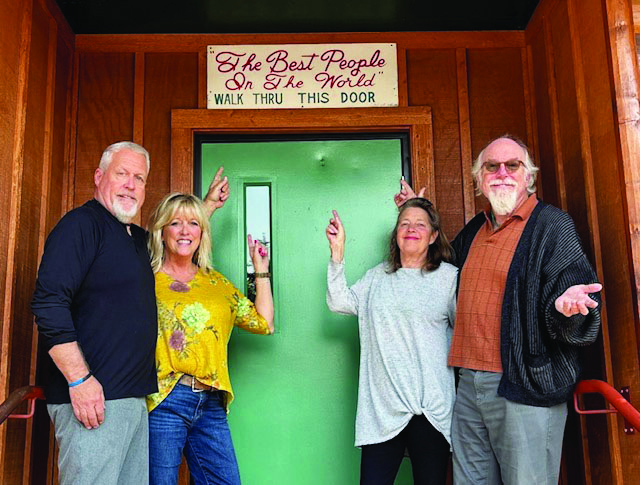
Instead, she and her husband John Rabideau live in a Cape Cod-styled timber frame home that serves as a model house for Grand Traverse Timberpeg®, a business they run together. And they’re surrounded not by the ghosts of pigs, cows and chickens but by their lively neighbors, the Dotsons, Judy Reinhardt and Jim Schwantes of the Sweeter Song Farm CSA and John and JoEllen Evans, known for their foster parenting and musical talents.
As a regional manufacturer’s representative for Timberpeg®, makers of timber frame homes for three decades, Noble can indulge her passion for barn-like structures in a way she said is more “feasible.”
She’s a commercial interior designer (now designing custom furniture and memorial urns) and a former vice president of operations for a national interior design firm. She has also worked as a project manager for a construction firm. Rabideau is a geologist working in the environmental field and a potter in his spare time. They both attended the homebuilders’ expo the first year they moved to their “childhood summer vacation land.” (She relocated from the East Coast; he moved from the West.) They were so taken with what they saw, they became Timberpeg® exhibitors at the expo the following year.
Timberpeg® uses four-sided beams and posts milled from logs of Eastern white pine and from already-felled and partially-dried Douglas fir found on West Coast forest floors. The hallmark of a post-and-beam constructed home is the strength of mortise and tenon joinery used in North American barns built prior to 1900 and in Chinese structures thousands of years old. The mortise is a notched or recessed piece — in this case, of wood — that allows a tenon or tongued piece to fit into it. In a Timberpeg® home, the fitted joints are locked with an oak peg.
Timber frame versus log
“A huge advantage of timber frame over log homes is, there are no bearing walls,” Noble explained.
The aesthetics of the timber frame — with its open floor plan, simple construction and rough timbers that are “rustic enough, but not too rustic” — appeal to both men and women, according to Noble. The interior finishing usually includes some drywall and rough, exposed wood, which offers a compromise between the rustic, “heavy” ambience of a log home and the modern feel of a stick-built residence. Those who prefer a decorative look without any timbers can also be accommodated.
“They’re very casual,” she said of the homes, “yet there are a whole lot of design possibilities. You can have any style.”
A site evaluation is done to assess a client’s lifestyle and lot requirements. (“We work with their ideas,” she noted.) Once a home style is chosen, construction drawings are made and approved by the customer. A customized system is then pre-cut and pre-engineered and delivered to the site — including roofing, windows, wall systems, framing and paneling. Noble said the homes are “super insulated” with insulating panels or a “wrap-and-strap” insulation system, depending on the client’s time frame or budget.
Occasionally, a client will request a frame only, though she said they prefer to sell a complete system.
“It’s rare to do two homes alike,” she said, adding that a client can hire her engineering/ architectural team or use one of their own. “It’s custom done and pre-cut, so it goes together so simply for builders.”
Their current building partner is Storm Hill Development Group, LLC, custom homebuilders with headquarters in Empire. Visitors to the area can view Noble and Rabideau’s model home in Cedar or tour homes built by Storm Hill, by appointment. But the great thing about working with a nationwide company, Noble said, is that people can also wait until they are home and look at the Timberpeg® house nearest them.
As for cost, Noble said a timber frame home runs about 30 percent more expensive than a regular stick-built home, though the parent company has developed “scaled-down” hybrid (part timber frame, part stick-built) home designs.
“There’s a misconception sometimes because they’re so simply built and somewhat primitive. People say, ‘I want a cabin like that.’ The reality is that the low end is over $300,000.”
Still, she said, aesthetics are the number one reason people are drawn to timber frames.
“It’s funny. Kids come into our home and say, ‘Oh, wow, it’s like a fort.’ They’re immediately drawn to the loft.
There’s something about the warmth of wood and the enormity of the structure. They’re like, ‘Oh, so that’s how this thing comes together.’ You can see it; it’s exposed. There’s something really satisfying about understanding our surroundings. People come in contact with that simplicity and it’s a totally emotional response.”
For more information about Timberpeg® homes, visit www.timberpeg.com. Contact Anne Noble of Grand Traverse Timberpeg® at (231) 645-4180 or email her at nobleduo@aol.com.