
Common sense to preserving the Glen Lakes
 By Rob Karner
Sun contributor
Sometimes the solution to preserving our lakes and streams is simple. Often, keeping it simple has the best opportunity for success. Many people along the shorelines of the Glen Lakes-Crystal River Watershed need to water their lawns and plants (the greenbelt) during the dry periods of the summer. In addition, there are a significant number of people who want to keep their lawns and greenbelts healthy, so they apply fertilizer to enhance plant growth.
While it is good to keep your greenbelt and turf healthy and green, the hidden dilemma is that some of the fertilizer nutrients like nitrogen, and especially phosphorous, can end up in the water and promote unhealthy lake and stream conditions. So the question is, can we have the best of both worlds: healthy greenbelts and turf and protect the lake at the same time? The answer is yes.
What we do on land near a lake or stream affects the water quality.
So how can we keep it simple and promote a healthy greenbelt and lawn while not harming the lake or stream? The answer is simple — use lake water irrigation. Lake, pond and stream water contain decayed animal and vegetative matter. When these elements are sprayed onto your turf grass or greenbelt, they act as a natural fertilizer. Any run-off back into the lake, pond or river is water that actually came from that source, and so is not intrusive. In fact, the lake water is actually filtered again as it enters the soil. As it percolates, the roots of the plants on land take up the nitrogen and phosphorous and when the excess water enters the ground water, the lake water returns in a filtered state. In essence, the water you use to irrigate your greenbelt and turf is “cleaning the water”. How good is that?
The decayed vegetative and animal matter inherent in a natural pond, river or lake water greatly reduces the need to apply store-bought fertilizers to your lawn, which run off into your lake, pond or stream, causing algae bloom and harming the environment of the lake itself. So, pumping from a lake, pond or river is an excellent decision from an environmental standpoint, and the impact on lake levels are so inconsequential as to hardly be worth mentioning. A lake or pond is a reflection of the surrounding water table, so if you were to drill a well nearby, you would be pumping from the very same water table.
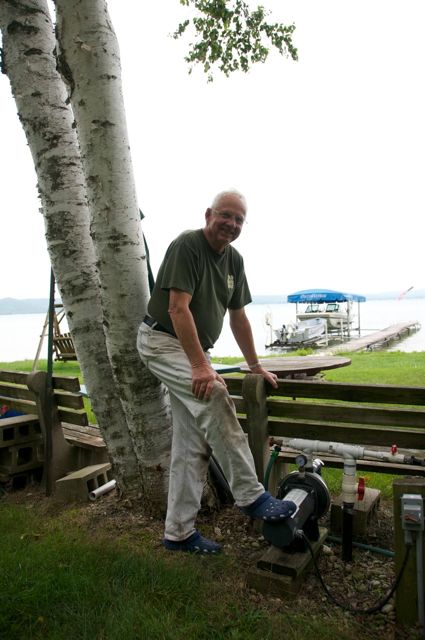
So why would you spend the extra money on fertilizer when the nutrients that your greenbelt and turf need are just a stone’s throw away? Bill Baxter, a long-time resident on the Glen Lakes is living proof that he can capitalize on using his lake water pump and irrigation system to both maintain his greenbelt and turf and at the same time, enhance the lakes’ water quality. He is among many citizens along the shores of the Glen Lakes who make this system the simple and common sense choice and the best of both worlds.
For more information about lake water irrigation, contact Rob Karner, Watershed Biologist for the Glen Lake Association. Email: rkarner@leelanau.org or call (231) 334-5831.