
“Everyday Art” at North Gallery
 By F. Josephine Arrowood
Sun contributor
With its bright red carriage doors beckoning a warm welcome, Lake Street Studios in Glen Arbor — a former three-stall mechanics’ garage — houses several stellar art galleries, each with its distinctive focus on beautifully crafted and aesthetically pleasing goods. Step through the left-hand doors into North Gallery, and enter the creative world of the multigenerational, multi-talented, Obata-Prieto artist clan.
Now in its fifth season in Glen Arbor, the gallery traces its roots back 20 years, to the original group of 12 visionaries known as the Glen Arbor Artists (GAA: the late Suzanne Wilson was the most visible spokesperson), whose combined spirit and energy created the foundation for the Glen Arbor Art Association, Manitou Music Festival, partnership with Sleeping Bear Dunes’ Thoreson Farm, and more.
Majel “Midge” Chance Obata, a textile artist and educator who specializes in weaving and spinning, was one of the GAA pioneers. After a successful career spent largely in St. Louis, Mo., where she also raised her three children, Midge decided to permanently relocate to her longtime family vacation home in Glen Arbor. “It was the best thing I ever did,” she smiles.
Midge explains, “In St. Louis, I had started out doing upholstery and drapery. I did commissions, I did at least one exhibition a year, and I had a representative and several employees. Up here, I didn’t want to do that, so I decided to teach, along with Ben Bricker, John Huston and Suzanne Wilson. When we started the Art Association, Suzanne asked me to be the director of the children’s classes, which I did at my studio, The Thread Shed [next door to the present gallery].”
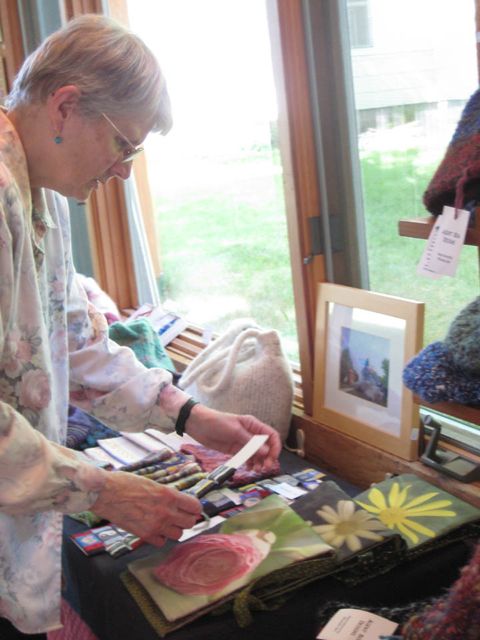
She bought the ramshackle building on Lake Street that later became her studio, sight unseen, then urged fellow GAA artist Ananda Bricker to buy the other two lots. With Ananda’s husband Ben doing a Peace Corps stint in far-off Tanzania at the time, the two women turned for help to Suzanne, who sealed the deal. Midge still teaches at the Glen Arbor Art Association, and creates works for the North Gallery. Her many fiber media include twining, a technique adapted from basketry, which she uses to make cotton tapestry rugs and wall hangings; paper box-making; book-binding (her favorite is an open stitch called Coptic binding, used by monks so that a book could lie open flat); and pillows and purses using crochet, knitting and hand-knotting. Her festive tanabata origami baubles celebrate an ancient Japanese weaving festival, which she describes as a “very happy” event, held on the seventh day of the seventh lunar month.
 The quiet center of the North Gallery’s energetic swirls of color, shape and textures is Nori Obata, Midge’s younger daughter. A ceramist and glass bead maker, Nori hails from a long line of artists whose work is firmly embedded in design principles that celebrate the daily round of life through well-made, beautiful objects and integrated environment Her grandfather, Chiura Obata, himself descended from many generations of Japanese artists and craftsmen, was an art professor at the University of California at Berkeley and landscape painter whose work was seminal in a prominent California style known as Watercolor School. Her older sister Kiku owns a nationally-acclaimed design firm in St. Louis, and her husband, glassblower and potter Esteban Prieto, himself comes from a well-known family of artists. His father also taught art at Berkeley, and his mother, Eunice Prieto Damron, is a famous Bay Area ceramist and retired professor at Oakland’s Mills College, whose recent landscape paintings grace North Gallery as well. An Obata cousin in California, Mia Kodani, specializes in quilted wall art based on traditional designs, specialty paper-wrapped photograph and mirror frames, and intimately scaled collage pieces.
Nori’s brother Gen Obata, also represented at the gallery, works extensively in fiber; many beautiful and vivid examples of hats, scarves and textile ornaments from his “Agent Boa” line invite closer exploration and lingering touches. An architect by training, Gen’s artistic explorations have taken him into music and photography as well. Based primarily in St. Louis, he travels to northern Michigan several times each summer with new works for the gallery, including handbags with fabrics he creates from his photo-transfers, a popular series of notecards featuring his larger-than-life cat Lilly in unusual, entertaining locales, quilted landscapes, colored pencil drawings and CDs of his original folk and old-county style music. He accompanies his vocals with guitar and occasionally, mandolin, and cites Doc Watson and Bill Monroe as pivotal influences.
Nori’s parents met at Michigan’s Cranbrook Academy of Art (a vortex of midcentury design that nurtured generations of artists in all disciplines), Midge as a gifted textile student, her father Gyo as an architect studying under legendary design guru Eliel Saarinen. Her father later went on to cofound HOK, one of the world’s largest architecture-engineering firms, whose commissions include sports stadiums, federal buildings, universities and museums.
Midge notes, “In the 1950s, there was an accent on good design; we did everything!” Adds Nori, “Growing up in an art family, you thought that everybody had that — but they didn’t! We had that upbringing and an appreciation of art.”
She deepened her knowledge and understanding of all things aesthetic at Wells College in upstate New York, majoring in art and art history. “They gave me a lot of freedom in my work,” she exclaims, “which was very helpful. As a teaching assistant, I knew how to run kilns,” which later proved useful when she re-met her husband Esteban, a fellow artist whose family had known hers in northern California’s intricately linked arts scene. The pair collaborates on some ceramic endeavors, and they own a glass-blowing studio in St. Louis, where they work from September to June, creating pieces for both galleries and select art shows in California.
The two became Glen Arbor summer residents about six years ago.”Suzanne approached me shortly before she died, and said, ‘I would love for you to be in this space, in whatever capacity,’” in the Lake Street Studios building. “I was honored and said we would love to be a part of it,” the community of artists that continues to grow and influence this beautiful corner of northern Michigan.
Nori sees people’s deep need for beauty in daily life as especially important in these hectic and unsettling times. “So many things are mass-made in China, made of plastic,” she grimaces. “They’re cheap, but they cost more to ship,” and they cost more spiritually, as well.
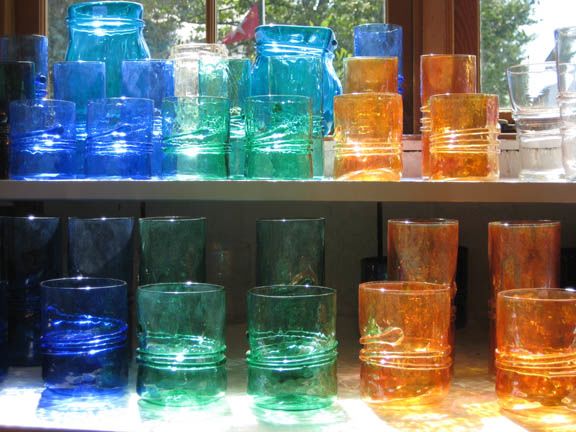
“People are trying to simplify, and to ‘go home,’” she explains. “As an artist, I think it’s important to make items that you use every day.” She points to her husband’s blown glass pieces, shimmering under the afternoon’s golden gaze.
“These are ‘workhorse tumblers,’ dishwasher safe, and wonderful to use,” and very reasonably priced. The cobalt blue and white ceramic dishware, her signature work, in collaboration with Esteban, is also highly functional, “and food looks terrific on it!” She laughs, but it’s clear that the importance of the total experience — an object’s look, the ease and joy of holding something well-proportioned, the connection to the local, natural world through color, shape, and materials — are important to her, and she wants that delight for your daily experience as well.
“Everyday art, art every day; this is how we make our living,” she says simply — a world where the artist thinks, reaches out a hand, sketches, weaves, paints, blows glass, throws pots, threads a needle, sings a melody and shares it all, every day.