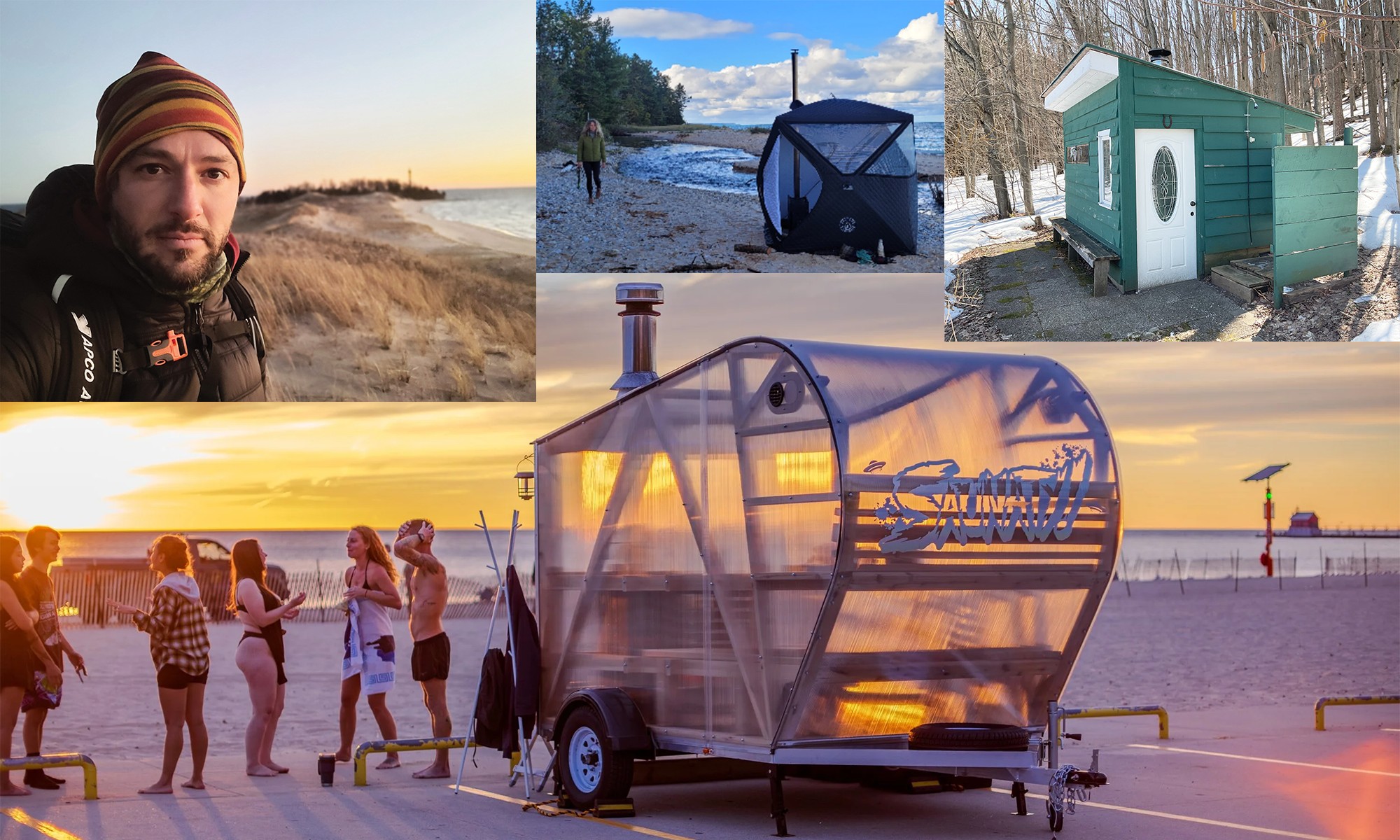
Winter survival in the sauna

“Cadillac of sauna stoves” are made here in northern Michigan
By Jacob Wheeler
Sun editor
It’s hot, damn hot, on the upper bench. The thermometer needle points into the red. Someone on the lower bench tosses a ladle of water on the rocks above the Nippa stove, unleashing a sizzle and a cloud of steam that rises to meet you.
“Breathe in,” your friend tells you. “It will feel great.”
All you can think about is how delicious a cool breeze or a chilly pool of water would feel on your overheating body. You begin counting the seconds before the sauna door will open and let you escape into the air outside. Even the thought of diving into a snowbank suddenly appeals to you. And you realize that, in longing for such extremes, you’ve been inducted into the sauna club.
The Finns brought their savusaunas to Michigan’s Upper Peninsula fleeing poverty and Russian domination in the late 1800s and early 1900s. Before them, Native Americans performed sweat lodge ceremonies in domed structures typically made with flexible willow branches and covered with blankets and canvas. Participants would sit in a circle around a heated rock pit, while the leader of the ceremony poured water on the stones to create steam.
In fact, the practice of gathering in small groups in huts made of wood, earth, or stone and introducing fire or hot rocks to induce perspiration has been common to many civilizations throughout the ages. In the fourth century B.C., Hippocrates wrote, “Give me the power to create a fever and I shall cure every illness.”
Immigrants to the Midwest brought their sweat culture with them. Those from the Nordic countries built saunas across the forests of the northern Midwest, from Minnesota’s Iron Range to Michigan’s Keweenaw Peninsula. Eastern European immigrants working in industrial factories and living in squalid urban quarters at the turn of the 20th century frequented community bathhouses, which offered their only opportunity to wash. One of the remaining few, the Division Street bathhouse in Chicago’s Ukrainian Village, inspired these words from Saul Bellow in Humboldt’s Gift: “Down in the super-heated subcellars all these Slavonic cavemen and wood demons with hanging laps of fat and legs of stone and lichen boil themselves and splash ice water on their heads by the bucket … there may be no village in the Carpathians where such practices still prevail.” Whenever I visit Chicago in the winter, my mates and I visit the Division Street bathhouse. The Slavonic cavemen are still there, even in 2017.
Here in Northern Michigan, we suffer (no, enjoy!) many bone-chilling months, but those of us who speak the language of the sauna fear not the onset of temperatures that plummet to 0 degrees Fahrenheit, or below.
We also have the maker of the “Cadillac of sauna stoves” just down the road in Benzie County. Nippa, whose factory is on US-31 just outside Beulah, turned 85 last year and celebrated its 10th anniversary in the region. Finnish immigrant Leo Nippa launched the company in 1930 in the village of Bruce Crossing in the Upper Peninsula. Nippa moved to Benzie in 2005, and was acquired in 2011 by Dean Michael.
Here are a few avid sauna lovers in our community who heat their hot rooms with Nippa stoves:
David Bradley, near Empire
“I built our sauna in about 2008, over several years. I installed a Hunter Green Nippa stove because I wanted to take advantage of our local product.
I had earlier built a smaller sauna with an electric stove in Interlochen, where we moved after coming to the area from our previous home in Saudi Arabia, but upon moving to Empire, I wanted a full-sized detached sauna with a wood-burning stove. I had to work with the inspectors, which was challenging since there were no specific codes for saunas, but eventually we got it worked out. I built most of it myself, though along with having the slab poured, I had electricians wire the lights.
We built it within a short walk of the house, for convenience, but far enough away that a fire wouldn’t present an immediate danger. It faces the woods and has a small porch, so if you get too hot you can stand outside. Sometimes you can hear owls or coyotes.
The Nippa stove has been great. It seems to be efficient, and the one I bought lent itself to the two-room setup of my sauna. It takes less than an hour to heat the sauna in the summer, but about two or a bit more in the winter, depending on the temperature. I usually like it best at about 160 degrees, but it is okay as low as 140. I’ve had it over 200, but only by accident, as that is miserable.
In the best of all worlds, we would have a natural pond to jump into, but we don’t. After working up a sweat in the sauna, some of us wash off with either water we’ve heated naturally in the sauna and soap, or by going outside and spraying off with the hose, or both. We’ve tried using the leafy birch switch (vihta) that they use in Finland, but it hasn’t really caught on. We’ve also rolled in the snow, but after discovering how long the snow sticks on, most people have only done it once or twice. The sauna is a bath, but the bathing suit is our norm for social occasions.
The sauna has been a nice social amenity. Most of our friends have tried it out, and some are regulars. It is perfect on a chilly day, but can be nice even in the summer. We’ve had as many as 13 inside at once.
Our own usage pattern varies. We’ll have weeks where we go out three times, but there have been spans of months when we don’t use it. Although it is great having a wood stove, the biggest drawback is needing to plan a couple of hours in advance.
We’ve loved having a sauna, and I encourage others to build one.”
Sharon Hendricks, near Empire
“It took three summers to harvest the ash trees before our sauna was finished. We started researching wood stoves and that led us to Nippa. My husband David, my son Will and I cut about 50 ash trees on our property infected with Emerald Ash Borer. We worked really hard all summer trimming the timber.
Our friend Robert Folks suggested building a log cabin frame sauna made with those timbers. We had to cut joints and make sure everything was level. Then we built the platform and sauna foundation on top of that. We built the benches from scratch in summer 2015 as well as the finish work. Thankfully we found someone else to do the stonework and make the chimney.
We had a sauna fire in the fall of 2015, the third time we used it. We were trying to heat up the sauna too fast. The walls burned on the inside, but the wood was thick enough that we didn’t have to entirely replace the walls. That winter Will cleaned out everything that was charred, and it was ready to go this past April. We used it when we returned from traveling last winter.
For years we’ve taken saunas with our friends the Wheelers and others. When Will was in high school he decided he wanted to build a sauna, and that we should do it as a family project. It also wouldn’t hurt to have another community sauna to share with friends. We usually have a meal after we sweat. We like to sauna once or twice a week during the winter. We enjoy the essential oils and use hot water to steam up the room. We hook up a cold shower in the summer. There’s a rectangular window that looks out into the forest, just like our friends have at their lakeside sauna in Canada. When we’re not using the building as a sauna, I do meditation on the deck during the warmer nine months a year.
Greg Halik, Glen Arbor and Iron Mountain
We live in Glen Arbor but have our sauna and Nippa stove at our “camp” in Dickinson County near Iron Mountain in the Upper Peninsula. We built the sauna a couple of years after we bought the camp, which was 1998. Before the sauna, we used to hang a shower bag from a tree to clean ourselves up.
The inspiration for the sauna came after I visited another camp that had built one. They had a wood stove inside an 8-by-10-foot room. A 55-gallon drum was filled with water that was heated by copper coils that wound through the stove. The unique thing about their setup was that the floor was built like a large shower pan with wood slats over it, such that you could sweat inside and when you were through, you could take a bucket of warm water from the drum and use it to wash up. The water went through the wood slats to the shower pan below and drained directly to the ground underneath. This concept seemed brilliant to me so I knew we had to build one similar, but without the Rube Goldberg-like mechanism for heating up the water.
Enter Nippa. We visited their showroom (then in Bruce Crossing in the UP) and found that they make sauna stoves that have a water chamber attached to the back of the stove which can heat the water to a boil if you get the fire hot enough. We built our sauna chamber 8-by-8-feet with wood slats for the floor with a shower pan like sub floor, covered with thick vinyl, that drains directly into the ground. Cool water is brought into the sauna in five-gallon buckets, and mixed with the hot water from the stove chamber, allowing for a complete clean up after sitting in 150 degrees for 20 minutes or so.
A good feature of the Nippa stove is that it is designed to be mounted through a cement block wall so the door where the wood goes is in another room, which in our case is a changing room of dimensions 4-by-8 feet. This design keeps the debris from the wood out of the sauna room while the bulk of the stove with the integrated water chamber is in the sauna room. The Nippa stove also has a built-in fence around the top that accommodates rocks that are heated up and can have water thrown on them for an instant boost of temperature if desired. We sourced our rocks from a beach in Port Oneida. Since most people in the UP name their camps, we decided to name ours “Camp Hot Rocks” after we built the sauna. The folks at Nippa have plans for how to build the cement block wall which we followed pretty close.
Our sauna is about 50 feet from the cabin in a remote site in Dickinson County. The camp is situated at the base of a 200-to 300-foot granite bluff, and is at the end of a two track on 120 acres bordering state land. There is a creek a quarter mile away so there is no jumping out of the sauna into cold water. However, in that location the winds are usually calm and skies clear at night unless a storm is coming through. This is beneficial since after coming out of the sauna it is possible to stand outside at night with the temperature 5 degrees outside and watch the stars for up to 5 minutes without getting cold with steam pouring off your body. We usually take ours right before bed since the whole process is extremely relaxing and facilitates quick sleep after a nightcap.
We use the sauna every day when we are at camp, even in the summer. There are discussions about building one at our home in Empire Township and I’m sure that will get done some day.