
Wings of Wonder: Predators need love too
By Christina Campbell
Sun contributor
Pearl was hit by a car and lost full use of her fingers. Iain was poisoned, and now he has coordination problems from the resulting brain damage. Sage was tangled in barbed wire and sustained massive scarring.
Pearl and Iain are permanently disabled red-tailed hawks, and Sage is a great-horned owl who can never be returned to the wild. But they live full, healthy lives as part of educational programs run by Wings of Wonder (WoW), a non-profit raptor rehabilitation, education and research center near Empire.
WoW founder and raptor guru Rebecca Lessard brings these rehabilitated but disabled predatory birds into schools, libraries, and other community forums to teach people about the beauty and brains behind the talons. Last year she gave over 90 talks to a total of almost 8,000 people. The audience may arrive intimidated by the gruesome arch of Simon the turkey vulture’s head, but by the time they leave Rebecca’s presentation, they know that turkey vultures are “the Labrador retrievers of the raptor world” — playful, social, and the bird that everyone in the flight enclosures can get along with.
Simon enjoys playing with cardboard boxes and Barbie dolls. Born without primary feathers — the feathers on the tips of his wings, the equivalent of fingers in people — Simon could never survive in the wild, but he is an amiable part of Rebecca’s educational entourage. And he’s smart, too, like most raptors. Left alone and loose in the hospital one day, he found a sealed package of construction paper, opened it up, pulled out only the orange sheets, and shredded them to his satisfaction, leaving the unappealing blues, greens, reds, and blacks untouched.
 But before a bird can become part of the WoW traveling educational program, it usually arrives at Wings of Wonder injured, unhealthy, and in need of rehabilitation. Not many bird centers take on the rehabilitation mission, because it is so financially and logistically draining. Although sometimes a couple weeks will go by without a new bird arriving at WoW, on any one day they might receive four, five or six raptors all in need of immediate medical attention. The stressed birds are brought into the WoW hospital, which is in the original cottage built on the property. The owl, hawk, kestrel, vulture or eagle is examined on a table and then stabilized with fluid therapy, medication or bandages. Some birds are infested with maggots that must be removed at breakneck speed before they cause irreversible damage. Once stabilized, the patient is brought to one of eight area vet clinics that donate their services to Wings of Wonder.
WoW’s vet volunteers fixed the leg and wing of Lola the red-shouldered hawk. Red-shoulders are a threatened Michigan species, so Rebecca is watching Lola carefully to see if she will recover enough to be released into the wild, to join the legions of birds released by WoW back into their natural habitats, including bald eagles and red-tailed hawks.
Some young barred owls released this May still hang around the trees above the Wings of Wonder flight enclosures and screech when they hear Rebecca’s voice, hoping she will feed them some mice. Rebecca tells them they have to hunt their own now. During their baby days in the flight enclosures, they were mentored by two grown barred owls who taught the babies to hunt live mice placed on the ground by Rebecca.
Even the smallest raptors have piercing-sharp talons, Rebecca explains to audiences as she displays items from her bag o’ feet. After the lecture, people can pick up palm-sized eagle feet, thumb-sized saw-whet owl feet, and raptor feet of all sizes in between. The skin is scaly and would look dinosaur-ish if not for the ruffles of silk-soft feathers coming down the leg, which in some hardy species stretch all the way down to the bird’s ankle like little leg-warmers.
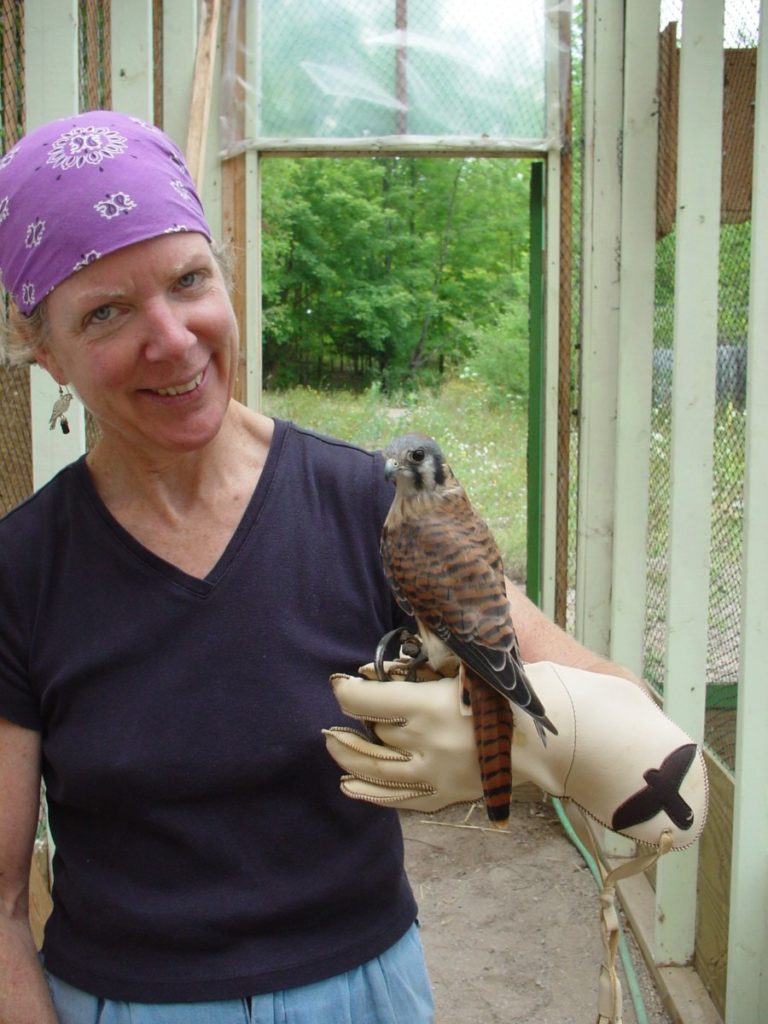
Of course the live birds are the stars of the show; Rebecca travels with several to every event. The raptors each have their own wooden travel crate, which they recognize even though to human eyes, all the boxes look the same. Ruby the one-eyed American kestrel loves to go to shows and jumps eagerly into her crate every time. She was fist-trained after only two days, unlike many raptors that require weeks or months of fist training and gradual public exposure before they are ready to become “educational birds”.
Currently the public’s only exposure to the Wings of Wonder birds is through these traveling lectures, but that is about to change. Rebecca is working with The Leelanau Conservancy to move WoW’s educational component to the Conservancy’s new DeYoung Natural Area, a historic farmstead that will house Michigan’s first-ever public raptor center. If all goes as planned, display enclosures could be constructed as early as next spring. The move allows WoW to share resources with other non-profits and to give back to the northern Michigan community for the years of support it has provided to Wings of Wonder.
Without public participation, WoW could not help as many birds as it does. The center is not equipped to go out and pick up every bird that needs help, especially when those patients are in Alpena or south of Cadillac. Except in the cases of bald eagles and turkey vultures, WoW relies on the person who discovers the bird to transport it to Wings of Wonder. Rebecca or a volunteer will talk the rescuer through the rescue process on the phone. One woman who found a red-tailed hawk was at first terrified to touch it — hawks don’t often weigh more than four pounds, but with their feathers they can look bigger and scarier — but after talking with Rebecca she walked up to the bird with a towel and gardening gloves, picked it up, and drove it to Wings of Wonder “with a big cheese-eating grin on her face” according to Rebecca, because she felt so empowered. Such stories are not uncommon among WoW’s customers, who include ordinary people who have rescued Great Horned Owls.
You’re most likely to run across a sick or injured raptor in autumn. “Immature raptors are literally falling out of the sky from starvation,” says Rebecca. These immatures are not yet very good at hunting and often cannot catch enough food to offset the migration energy expended.
What should you do if you run across a raptor that seems in need of help? First, determine if animal really needs rescuing. A baby alone is not necessarily a baby abandoned. If you are not sure, call an animal rescue center, a veterinarian, an animal control agency, or the Department of Natural Resources. Any of them can link you up with a licensed wildlife rehabilitator such as Rebecca. In this area, you can call 911 and get linked up with Wings of Wonder directly. If you see that the animal is obviously injured, do remove it from the wild immediately and carefully. Contact one of the above-mentioned animal care agencies as soon as possible.
Don’t try to rehabilitate an animal yourself — despite a caregiver’s best intentions, one mistake may cost the animal its life. It is also illegal to care for any wild animal unless you have a state and/or federal permit. Wings of Wonder greatly appreciates the northern Michigan community’s ongoing enthusiasm for raptors. The best way to help a needy bird is to call a professional. If you haven’t found an ailing raptor but still want to help, some options are to become a Wings of Wonder member. All membership donations directly support the operational expenses of rehabilitating the birds. WoW also always needs volunteers for cleaning, educational programs, and rescues. For more information, see www.wingsofwonder.org.