
Why we care about the “Olden Days” at Port Oneida
 By F. Josephine Arrowood
Sun contributor
As you drive or hike the verdant landscapes of the Sleeping Bear Dunes National Lakeshore (the local branch of the National Park Service), you spy a rustic log cabin tucked away in a deep glade, and wonder who lived there in the “olden days.” Later, you pass a one-room schoolhouse, an oak-sheltered cemetery, a towering barn and a white frame farmhouse. Through its wavy glass, you peer into the past, where you can almost see the wood-fired cook stove, heavy pantry bins, the long dining table set for a noonday meal. You want to open the door, join the large family gathered there, and ask them about the joys and sorrows of their long-ago lives.
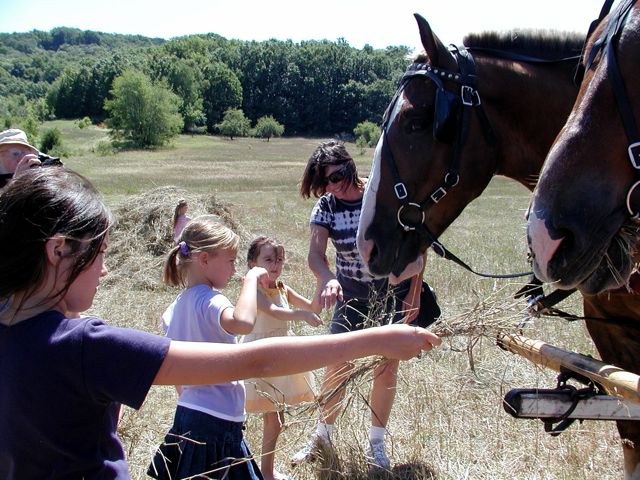
Whether your ancestors tamed a plot of land here or elsewhere, or escaped their agricultural roots generations earlier for city life, you can return to the past — at least temporarily — at the Port Oneida Rural Arts and Culture Fair. On the second Friday and Saturday of each August, thousands of visitors sample the slower yet complex farm lifestyles of the 1850s through the 1930s, including transportation by horse and wagon, butter churning, making barrels, farming with oxen, spinning, weaving, blacksmithing and more.
Now in its eighth year, the Port Oneida Fair represents the culmination of months of work each year by several nonprofit groups. Major players include Preserve Historic Sleeping Bear, Glen Arbor Art Association, Friends of Sleeping Bear, and the Park. Their concerted aim is to bring to vivid life the rich history, culture and landscapes of this once-thriving community.
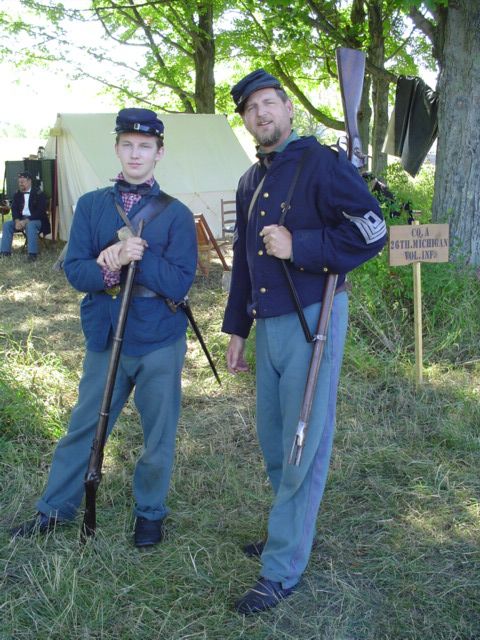 Kimberly Mann, the Park’s historical architect, and Bill Herd, a 35-year park ranger who retired this past January, were instrumental in starting the first fair in 2002. Mann says, “This is a huge undertaking by many groups,” each year, but she cites Herd’s longstanding devotion to historical preservation as a catalyst, at a time when the Park’s official policy was to let built environments “molder” and return to wilderness.
She states, “Bill tied himself figuratively around these historic structures, and drew a line many times,” in advocating for them. Only after 1994, when North Manitou Island’s lifesaving station was deemed a nationally significant site, the nearly glacial shift in bureaucratic policy from decay to preservation began.
Although momentum is now toward preservation, education, and adaptive reuse of the cultural resources, the fair itself may be in jeopardy. The state of Michigan will likely cut nearly all of its funding to the Michigan Council for the Arts and Cultural Affairs, a major underwriter of the $12,000-$14,000 event, says Friends of Sleeping Bear chairman Kerry Kelly. In addition to the thousands of volunteer hours and in-kind donations from individuals and local businesses, some parts of the fair cost money, he notes, like the trolley that shuttles visitors between sites, signage, printing costs, tents and portable toilet rentals. The fair committee is working to make it easier for visitors to donate, if they wish, with large milk cans at each site. He sees great value in the fair.
Kelly says, “The Friends of Sleeping Bear’s main mission is to support the Park. The fair highlights this northern portion. It gives people a chance to get into some of the buildings, the barns and the schoolhouse. It’s a way for them to actually experience what people used to do as a regular part of their life.” Like shelling corn, for instance? “I grew up on a farm in Wisconsin, and shelling 10 bushels of corn was never my favorite thing,” he laughs. “It’s fun to try it, though. Kids especially love hands-on experiences!” He believes that living history “helps to understand your roots, and contributes to a better understanding of who we are as people.”
“Kim and Bill put their whole hearts into creating this [fair], to celebrate and make the public aware,” of the need to preserve this vital part of America’s heritage, according to Barbara Winkelman, a fair committee member from the Art Association, along with her husband Eric. Their work begins each January to review the past year’s fair, brainstorm about fundraising, discover artwork depicting the Port Oneida district for the annual poster, and contact artisans to demonstrate bygone activities of daily life.
She relates, “My heart is so dedicated to the farmstead. When I was young in Detroit, we’d go to my grandfather’s farm in Ohio. From the city’s sidewalks and small backyards, I loved the freedom, the rolling hills. When we moved here, I rediscovered my childhood.” Ironically, her family’s farm was sold to become a state park. “Everything was torn down,” she mourns, “except for a milk house my father built when he was 27. So, more than ever, I understand the need for historic preservation.”
As a partner in the Park, the Art Association tends to the ongoing renovations at the Thoreson Farm. Volunteers helped restore the barn, granary and outhouses and converted the machine shed into space for art classes. David Hawkins of Glen Arbor worked at the farm, and has also been a greeter during the fair. “It was a lot of fun,” he recalls. “The farmhouse didn’t have any siding; it was really rustic. We eventually completed the living room, put flooring in the barn, and poured a concrete base and painted the outhouses.” Fair visitors seem to relish using these restored privies, complete with old catalogues and corncobs.
Some volunteers have participated every year at the fair, while others have more recently discovered its benefits. John Owsley of Empire, a longtime seasonal resident, moved here full-time with his family in 2005. “I love this area,” he exclaims. “I want to help out, participate in the community; it’s payback.” He too remembers a grandfather’s 40-acre homestead in Ohio, to which he traces his love of the woods and being outdoors.
“The whole history of the area is so rich,” he enthuses. “The blood, sweat and tears that have gone into it. Everything is so convenient these days. Maybe that’s why we love it here!”
Preserve Historic Sleeping Bear (PHSB) Director Susan Pocklington oversees the Charles and Hattie Olsen Farm on M-22, a highly visible site during the fair. Her previous career as an event planner and passion for history enable her to effectively showcase the district to the public. “We try to line up some new and exciting presenters each year. They’re the heart and soul of the fair. We also spent days making all the sandwich boards, banners and yard signs, signs telling visitors where to go. We provide tables, set-up and teardown for our presenters and run electricity out to the barn. I have my in-house docents and volunteers come in clothing that’s reminiscent of the period,” to help draw visitors back into an earlier era where activities like rug hooking and timber framing were common.
The PHSB’s cadre of volunteers includes Mary Crane, who shares a personal history connection. Her Chicago parents bought a summer cottage in Port Oneida in 1942, and their neighbor was Ellen Miller, Charles Olsen’s sister. “She was like a third grandmother to me,” she remembers. Looking around the partially restored farmhouse, she exclaims, “How I wish I could bring her back! I would have so much to ask her,” about the places her family lovingly tended for so many decades.
Pocklington observes, “To find a place so beautiful, untainted by development — these farms connect to the natural world; they provide a context. It reminds people of home, gives them a sense of place. They want their children to see where they came from,” metaphorically speaking. She adds, “I’ve been observing the fair all these years. Even with 4,000 people and all the activity, you can feel the quiet appreciation for this place. I’ll see people walking in the meadow from one farm to the next. They’re getting in some family time, getting into nature, getting the history.”
Barb Winkelman concurs: “During the fair, there is such good cheer, and wonderful gracious visitors! They get the aura of this landscape, the serenity of the farms and the life that had been shared there. Hopefully this fair will go on for many more years.”
To volunteer time, vintage materials or donations to the Port Oneida Fair or its Partners in the Park, contact Kim Mann at (231) 326-5134, ext. 501.