
We celebrate Paul Walters
By Norm Wheeler
Sun editor
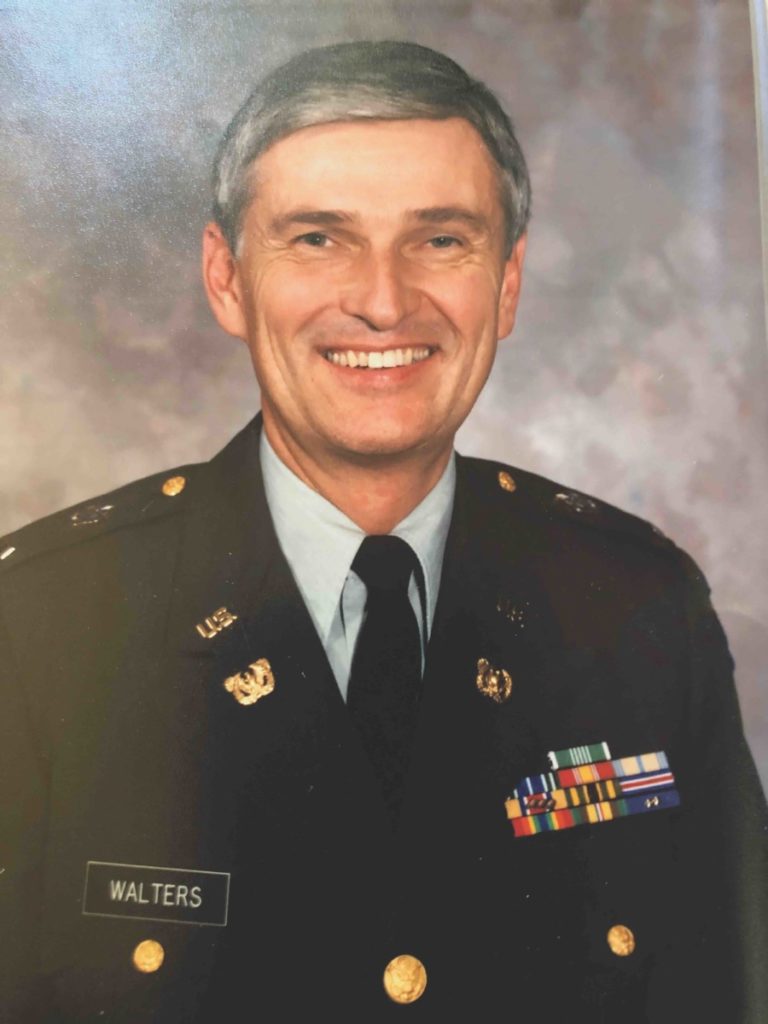
If you spot a tall, still-good-looking-in-his-70’s fella riding around Glen Arbor on his bicycle or in his little silver sport convertible, it’s probably Paul Walters. By the time he was 18, Paul Walters was already playing euphonium and trombone in the Grand Rapids Symphony Orchestra. Paul’s father was the President of the Reformed Bible College in Grand Rapids, MI. Paul’s brother, another gifted musician, “Was in the US Army field band in Washington, D.C., “ Paul explains. “He was always involved in music, and so was I.” But Paul had no idea then that he would end up as Chief Warrant Officer Paul Walters, the director of the Michigan National Guard Army Band. Here’s the story of how that happened.
Paul attended Calvin College in GR and was slated to graduate in 1965. “I didn’t take college very seriously,” he claims. (He’d majored in math and minored in chemistry!) “It was a very ugly time. We’d go to college each day and find out who was drafted to go to Vietnam. In those days your only choices for avoiding the war were to get married or to go into teaching. I decided to go into teaching for a year or two until the war was over. But I didn’t want to teach math. So I stayed at Calvin for another year to change my major to music and then to student teach. I didn’t want to go half way around the world to kill people.”
The next two years served up a sequence of events that would shape Paul’s life forever. He graduated from Calvin in June of 1966, and secured a job as band director at Coopersville Public School, just up the road from Grand Rapids, to begin in September. “Then they changed the rules of the draft, and I discovered that I would probably get drafted after all,” Paul remembers. “As I was just getting started in Coopersville as band director, I found out in November that if I joined the National Guard I wouldn’t be drafted.” There was a Michigan National Guard band made up of 28 members, and it was full. “But the band director there knew me from the Grand Rapids Symphony.”
So Charles R. Berry, band director and a veteran of WW2, told Paul, “If you come down to the Armory (in GR) on November 11, you can play in the Veteran’s Day parade with us, and I will enroll you and swear you in as a member of the National Guard band.” Paul showed up and marched. He had enlisted as a member of the 126thArmy Band!
In January of 1967, Paul’s mother died. In March he was sent to basic training, because even national guardsmen had to go through the same basic training that combat troops did. “I went to Fort Benning, GA, the home of the Army Rangers, the really tough guys. Wow, that was an eye-opener! That was something! Our feet never stopped moving. Even when standing still we had to keep our feet moving double-time! It was really tough.” When he returned in October from basic training, Paul moved in with his father, who now lived alone. Paul’s sister was a professor at Calvin, and one of her students was named Marcia Bolt. Paul and Marcia were engaged in November of 1967. Then Paul’s father died on his 60thbirthday in December. The year 1967 had been a tough, tough year. “Reality was just so weird,” Paul recalls. “After that year, nothing surprises me anymore.” In the wake of all of that, Paul and Marcia got married the following February.
On top of directing the Coopersville band program every day, Paul had Army National Guard band rehearsal every Monday night, and he had to go to the annual two-week training session every summer in Grayling. “All of us were avoiding Vietnam in those days. We didn’t care how we played, and we seldom played in public, maybe a few marches,” he recalls. “We were all proud of having crummy attitudes. Every guy knew exactly how many days he had left until he could get out. It was ugly, and nobody respected us.”
As the war was winding down in 1973, the commander of the band had to retire for health reasons. “Why don’t you take over the band?” he asked Paul. Paul thought about it, and one day he went before the band. When he told them he was thinking of taking over the band, they all laughed. “They were thinking ‘why would anybody want to do that?’ At that time the band was down to less than 20. We could barely play the National Anthem.”
But Paul continued on with his pitch. “We’ve gotta be the dumbest 20 people around,” he told the band. “We’re known for goofing off, for playing volleyball, not music. We get paid, provided for, we’re fed, we get transportation, and we get paid as much as the Grand Rapids Symphony. OK, and we like to play some music together. We don’t even realize how lucky we’ve got it!” Now they just chuckled. “Here’s what I’d like to try,” Paul continued. “Let’s change our image altogether. Around any military people or events, let’s act like professionals, let’s play the game, call each other by our ranks, captain, corporal, etc. If everyone can bring me just two names of musicians who might be good members of this band, I’ll talk to them. Let me talk to them. Let’s see if we can build this into a stellar organization.” Now no one was laughing.
The 126thArmy Band grew. He got names of interested musicians, and some of them joined. The band grew from 15 to 28 members. Gradually the Michigan Army National Guard allowed the band to grow to 42 members over a few years. Paul kept adding players until there were 55, way over the limit. “But the state loved what we were doing, and in 1987 I got a call from PBS that they wanted us to play a live televised concert on the lawn of the Gerald R. Ford Museum in Grand Rapids. We couldn’t believe it!” They were again asked by PBS to do another outdoor concert in Detroit on July 4, 1988. ”All of a sudden we were getting some recognition. We were taking it seriously, and it was working.”
During the years of growth for the army band, Paul had left Coopersville after 7 years and settled in as the band director at Grand Rapids Forest Hills, where he stayed for 21 years. In 1989 the full-time Unit Administrator called. “You won’t believe where you’re going for your 2 week training this summer,” he said to Paul. “They want you to be the first US military unit since 1948 to tour Beijing, China!” But then a guy stood in front of the tanks in Tiananmen Square, and the trip was cancelled. Instead, the 126thArmy Band was sent to play at the NATO 40thanniversary celebration in London, England. They did 30 shows, with 15,000 people at each show. That was the major turning point for the band.
In subsequent summers for their two week “training”, Paul and the band toured Italy (“in 1992, best tour of my life,” says Paul), Trinidad/Tobago, Latvia three times, and Australia. Most of the band members stayed on through those years, re-enlisting to continue their commitment. It was a total turnaround from the band of Paul’s early years. Many of the musicians earned military retirements. In 1996 the band was chosen as the Superior Unit in the Michigan National Guard and awarded the Eisenhower Trophy. “We got all that because we changed our attitudes,” Paul concludes. “Now everybody in the band is grateful.”
Paul Walters is humble, not braggy, about what was accomplished. Raised in west Michigan, he was instilled with the Dutch values of frugality, hard work, and dedication to the family and to the group. He taught his students the same virtues. “I didn’t give out a lot of awards,” he remembers. “I wanted them to learn that working hard and making both yourself and the band better was a reward in itself.” After retiring from teaching, Paul took a job at Meyer Music Company in Grand Rapids for 11 years. He also lectured to university instrumental music students about how to run a program. He and Marcia started spending more time up north in Glen Arbor, finally moving up for good in 2005. They helped to turn the Old School Hardware into the Glen Arbor Athletic Club. Now a member of the Glen Arbor Parks Board, Paul was instrumental in getting pickle ball courts added to the new park. “When I first heard about pickle ball on Anna-Maria Island in Florida, I thought it was hilarious. I had played tennis at Calvin. But when we played I discovered that it was really fun. Now it’s a big hit: it’s 1/10ththe effort of tennis with 10 times the action.”
So Paul and Marcia Walters are locals now, and Glen Arbor is mighty fortunate to have them. If you see retired Chief Warrant Officer Paul Walters around town, remember to thank him for his music.

