
The Party Gets Ugly: Partisan ads turn sour in 101st State House race
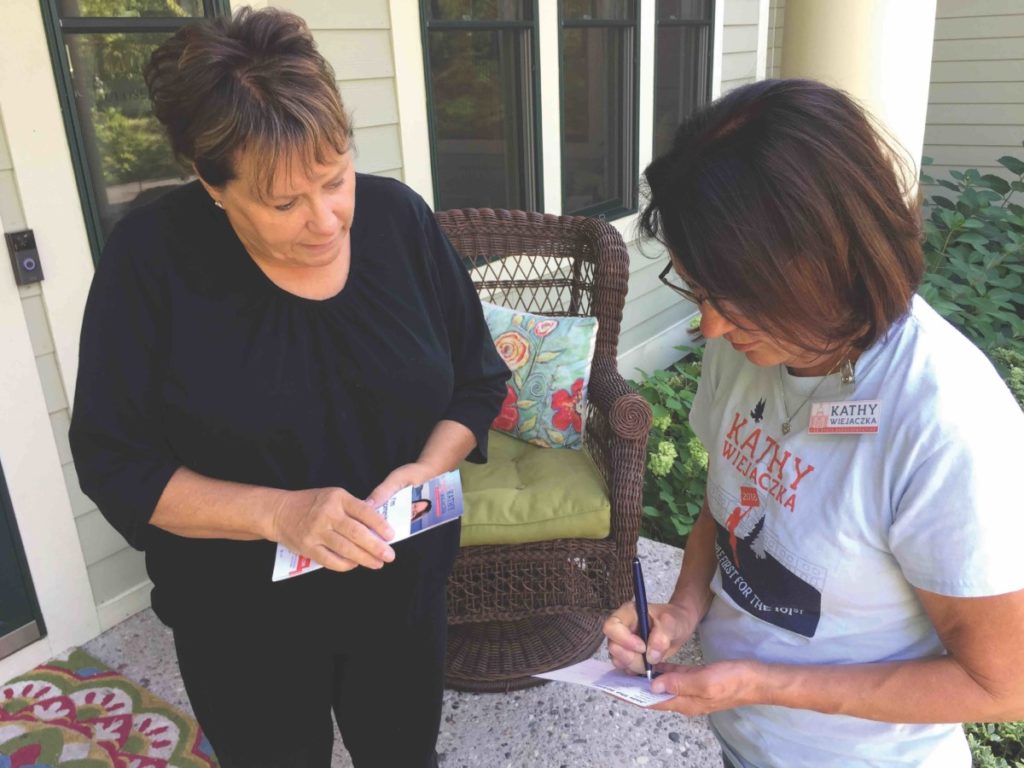
Caption: Kathy Wiejaczka door knocking in Glen Arbor in early September
By Jacob Wheeler
Sun editor
Black-clad antifa protestors marching through the streets; an old man crossing a field with a rifle slung over his shoulder; a wheelchair sitting alone in a hospital ward. Dystopian scenes that might appear in a trailer for The Hunger Games.
The Michigan Republican House Caucus is using these images in a series of televised attack ads against Democratic 101st State House candidate Kathy Wiejaczka, in the run-up to Tuesday’s national midterm election. A mailer sent early this fall featured an unflattering photo of her, and incorrectly stated that “she supports a complete government takeover of your healthcare”. The mailer encouraged the reader to visit the website RealKathyWiejaczka.com and “tell her you oppose a total government takeover of our healthcare.”
The ads appear to have no basis in reality, and the emotionally manipulative commercials do not attempt to rationalize any inferred links between anarchy, gun rights and lost healthcare with her candidacy. Wiejaczka is a retired nurse who lives in Empire. Expanding healthcare is the issue she has touted most on the campaign trail.
In turn, the “Fighting for Families Fund”, paid for by the Michigan Democratic State Central Committee, is running a gut-wrenching and equally manipulative online ad called “Jack O’Malley is bad for our health” which states that Wiejaczka’s Republican opponent “is supported by politicians who voted to rip healthcare away from over 100,000 Michiganders.” The Facebook commercial plays audio of a woman telling her daughter that her father has died of a heart attack. The voiceover continues: “He doesn’t have to live with the consequences, we do.”
In fact, O’Malleys own father died of a heart attack.
Meanwhile, the state Democratic party has run a mildly critical television ad against Jack O’Malley, a former WTCM radio show host and Lake Ann resident. In that ad, a series of constituents say about O’Malley, “He seemed like nice guy with a nice voice. We don’t need a nice guy representing us in Lansing. We need a representative who stands up for us in Lansing …”
The state parties often run TV advertisements without the approval of the candidates, themselves.
In a previous interview with the Sun that ran in our Oct. 4 edition, O’Malley stopped short of condemning the mailer sent by the Republican Party, its message or the practice.
“There are certain things that happen in campaigns on both sides that are out of the control of local candidates,” said O’Malley. “Parties act on their own behalf. That’s our system. That’s our campaign finance laws. … Do I like it? I don’t. The state GOP party didn’t tell me. It’s complicated. But it’s a discussion for a different time.”
“Politics since the beginning of time is rough,” he added.
O’Malley predicted that the Democratic party would come after him, too, particularly if he began to pull ahead in the race.
No polls have been published showing who’s winning the race.
“What you find with both parties is that we take a look at the candidates, their strengths and weaknesses,” said Tony Zammit, deputy communications director with the Michigan Republican Party, which ran the attacks ads against Wiejaczka. “We do polling in areas to see what issues will resonate with local people. Healthcare is an important issue across Michigan, with lots of retirees in the Leelanau and Grand Traverse area.”
“We run ads that are both positive and ads that inform people about candidates’ opponents.”
Michigan Democratic Party press secretary and communications director Paul Kanan agreed that the parties attempt to draw distinctions between the candidates.
“What we’re trying to do is make clear the contrast between the candidate who is running for what we see as a continuation of the same kind of corporate, special interest leadership in Lansing with the kind of leadership we think the 101st deserves.
But Kanan also accused Republicans of hitting below the belt.
“Our Republican colleagues, statewide and across the country, are willing to blatantly lie,” said Kanan. “On television or in digital or social media advertising, our approach is one of accountability, not falsehoods. We try to make sure that every point we’re hitting on, we have citations and sources, so people or journalists can trace the facts.”


