
The Grand Vision: A Shared Commitment
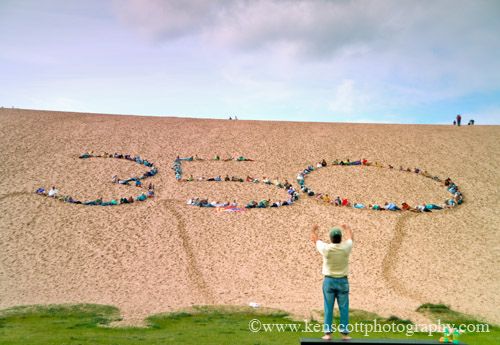
Climate activists gathered at the Sleeping Bear Dune Climb this fall to join the worldwide 350 campaign and call on politicians to push carbon emissions back to 350 parts per million, to stave off global climate change. View a video of the gathering on our homepage, www.glenarborsun.com. Photo by Ken Scott
The traditional way to plan for roads is to conduct transportation studies, build roads and then development follows. The Grand Vision, with the full support of the Michigan Department of Transportation, made a decision to flip that process around and gather land use input first as the basis for the transportation study. Starting with the values that drive land use, we asked citizens about their vision and goals for their communities so that a transportation system can be designed and built to fit what the citizens want for their future.
Support for the Grand Vision has been broad and deep. It began by conducting a scientific survey to identify shared values of residents in the region. That was followed by workshops across all six counties, where more than 3,000 volunteers shared ideas about growth patterns, transportation flow, and areas to invest in and protect. This public input was compiled by a leading national consultant into a vision for the future.
And importantly, it was confirmed that the 15,000 people who participated in defining this vision were not unique, special interests by conducting a second independent random-sample scientific survey. This survey documented that this vision is broadly supported.
Because it was so successful at gaining public participation, the Grand Vision also has raised high expectations — and created some skeptics and even critics. (Earlier this fall the Leelanau County Board of Commissioners rejected the Grand Vision, and The Leelanau Enterprise criticized the process in an editorial, calling it an expansion of government and claiming that it detracts from the construction of new roads.) It is great that expectations are high, and Grand Vision organizers — of which there are dozens of community leaders representing a host of different segments of the community — understand how important it is that there be support and guidance to help keep efforts focused on the community vision.
The vision is consistent with what most of our community master plans already say. Our community vision is for:
• Growth and investment concentrated primarily in existing cities and villages, with an emphasis on safe, walkable neighborhoods.
• The region’s transportation network should maintain and improve existing roads, while also investing in public transportation, passenger rail service to other regions, and sidewalks and trails.
• A mixture of housing choices that meet needs of all household sizes and incomes.
• Programs that protect our natural resources, promote healthy food and support our local farmers, and investments in sustainable, clean energy.
Over the past several months representatives from dozens of community organizations and local governments have been meeting in six working groups to set goals for action and implementation. Those working groups will all be coming together for the first time on November 19 to share their goals and discuss how to work together. If you are interested in following the progress of these working groups you can attend this meeting or visit www.TheGrandVision.org.
It is important to remember that this is a 50-year vision developed by citizens. Implementation will not happen overnight, and will not happen by “the Grand Vision organizers”. The Grand Vision does not have any legal authority, nor does it have a vast reserve of money to invest in new infrastructure.
The Grand Vision provides a framework for dialogue between citizens and government officials: private and public sector community leaders concerning future growth and transportation investments. It will be implemented by all of us — the citizens, business owners, planning commissioners and students that live and work here. It will take a lot of time, will happen in numerous township and village halls, corporate board rooms and community group events.
We understand why there are skeptics. This is a Grand Vision, and it will require a long-term commitment from all regional residents. But it is a shared commitment.
Marsha Smith is the Executive Director of Rotary Charities of Traverse City and serves in a volunteer capacity as the Chair of the Grand Vision CORE Committee.