
The end: writing your own obituary
By F. Josephine Arrowood
Sun contributor
“The report of my death was an exaggeration.” –Mark Twain, 1876
William S. of Glen Lake is still alive and kicking, but he has already crossed off an important item from his bucket list: his obituary. (A private man, he requested that his full name not be used in this article.)
“My understanding is, an obituary has two purposes: first, it historically lays out who you were and who your relatives were,” William explained. “So a hundred years from now, families can track things back and understand that. The second thing is to explain to the public what was important in that person’s life.”
When his mother-in-law died a decade ago, the grieving family seemed unable to gather the details of her multifaceted life into an appropriate, timely tribute. William volunteered to start the process. He crafted simple paragraphs that included basics of his mother-in-law’s birth and death dates and places, family members, education, marriage, career, community involvement, and more.
Then various members of the extended clan passed it around; they added things, changed details, highlighting some and deleting others. “The final, published piece was unrecognizable from my first draft,” William said. “But that was all right with me. I just got them started.”
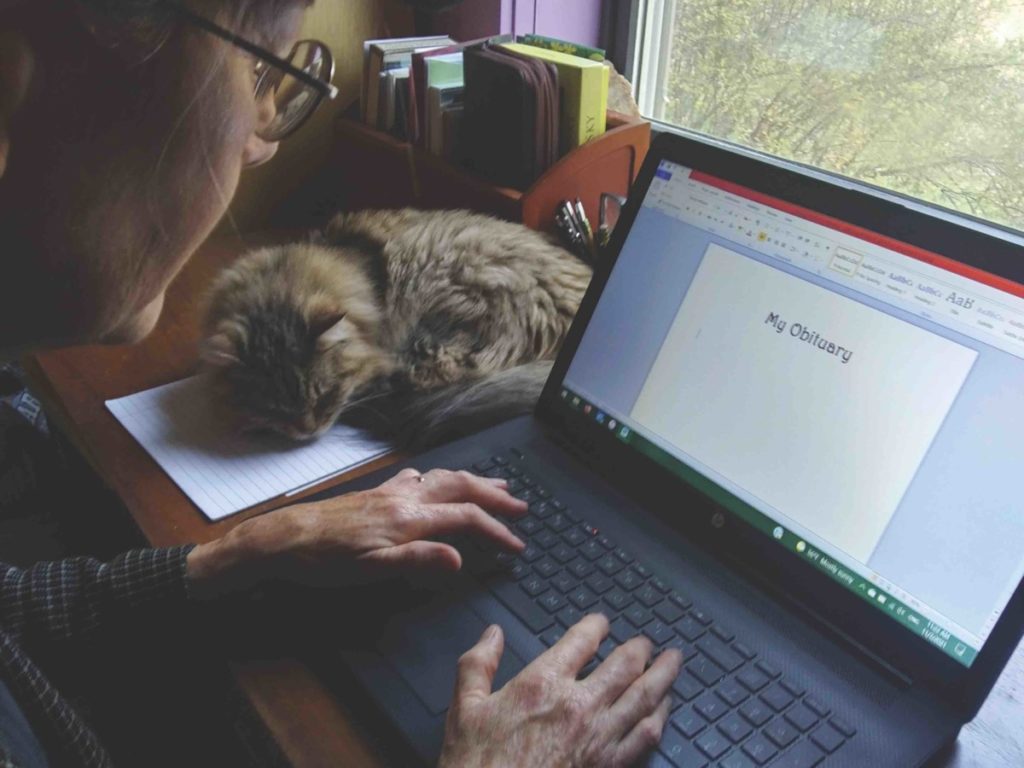
The process also made William realize, at age 70, that he wanted to write his own obituary.
“It wasn’t hard. I’ve done a lot of writing in my life. I was the editor of my college newspaper; I’ve written for literary magazines.”
Initially he thought he would write in a humorous, first-person voice, but quickly decided that was too cumbersome. And what if someone didn’t get his jokes?
“I found that I just needed to sit down and write it, third-person. I didn’t think, ‘Is this the right word or should I change that?’ You just sit down and write it, and let it go. Then you go back and clean it up and rewrite, change sentences. At various times, I went back and added things, changed things,” William said.
“In most obituaries, everybody moves up a couple rungs when they die, like that character in Oklahoma! ‘Pore Jud is daid, he loved all children and dogs, only nobody ever knowed it.’ I wanted to put my best foot forward, but I wanted to be honest. I wanted that control.”
Since the COVID-19 pandemic began in early 2020, the rituals memorializing our departed loved ones have changed, sometimes dramatically. When in-person gatherings were too risky and families were unable to safely travel to a funeral, obituaries took on added significance—one that remains even as pandemic restrictions have waxed and waned. An obituary notifies the community of an individual’s passing. It alerts us to grieving family, friends, colleagues, and acquaintances. It celebrates the unique qualities of someone’s life, no matter how grand its scope or how narrow its parameters. It has become the memento mori of our time, simultaneously warning of death’s inevitability and inspiring us to live, perhaps, a little better, a little more boldly; to use the time we have, or to prepare us for the hereafter. Is it any wonder that obituaries are the most-read section of the newspaper?
Like many newspapers large and small, northern Michigan’s daily publication, the Traverse City Record-Eagle, doesn’t employ a dedicated obituary writer. Rather, it provides a series of short tutorials that guide the person designated to write a family member or friend’s ultimate tribute, and an obituary clerk who can assist with submitting forms, photos, and of course, payment.
For a price (much less than the cost of a grave plot), obits can be published in the newspaper(s) of one’s choice, as well as on funeral home websites and other sites such as Legacy.com. As a result, these written memorials live online indefinitely; they have become the 21st century’s virtual memorial garden, often replacing the traditional burial ground as a place where family, friends, and even strangers visit to remember the dead. Recognizing the community need, the Record-Eagle began in June 2021 to publish a special monthly section, “Remembrance,” reprinting the paper’s obituaries for that month.
Like other funeral rites and rituals, the form of obituaries has also changed, since the 1960s at least, according to Marilyn Johnson, a professional obituary writer and author of The Dead Beat: Lost Souls, Lucky Stiffs, and the Perverse Pleasures of Obituaries. While “the historical record is the point . . . entertainment is the occasional bonus, not its aim.”
Still, obituaries have become more personal, colorful, and even unconventional, encompassing much more than the tidy labels of profession, marital status, offspring, education, and hobbies. In a society that champions individualism, what could be more personal, more authoritative—the last word, as it were—than writing one’s own obituary?
Websites and self-help books on the subject abound. Legacy.com’s tips include, “Just get started. Add substance. Your favorite people, places, and things. Your place in history. Career highlights, accomplishments, military service. Lessons learned.”
“Think of it as an opportunity,” states author and writing teacher Alan Gelb. “A few key words that describe you. What your life means to you.”
“Push the resume into the background,” advises writing coach Don Fry.
Adds Johnson in The Dead Beat, “Get past the polite veneer that usually glosses tributes to the dead.”
And last but not least, leave your obituary where your loved ones can easily find it after you’re gone: a “Final File” that holds your important death documents—including your will, passwords, documents, and your final words for your own memorialization.
There is no worry about spoiler alerts in an obituary—after all, everything has already happened. Even a self-written obituary is, of necessity, nearly complete. But some parts of one’s life may be little known to others. Conversely, there may be a theme or through-line, creating a pattern that becomes clear when one examines the whole.
Heather Lende’s 2015 bestselling book, Find the Good: Unexpected Life Lessons from a Small-Town Obituary Writer,serves as a primer of sorts. If Lende instructs us to look for the good, then should we each write our own obituaries as an exercise and a discovery of what gives meaning to our own lives? A time of reflection and perspective—before our life is complete?
William, the local author of his own obituary, has accomplished much in a long, fulfilling life. But it was failure that marked him early and set him on a new path in life, he revealed. As a young man, he flunked out of an Ivy League college in his freshman year.
“I wasn’t prepared; I didn’t know what I was doing,” he said. “My roommates were studying and I was staying up late every night, not going to class.”
After he flunked out, William realized that he needed to get serious about his future. The problem? Other schools didn’t want to accept a failed student. Eventually, a small, liberal arts college in the Midwest took a chance on him.
“I worked hard and made the dean’s list. I became editor of the school paper. And it changed my whole life,” he said.
William said that, since penning his obituary 10 years ago, he has no regrets. “By the time I was 70 or so, I had it thought out and figured out pretty well what was important to me, and what it meant. When I was face-to-face with adversity, then I really got to work and did a good job of dealing with it. I look back on those events—not as good times, but as times I could be proud of.
“I don’t think I’m done with it yet. I’ll read it again and think, ‘Oh, that reminds me of some other thing I need to put in.’ I don’t think it gets shorter,” he laughed.
He also picked out pictures of himself that he likes and wants included in his obituary. “I always thought it was a waste of space to put in some picture of an old person who’s ready to die. I have three pictures: one of me as a happy little baby, one from college, and one of my wife and me. It’s good to have control and know it won’t be botched by someone else. Only my wife and my daughter will be allowed to change anything in my obituary after I’m gone.”
As Johnson points out in The Dead Beat, “Obits have a pull, a natural gravity for those of us who’ve observed that life has a way of ending.”
William echoed the sentiment. “I don’t expect to need my obituary for another 15 years—but we just don’t know. So it made sense to get it out of the way and have it done—except that someone else is going to have to write the last couple of sentences!”

