
Storm Hill developer gets wastewater go-ahead from MDEQ

Decision may open opportunity for Empire’s old hardware store and livery barn
By Linda Alice Dewey
Sun contributor
An Empire real estate development firm has cleared the first hurdle in developing a vacant three-acre strip of properties at the end of Lake Street. The complex would include the old Salisbury/Ace hardware store, the white house just south of it, the livery barn on the corner of Lake and Niagara, a house across Niagara Street to the north, and a quarter mile strip of land along South Bar Lake.
Empire Associates, owned by Empire residents Jim Bagaloff and John Collins, has been granted permission from the Michigan Department of Environmental Quality (MDEQ) for a 20,000-gallon wastewater treatment center. Bagaloff, calling it “a huge advantage,” said, “It opens up the opportunity to, really, any type of project.”
Bagaloff also developed Empire’s Storm Hill, a high-end residential development on Lake Michigan’s shore just south of the public beach.
The next hurdle will be to attract investors. The developers have had some nibbles, said Bagaloff. “We’ve got interested people, but no one’s come to the table yet for sure.” However, he pointed out, “We’ve got one of the only venues with views of both Lake Michigan and South Bar Lake.”
That’s a big plus. Three years ago, when Bagaloff and Collins went into business together, they generated a concept and took it to the county’s building inspector, Steve Haugen. “It was doable,” said Haugen, who called the land “quite a strip of property. They would just have to go through some hoops to do some stuff.” The first big hoop was solving the wastewater issue, since Empire has no municipal wastewater system.
Now that they know their capacity and move forward, Bagaloff and Collins intend to be mindful of the community. “We’re trying to do something that would be beneficial to the village,” said Bagaloff, “that would bring a little bit more life and activity to the town.” Things like, on the upper floor of the barn—the “showcase” of the property—a movie night then a dance night, a brewery or a cidery with a restaurant. “The hardware store could be repurposed into a general store.”
They have more ideas—a boutique hotel or some type of senior living. The spot is perfect for that. “The beauty of the property is we’re a block and a half from the beach, a block and a half from the library,” said Bagaloff. “We’ve got the post office right across the street, the store, a doctor and a pharmacy.” It’s a senior-community planner’s dream.
“When we finish this,” Bagaloff envisioned, “it’s going to have an outdoor patio area that’s going to have incredible views.” The barn property slopes back into the hillside. Picture an open beer garden with a view of spectacular summer sunsets and year-round vistas of South Bar Lake and Lake Michigan.
That’s just one part of any number of larger concepts. “If we did a boutique hotel,” he continued, “we were thinking about a horseshoe design. Where Front Street intersects Lake Street, you would look directly into a courtyard. The hotel would wrap around to the front.” A stay at the hotel might include amenities like bicycles and kayaking on South Bar Lake as part of the package. “Even with that, we were thinking that would be part of a coordinated complex where you’d have possibly a brewery, a restaurant, cyclery, things like that.”
When asked whether there might be residences for workers, Bagaloff said that, with the white and yellow houses, “[w]e could house 20-30 people.”
There are more possibilities. “You could go in a totally different direction,” he suggested, “a pocket neighborhood, where you’d have little cottages that are 1100-1400 feet around a common courtyard.” In that scenario, “the barn could be used as an athletic club.”
Any business owner here knows the area’s seasonality can pose financial feasibility issues. It’s an economic balancing act between the extremely busy summers and the light winter traffic. “How do you keep your employees in the off-season?” asked Empire business owner Paul Skinner.
Bagaloff sought to address this issue. “With the right concepts, I think you can do extraordinarily well,” he maintained. “If you look at Cherry Republic as an example—even the restaurants in Glen Arbor—they’re managed, and they’re successful. If you’ve got the right combination here, you’re just going to attract more people.”
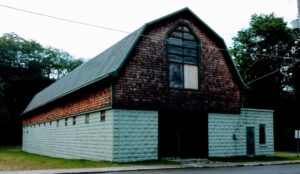 Bagaloff raved about the structurally solid barn, which has sat vacant for years and years. “The second floor of the barn,” he explained, “it’s incredible. It’s got a gambrel roof. It looks like a cathedral on the inside. The arches in there are all clear span from one end to the other. It’s in two tiers; part of it’s elevated at one end, so it’s almost like a perfect hall right away for plays, or for an entertainment facility where you could have a band at the one end with people dancing.”
Measuring 120 x 32 feet, it once housed horses and carriages. “The barn was the livery,” said Bagaloff. “This was an industrial town with the mills that were here in Empire.” When people came to town for the day, they left their horses and carriages to be watered down and fed at the livery, where they stayed until the customer was ready to leave. In more recent days gone by, it became a county garage, which Bagaloff picked up as part of Storm Hill when he bought the complex in 1979.
Back then, Bagaloff often came north on business but had never been to this area. Working in the financial industry selling pensions, he said, “I would go to Traverse City, then up to Charlevoix and on to Petoskey.” But never to Leelanau. “The thing about Leelanau County,” he observed, “there’s no roadway to bring you here. You’ve got to want to come here.”
One day, he was reading the Wall Street Journal in his East Lansing home, when a picture in an ad in the Friday real estate section caught his eye. The listing was by Lansing realtor Bill Martin, father of Glen Arbor realtor John Martin. Bagaloff knew Bill and gave him a call. The next day, Saturday, he said, “I came up, saw the house, took a look out there, and said, ‘Holy smokes!’ The view was just incredible.” He put in an offer on Monday, and it was accepted on Tuesday.”
His business partner, John Collins, began his career in the Navy. He then became vice president in charge of facilities for the University of Chicago and now owns a place on the beach at Storm Hill.
Bagaloff’s current home is the original hundred-year-old house at the top of the hill owned by Harvey Wilce, who once owned Empire’s mills.
In 1990-91, Bagaloff developed and parceled Storm Hill, then built half the homes.
Now 71, Bagaloff feels he’s slowing down and wishes to downsize. To that end, he has already parceled the rest of his Storm Hill property. Perhaps one day, he says, he will live on one of the smaller lots on the back of the property.
Age is also the reason he’s not intent on developing the Lake Street properties with Collins. “It’s going to take investors with a little more time ahead of them to make it happen,” he believed. “So that’s why we’re looking at investors.”
So, what about Empire’s dear old hardware store, which Bagaloff bought in 1992? “The hardware store would be difficult to repurpose without spending an awful lot of money,” he said. At one time, he tried to level the floors, but “it was causing more damage to the building than it was doing good. It started getting leaks and things. Frankly, the most attractive thing about the hardware is its facade.”
“A lot of uses can still be done for the barn,” he acknowledged, “but that would require taking down the hardware store, and the white house on the other side of it.
“However,” he added, “it all depends on what the investors want to do.” What if investors have their own ideas? “If an investor comes along and says, ‘Hey, we want to do it for ourselves,’ that would be fine, too.”


