
Rifino Valentine’s spirited enterprise goes against grain
 By F. Josephine Arrowood
Sun contributor
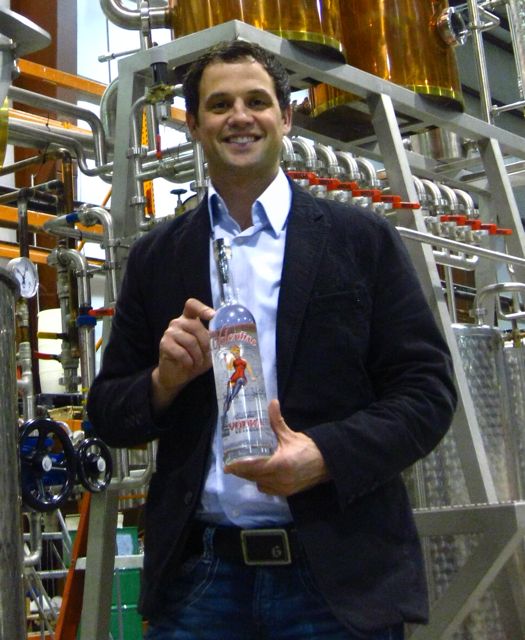
Micro-distiller Rifino Valentine is going against the grain with his one-batch-at-a-time Valentine Vodka, which he launched in 2009. Searching for a high quality alternative to mass-produced spirits, he envisioned the ideal formula that would let him use local, sustainable resources, control the entire distilling process, and provide discerning drinkers with an artisan-made alternative to so-so products made by “faceless corporations.”
“In college, I used to brew my own beer. I ended up working on Wall Street for 13 years. One day, I had one of those moments: I could apply the same handcrafted techniques to spirits. Maybe it was the Manhattan influence,” Rifino laughs. “I wanted to make the best damn martini ever.”
With this spirited enterprise during challenging economic times, the entrepreneur carries on his Leelanau family’s tradition of can-do resourcefulness. His dad Nello grew up in Chicago, while his mom, Margaret Patchin, originally hailed from Detroit’s northern suburb of Berkley. The two met at Western Michigan University, and ended up living in Alameda, Calif. on a houseboat with their first son, Nello, Jr. It was the turbulent 1960s, with a lot of people questioning the status quo and their place within that structure.
“My dad had a suit and an office job,” he laughs. “Then they came here, bought a farm [near Cedar], had goats, chickens, everything.” In 1970, Rifino was born there, with his dad, demonstrating more of the family self-sufficiency, acting as midwife to deliver his son.
Rifino recalls, “My brother and me, we started working on the farm about the time we were born! The animals we thought of as kind of pets, but then they’d be killed, butchered.”
He explains, “When they bought that farm, it had been grazed extensively; the soil was really depleted. He was trying to reforest, stop erosion. When the trees started getting bigger, he realized the possibilities.” Thus, the Valentine Tree Farm was born. “My brother and I planted a lot of the big trees you can still see growing there. I think my dad still plants trees all over the county, all over northern Michigan, in fact.” It was all part of the back-to-the-land movement of the early 1970s, not unlike today’s sustainable, locovore initiatives by a growing number of disaffected global villagers.
The Glen Lake High School graduate went on to earn an economics degree at Cornell University, then worked as an independent trader in New York City for over a decade. Several years ago, he moved to Detroit to pursue his vision of creating a handcrafted, limited-edition vodka, drawing on the Motor City’s rich history as a “Mecca” of Prohibition-era liquor making, and the good times of the Roaring Twenties.
 “The Walmartization of everything, the liquor industry is no different,” Rifino asserts. “In the federal regulations for vodka, after you’re done with the distilling, you’re allowed to add sugar and glycerol to make it go smoother down your throat. Most use continuous distillation, with ethanol spit out the other end. The process is just computer-controlled; when you cut the ‘heart’ away from the process, you end up with harsher, more astringent vodka.”
When he set out to create his own single-batch, handcrafted spirits, Rifino looked to the experts. He took a distilling class at Cornell, his alma mater, where he met Kris Berglund, a chemical engineer and forestry professor from Michigan State University (MSU). “Kris is considered the father of distilling in Michigan,” Rifino says. “He’s been integral in this, he really took me under his wing.”
“We’re one of the first few distilleries in the world to use a multigrain recipe,” he continues. Corn, red Michigan wheat, and two-row malted barley, supplied by Michigan farmers, provide the drink’s crisp flavor, with “different tasting notes and attributes. That’s part of the artisanal process.”
Each batch of vodka is triple-distilled, which means that the middle, or the “heart” of the mash’s run, is smelled and tasted by the master distiller, to determine “where to cut the ‘heads’ and ‘tails,’” or the undesirable compounds that are present at the beginning and end of each run. Valentine’s result is a smooth, clean, all-natural spirit, literally (and figuratively) from the heart of the distillation process. ”It’s not the cheapest way to make vodka, but it’s the way it’s meant to be made.”
“From grain to your glass, we’re a 100 percent Michigan product. As a whole, we need to start making things here again. It’s great to get people in Michigan to make Michigan-made spirits. If one in 10 people bought [the product], $100 million stays here, rather than ships out.”
But he acknowledges, “There’s only so many people that will buy something just because it’s made here — it has to be better. That’s the overall philosophy.” Currently, Valentine Vodka manufactures its product at a plant near East Lansing, leased from MSU, while working to bring the business to Detroit by the end of the summer. “We want to show people that Detroit is not just the butt of everyone’s jokes, but a viable place,” in which to do business.
“I’ve always appreciated and leaned toward the handmade,” Rifino reflects. So when it came time to launch a unique Valentine’s Day promotional package that could riff off his surname, yet tweak the traditional lovers’ gift, he instantly thought of Grocer’s Daughter Chocolate, based in Empire.
“I didn’t pick Grocer’s Daughter because it was local; we really looked for the best chocolate out there, and Mimi’s [Wheeler] is just phenomenal. We think our vodka is the best, and we wanted the best to go with it. We selected a beautiful heart-shaped chocolate with a raspberry-caramel filling,” which was created especially to complement Valentine Vodka. The presentation is exquisite as well, with the sweet ensconced in Grocer’s Daughter’s handmade case, beribboned atop each 750ml bottle.
The vodka-chocolate duet is now available at many local liquor retailers, both locally (Cedar City Market, Leland Mercantile, Bayside Market in Traverse City, and Barrels and Barrels in Suttons Bay, to name a few listed at www.valentinevodka.com), and throughout the state. Valentine Vodka is available by the glassful at many local eateries as well, including Art’s Tavern, Blu, LaBecasse, Martha’s Leelanau Table, and more.
In addition to running his business full time, Rifino is negotiating for a suitable manufacturing property in the metropolitan Detroit area, planning an interstate expansion of Valentine Vodka through a “strong distributor who will represent us well,” and dreaming up a flavored vodka that will capture the delicious essence of Michigan’s bountiful agriculture.
From his hippie-era youth in Leelanau, he has come, if not full circle, than in an upward spiral along the same arc of self-reliance within community. He has taken Valentine family traditions to a more refined level, perhaps, than landscape trees and farm animals, but carries along the same principles of hard work, hands-on craftsmanship, and sense of place, qualities so sorely needed in Leelanau, Michigan, and the rest of the country.
(In the interest of full disclosure, Grocer’s Daughter Chocolate is owned by the mother of the Glen Arbor Sun founder and editor, Jacob Wheeler.)